

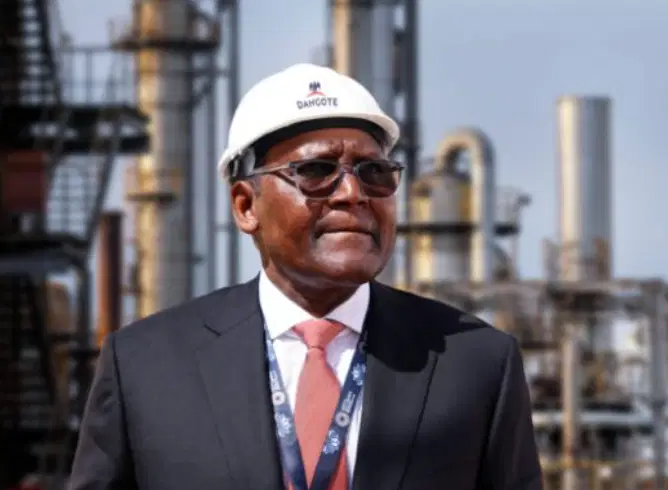

The President of Dangote Group, Alhaji Aliko Dangote, has announced plans to slash the price of Liquefied Petroleum Gas (LPG), commonly known as cooking gas, across Nigeria. He warned distributors on Monday that he would begin direct sales to consumers if middlemen continue to resist lowering prices.

But operators in the sector have pushed back, accusing Dangote of planning to dominate and monopolise the LPG market.
Speaking during a refinery tour with local and international guests in Lekki, Lagos, Dangote said his refinery currently produces 2,000 tonnes of LPG daily and is ramping up supply to the domestic market.

“I believe the current price of cooking gas is too expensive for the common man,” Dangote stated. “If distributors don’t bring prices down, we’ll sell directly to consumers so people can transition from firewood and kerosene to LPG for cooking.”
The billionaire revealed that his company’s plans for August also include direct distribution of petrol, diesel, and aviation fuel using 4,000 compressed natural gas-powered buses procured for the exercise.

Currently, cooking gas sells between ₦1,000 and ₦1,300 per kilogramme nationwide.
Reacting to the announcement, operators in the LPG market accused Dangote of attempting to frustrate existing players and hijack the sector.
Mr Godwin Okoduwa, former chairman of the LPG and Natural Gas Downstream Group at the Lagos Chamber of Commerce and Industry, described the move as “monopolistic” and warned that such an approach could erode years of collaborative market growth.
“The LPG industry in Nigeria grew from 70,000 metric tonnes in 2007 to over 1.3 million tonnes in 2022 through collaboration between investors, the Federal Government, and offtakers. Growth cannot be achieved through monopoly,” Okoduwa said.
He advised Dangote to focus on expanding infrastructure in underdeveloped regions like the Northeast rather than disrupting existing players.
The Executive Secretary of the Nigerian Association of LPG Marketers, Mr Bassey Essien, also questioned the feasibility of Dangote’s plan to bypass distributors.
“I’m saying it’s unrealistic. Has his refinery been able to sell petrol directly to car owners at a cheap rate? Why should LPG be any different?” Essien asked.
Dangote argues that his intervention will make cooking gas more affordable and reduce reliance on firewood. However, stakeholders insist any unilateral attempt to disrupt the market could harm small businesses and stifle competition.