

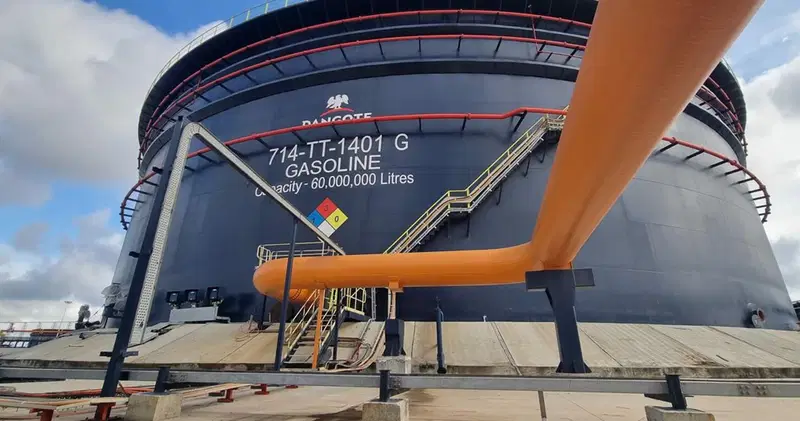

The $20 billion Dangote refinery recently announced plans to deploy 4,000 Compressed Natural Gas powered tankers for the direct nationwide distribution of petrol and diesel to large consumers such as manufacturers, telecom firms, and airlines. The ambitious strategy, scheduled to begin on August 15, is designed to slash logistics costs and enhance energy efficiency but has also triggered fears of an effective market monopoly.
Industry estimates project the initiative could save the Nigerian economy over ₦1.7 trillion annually and boost over 42 million Micro, Small and Medium Enterprises (MSMEs).

However, the move has been met with fierce resistance from entrenched players in the fuel supply value chain. The Natural Oil and Gas Suppliers Association of Nigeria (NOGASA) and the Petroleum Products Retail Outlet Owners Association of Nigeria (PETROAN) have jointly criticised the plan, warning that it threatens to collapse existing supply networks, displace thousands of jobs, and create long-term market instability.
Speaking at NOGASA’s Annual General Meeting in Abuja, on Thursday, National President Bennett Korie urged the federal government to intervene, warning that Dangote’s vertical integration—refining, distribution, and retail—could mirror the failed experience of the Nigerian National Petroleum Company Limited. He argued that similar consolidation by NNPCL led to inefficiencies and the eventual decline of state-owned refineries.

“We supported the Dangote refinery from the start, but bypassing depots and marketers for direct distribution is unsustainable,” Korie said. “We’re not against progress, we’re against monopoly. History shows that when refining and distribution are handled solely by one entity, the system suffers.”
He further warned that sidelining over 50,000 filling stations and their supply chains could lead to mass unemployment. “Dangote cannot sustainably handle nationwide distribution alone,” he added, calling for a return to traditional supply chains that allow refinery products to pass through depots and independent marketers.
The refinery’s move has already rattled the market. On Thursday, depot prices for petrol surged by seven per cent, from ₦815 to ₦870 per litre. Dangote refinery also abruptly suspended petrol sales, deepening supply uncertainty. An internal memo instructed marketers to halt payments for petrol loading, citing ongoing adjustments to its distribution framework.
Meanwhile, PETROAN President Billy Gillis-Harry likened the unfolding scenario to Nigeria’s cement industry, where market dominance by a few players led to steep price hikes. “Today, cement is over ₦10,000 per bag from ₦115. We fear similar inflationary consequences in fuel prices,” he warned, adding that independent retailers are losing up to ₦80 per litre due to sudden depot price hikes.
Gillis-Harry criticised what he termed a “monopolistic ambition,” warning that a single company refining, distributing, and retailing fuel could effectively act as both regulator and competitor, to the detriment of consumers and small businesses. He called on regulators to intervene, enforce fair pricing, and ensure crude oil supply to all local refineries.
Despite the outcry, a senior official from Dangote Group defended the strategy, arguing that removing middlemen and logistics costs is a patriotic move that will ultimately lower prices for consumers.
“We are not charging for logistics. This is about efficiency and savings for Nigerians,” the official said, accusing NOGASA of being “anti-Nigeria” for resisting cost-saving innovation. “There are 774 local governments in Nigeria—4,000 trucks can’t even cover them all. The market is big enough for everyone.”
The Independent Petroleum Marketers Association of Nigeria (IPMAN) offered a more measured stance. Vice Chairman Hammed Fashola acknowledged widespread concern but noted that dialogue may still yield a compromise. “Everyone is trying to protect their business, but I believe Dangote will listen to stakeholders,” he said.
The situation underscores mounting tensions as Nigeria navigates energy sector reforms. While Dangote’s initiative aims to modernise fuel distribution, the potential for monopolistic control, displacement of smaller players, and price instability remains a major concern.
Industry watchers now look to the federal government and regulators, particularly the Nigerian Midstream and Downstream Petroleum Regulatory Authority, to broker a balanced resolution that preserves competition, protects jobs, and ensures stable fuel supply across Africa’s largest economy.