

European football has plunged into a major governance crisis after the Union of European Football Associations (UEFA) and its 55 member associations agreed to boycott FIFA competitions if the world governing body proceeds with plans to sell stakes in the FIFA World Cup and other flagship tournaments to private investors.

The unprecedented decision followed an emergency online meeting on Thursday, where UEFA unanimously rejected FIFA President Gianni Infantino’s proposal to create a new commercial entity that would allow private equity firms to acquire ownership interests in the governing body’s most valuable competitions.
In a strongly worded statement, UEFA declared that neither it nor its member associations would participate in FIFA competitions while the proposal remained under consideration.

“The FIFA World Cup belongs to football. It always will. And so long as Europe has a voice, it will never be for sale,” UEFA said.
If implemented, the boycott would affect the Women’s Under-20 World Cup scheduled to kick off in Poland on September 5, as well as subsequent FIFA tournaments involving European national teams and clubs.

Controversial $20bn proposal
The dispute centres on Infantino’s proposal to establish a new commercial subsidiary, FIFA Forward Enterprise (FFE), valued at about $20 billion. Under the plan, private investors would own a 20 per cent stake in the company, which would control the commercial rights to the FIFA World Cup, Club World Cups and other global competitions.
The lead investor is expected to be a New York-based investment firm founded by Joshua Kushner, brother of Jared Kushner, son-in-law of U.S. President Donald Trump.
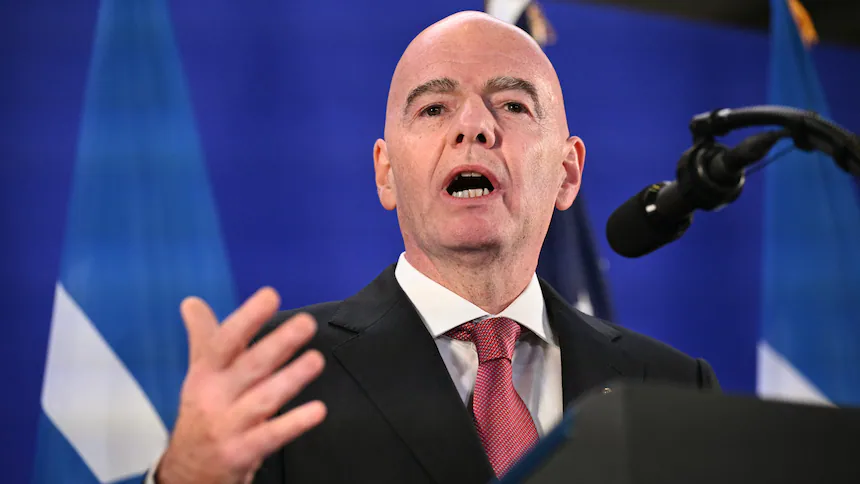
Infantino has written to FIFA’s 211 member associations urging them to approve the proposal by mid-September.
As an incentive, FIFA has pledged to double its basic development funding from $10 million to $20 million for each member association over the next four-year cycle. FIFA also projects that each member could receive as much as $86 million in funding by 2038, compared with roughly $36 million under the current model.
Infantino has argued that the new structure would “turbocharge” football development globally by unlocking additional commercial revenues.
UEFA rejects private ownership
UEFA, however, described the proposal as a dangerous shift away from football’s traditional governance model.
“This is not merely a profound failure of leadership, but an abdication of FIFA’s duty as the custodian of world football,” the European governing body said.
It warned that introducing outside investors into football’s biggest competitions would permanently alter the sport’s priorities.
“The moment external investors acquire ownership interests in FIFA competitions, football changes forever. Commercial return becomes a permanent obligation. Investor expectations become a daily pressure,” UEFA stated.
European football officials also questioned why FIFA was seeking private capital despite holding billions of dollars in financial reserves that could be used to expand development programmes without selling ownership interests.
Infantino faces growing opposition
The backlash represents the most serious challenge yet to Infantino’s leadership since he became FIFA president in 2016.
Only days after the conclusion of the FIFA World Cup in the United States, where Infantino appeared set to secure an uncontested fourth and final presidential term next year, opposition has rapidly intensified.
FIFA members are expected to elect the next president in Rabat, Morocco, in March 2027, with prospective candidates required to declare by November 18.
The controversy has also fuelled speculation over Infantino’s long-term ambitions. Football officials have privately suggested he could seek a senior executive role within FIFA Forward Enterprise after leaving the presidency.
Supporters’ groups have also joined the criticism, with Football Supporters Europe declaring on social media: “Game over, Gianni. InfantinOUT.”
Threat to global football
UEFA said its member associations would refuse to participate in FIFA competitions until the proposal was withdrawn completely and FIFA provided binding guarantees that it would never again seek private ownership of its competitions.
“As a result of today’s discussion, no UEFA national teams will participate in any FIFA competition for so long as these proposals remain alive,” UEFA said.
The standoff threatens to trigger one of the deepest institutional crises in modern football, pitting Europe’s most powerful football nations against FIFA over the future ownership and governance of the world’s biggest sporting events.