
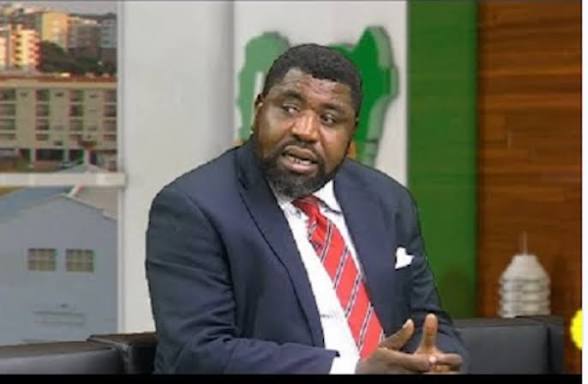

Anthony Kila, the Pro-Chancellor of Michael and Cecilia Ibru University (MCIU), has for years been presented to the Nigerian public as a professor.

He has been introduced as “Prof. Anthony Kila” on university websites, television programmes and in newspaper interviews. Some profiles have gone further, describing him as a “Jean Monnet Professor of Strategy and Development.”
But an investigation by Premium Times has thrown the prestigious title into doubt, finding no verifiable evidence that Kila was ever awarded a professorship by a recognised university or academic institution.

The findings are particularly significant because Kila has occupied one of the most powerful positions in a Nigerian university since his appointment as MCIU Pro-Chancellor in August 2025.
A pro-chancellor chairs the university’s governing council, which has responsibility for broad oversight of the institution, including its administration, policies, finances and assets.

Yet, according to the investigation, the academic distinction attached to the man occupying that position appears to have no verifiable institutional foundation.
When confronted with questions about his professorship, Kila reportedly told the paper that he received the title in 2016 from an organisation called the European Centre for Advanced and Professional Studies (ECAPS), which he said was based in Cambridge, United Kingdom.
That claim became one of the central findings of the investigation.
The paper searched the UK Companies House, Nigeria’s Corporate Affairs Commission and other publicly available sources but could not establish the existence of the institution.
There was no verifiable website, physical address, social media presence, alumni record or other independent trace of the organisation, according to the investigation.
In effect, the institution Kila cited as the source of his professorial title could not be independently located.
The investigation also found that Kila’s profiles on the websites of MCIU and the Commonwealth Institute of Advanced and Professional Studies (CIAPS) identify him as “Prof. Anthony Kila”.
He has also been repeatedly addressed as a professor during television and newspaper appearances.
And then came the ‘Jean Monnet’ claim
The questions became even more intriguing over Kila’s description as a “Jean Monnet Professor of Strategy and Development.”
The Jean Monnet title is associated with the European Union’s Jean Monnet Actions, a programme designed to support teaching, research and debate on European integration.
The paper contacted the European Education and Culture Executive Agency (EACEA), which administers the programme, to establish whether Kila had held such a position.
The agency reportedly found no record of him as a Jean Monnet project coordinator in the publicly available data.
It said that, since 2015, Kila had not been listed as holding the role of Jean Monnet project coordinator within the period covered by its available records.
That was not the only setback to the claim.
Jean-Marc Trouille, a professor and co-chair of the AfriquEurope Jean Monnet Network, reportedly told the paper that it was “highly unlikely” that Kila held a Jean Monnet Chair award.
Trouille said his search found only one Jean Monnet module in Nigeria that he was aware of, at the University of Lagos, and Kila was not listed among those involved.
Kila subsequently confirmed to the paper that he was not associated with the Jean Monnet Actions.
He did not, however, explain how the description “Jean Monnet Professor” came to be attached to his name.
In the university system, professorship is not simply an honorary description.
It is normally the highest academic rank and is attained after a rigorous assessment of a scholar’s qualifications, teaching, research, publications and contribution to knowledge.
The National Universities Commission (NUC) requires, among other things, a doctorate in the relevant field and substantial teaching and research experience.
The conventional academic progression takes a scholar through Lecturer II, Lecturer I, Senior Lecturer and Associate Professor before consideration for the professorial rank.
At each stage, academic output, publications, teaching, research and other contributions are assessed.
Ahmad Galadima, a professor and former Deputy Vice-Chancellor of the Federal University Gusau, told the paper that candidates for professorship undergo assessments at departmental and faculty levels before their records are considered by the university’s promotion committee.
Their publications, teaching experience, research, administrative responsibilities and community service are among the factors examined.
Candidates are subsequently subjected to external assessment by senior academics in their fields.
“When the requirements are fully satisfied, their CVs are sent for external assessment,” Galadima explained, adding that two favourable assessments are required for promotion.
The investigation, however, found no evidence that Kila had followed such a conventional academic route to professorship.
Another part of the investigation concerned Kila’s academic publications.
His Google Scholar profile listed 22 works, including books, journal articles and book chapters.
But the paper found that nine of the 22 works were not authored by him.
More significantly, it said none of the works attributed to him could be independently established as a peer-reviewed article in a reputable academic journal.
Three of the entries were listed as publications in the CIAPS Journal, a publication associated with the organisation founded by Kila.
His ResearchGate profile identifies him as a “full professor”, yet the profile reportedly contains no publications.
That finding raises another uncomfortable question: if the professorial title was earned through the normal academic route, where is the body of peer-reviewed research ordinarily expected of a professor?
Conflicting stories about his education
The questions do not end with the professorial title.
The investigation also uncovered discrepancies between Kila’s various public biographies and the academic qualifications he later supplied.
His public profiles list qualifications including an LLM, MBA, MSc, PhD and PGCE.
They also state that he studied in Cambridge, London, Perugia and Suffolk and describe him as having graduated with a first-class degree in political economy before specialising in political anthropology.
But when the paper requested his full curriculum vitae, Kila initially said he did not have one readily available.
He subsequently supplied a list of his qualifications.
According to that account, he obtained a BA in Classical Studies from Università per Stranieri in Italy in 1989 and an MA in European Studies from the same institution in 1991.
He said he subsequently obtained a postgraduate diploma in Media and Communication from the University of Essex in 1992 and an MSc in International Banking and Finance from City University London in 1994.
He also listed a PhD in Political Economy from the University of Perugia in 1997, an MBA from Aston University in 2002, a postgraduate certificate in Higher Education in 2006 and an LLM from Cambridge in 2009.
But that version differs from descriptions contained in his other public profiles.
The CIAPS and MCIU biographies had described his first degree differently, saying he graduated with a first-class degree in political economy and later specialised in political anthropology.
The discrepancy has therefore added another layer to questions surrounding his academic history.
Another institution says: ‘We don’t know him’
There was yet another twist.
Kila’s biographies repeatedly refer to him as an international Director of Studies at the “European Centre of Advanced and Professional Studies”.
The name bears similarities to the European Centre for Advanced Studies (ECAS), an institution established by the University of Glasgow and Leuphana University.
But the two institutions are not the same.
And ECAS reportedly told the paper that it had no connection with Kila.
“The European Centre for Advanced Studies has no knowledge of this person,” its Academic Director, James Conroy, said.
When the university was confronted with the findings, an MCIU spokesperson reportedly declined to debate the matter before publication.
The spokesperson said the university had no evidence contradicting Kila’s claim that he was a professor.
“We don’t debate issues. You can go up with whatever you are going up with. If there’s a need to respond, we will respond when we see the article,” the spokesperson said.
That response leaves the central question hanging: what institution actually conferred the professorial title on the man who chairs the governing council of a Nigerian university?
The investigation also took an unusual turn after Kila was confronted with the findings.
The CIAPS website, which contained several of the biographical claims about him, reportedly became inaccessible.
The paper said the website was repeatedly altered, with Kila’s profile initially removed before the entire site eventually went offline.
The development further complicated efforts to independently verify the information contained in his public biographies.
The investigation has established serious questions around the provenance of Kila’s professorial title, but the paper said its wider verification of his educational qualifications was continuing because responses were still awaited from some institutions he claimed to have attended.