


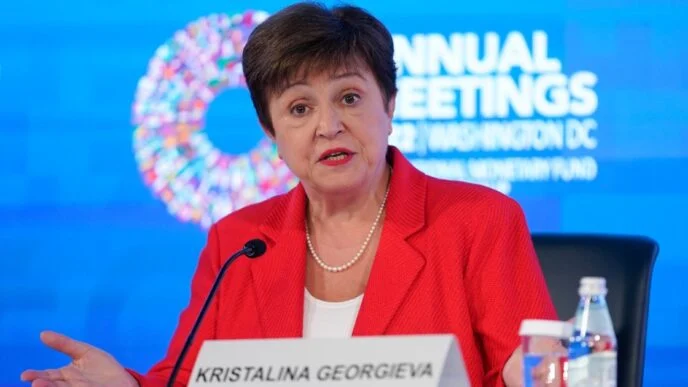

The managing director of the International Monetary Fund (IMF), Kristalina Georgieva, has urged African leaders to deepen intra-regional trade and cooperation to withstand global economic shocks in a tariff era.

Georgieva spoke on Thursday while briefing journalists on the global policy agenda at the spring meetings of the IMF and World Bank in Washington DC, the United States (US).
On April 22, the IMF said the global economic growth will drop to 2.8 percent this year, and 3 percent in 2026 — citing the US tariffs announcement, which has heightened uncertainty around the world and threatened global financial stability.

Speaking at the event, Goergieva said the African continent has had some of the fastest-growing economies over the last years, but low-income countries (and among them, fragile conflict-affected countries) are falling further behind.
She said the direct impact of the US tariffs on most of Africa is relatively small, noting that the indirect effect is quite significant.

The managing director stressed that slowing global growth will result in a downgrade for the continent.
“And actually, we have downgraded growth prospects for the continent,” Georgieva said.
“For the oil producers like Nigeria, falling oil prices create additional pressure on their budgets. On the other hand, for the oil importers, this is a breath of fresh air. In other words, different countries face different challenges.”
To navigate the turbulence, Georgieva asked African leaders to deepen intra-regional trade and cooperation and remove the obstacles to it.
She said while there are infrastructure obstacles, Africa has much to offer the world with its mineral resources and young population.
“The World Bank is working on reducing that infrastructure obstacle to growth and trade,” the IMF boss said.
“I think a more unified, more collaborative continent can go a long, long way to [becoming] an economic powerhouse.”
Georgieva also advised African governments to continue on a path of strengthening their fundamentals, stressing that a lot still needs to be done to bolster the fiscal side to have buffers for a moment of shock.
The economist also said more needs to be done to broaden the tax base and reduce tax evasion and avoidance, advising African countries to “chase the tax dollar” using technology.
“On the monetary policy side, we are no more in a place when you can look at the book of the Central Bank Governor of the neighbouring country and say, oh, they are doing this, I will do the same, because you have to really assess domestic resource mobilisation, what is your inflationary pressures and do the right thing for your country,” she said.
“But above all, make it so that the image of the whole continent changes because now everybody suffers from wrongdoing, from corruption or from conflict in one country. It throws a shadow on the rest of the continent.”
On April 22, the IMF said in emerging market and developing economies, growth is expected to slow down to 3.7 percent in 2025 and 3.9 percent in 2026.


