

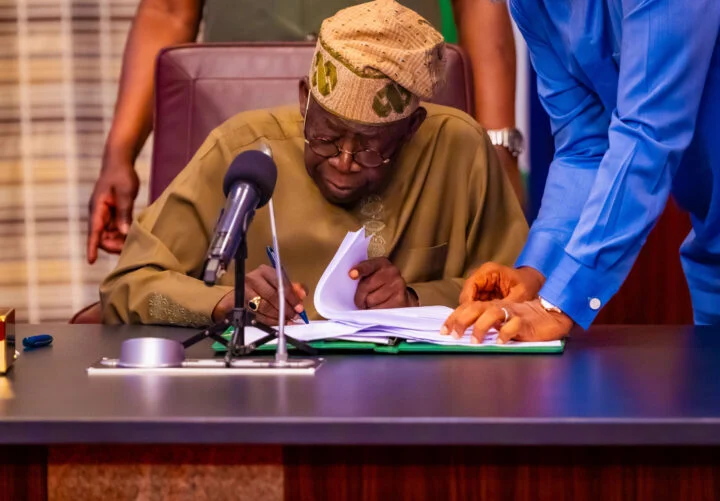

President Bola Tinubu has signed the four tax reform bills into law implementing a key plank of his economic reform agenda.

Tinubu assented to the bills at the Presidential Villa on Thursday.
The four new laws are:

The Nigeria Tax Act, which merges various rules into a single, easier-to-understand code and eliminates more than 50 small, overlapping taxes. The presidency has said that reducing the number of taxes and eliminating duplication, will making doing business easier;
The Tax Administration Act, which sets common rules for how taxes are collected across federal, state, and local governments;

The Nigeria Revenue Service Act, which replaces the Federal Inland Revenue Service (FIRS) with a new, independent agency – the Nigeria Revenue Service (NRS) and;
The Joint Revenue Board Act, which improves co-ordination between levels of government and creates a Tax Ombudsman and Tax Appeal Tribunal to resolve disputes.
The signing ceremony was attended by Senate President Godswill Akpabio, Tajudeen Abbas, speaker of the house of representatives, and Julius Ihonvbere, house majority leader.
Also present were Abdulrazaq Abdulrahman, governor of Kwara, Hope Uzodinma, his Imo counterpart, and Wale Edun, minister of finance, among others.
Tinubu transmitted the proposed legislation to the national assembly on October 3, 2024, urging lawmakers to pass the tax reform bills.
The bills initially faced opposition from the northern governors, who argued that the proposed laws could harm the region’s interests, asking the national assembly to reject the bills and demanding fair and equitable implementation across all regions.
However, in January, the Nigeria Governors’ Forum (NGF) endorsed the bills after agreeing on an “equitable” VAT-sharing formula.
The house of representatives passed the bills in March, while the senate approved them in May.
On June 18, the legislature transmitted the bills to the president for assent.
Speaking earlier on Thursday, Tinubu said the tax bills will unify the country’s fragmented tax system.
“They (tax reform bills) deliver the first major, pro-people tax cuts in a generation, targeted relief for low-income earners, small businesses, and families working hard to make ends meet,” Tinubu said.
“For too long, our tax system has been a patchwork—complex, inequitable, and burdensome. It has weighed down the vulnerable and shielded inefficiency. That era ends today.”
Tinubu added that the bills will eliminate wasteful duplications, reduce red tape, restore investor trust, and promote transparency and coordination at all levels.