

By Our Correspondent
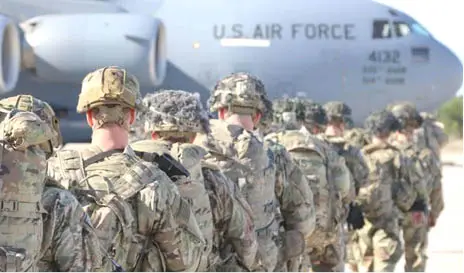
The United States is set to deploy about 200 military personnel to Nigeria to train and provide technical support to the Nigerian Armed Forces in their fight against jihadist groups and other armed actors, officials from both countries have confirmed.
The deployment, expected to take place in the coming weeks, marks a significant expansion of security cooperation between Abuja and Washington amid worsening insecurity across large parts of the country.

Speaking to international media, the spokesman of Nigeria’s Defence Headquarters, Maj. Gen. Samaila Uba, said the American troops would play no combat role and would not participate directly in military operations.
“We are getting U.S. troops to assist in training and technical support,” Uba said.
“These personnel do not serve in a combat capacity and will not assume a direct operational role. Nigerian forces retain full command authority, make all operational decisions and will lead all missions on Nigerian sovereign territory.”
He added that the deployment was part of ongoing cooperation under the U.S.–Nigeria Joint Working Group, but declined to disclose the exact date of arrival or where the troops would be stationed.
The Wall Street Journal, which first reported the deployment, said the additional troops would supplement a small U.S. team already operating in Nigeria to assist with intelligence gathering and airstrike targeting.
According to the report, the incoming personnel would provide training and technical guidance, including helping Nigerian forces better coordinate joint operations involving air power and ground troops.

A spokeswoman for the United States Africa Command (AFRICOM) confirmed the details, noting that the mission was focused on capacity-building and advisory support.
Last week, the commander of AFRICOM, Gen. Dagvin Anderson, disclosed that the U.S. had already dispatched a “small team” of troops to Nigeria as part of enhanced security cooperation between both countries. His comments sparked public debate after it emerged that this was the first official acknowledgment of U.S. boots on the ground in Nigeria since a joint strike carried out in December.
However, Nigerian and U.S. officials have played down the development, stressing that American troops have long supported Nigeria in advisory and intelligence roles, and that what has changed is the scope and scale of assistance.
Meanwhile, officials familiar with discussions between both governments told TheCable that the United States has also requested the establishment of a drone refuelling station in Nigeria to support counter-terrorism operations, including intelligence, surveillance and reconnaissance missions.
According to the sources, the facility would allow U.S. drones operating from Accra, Ghana — a major logistics hub for American military operations in Africa — to refuel and extend their operational range over Nigerian territory.
A North-East state has reportedly been identified as the preferred host for the facility, after proposals to locate it in Lagos or Abuja were rejected on security and political grounds. The North-East already hosts key Nigerian drone operations linked to the fight against Boko Haram and Islamic State West Africa Province (ISWAP).
An official familiar with the talks said the proposed station would not amount to a permanent U.S. military base.
“We’re not going to have boots on the ground in a fighting capacity,” the official said.
“They are only going to support Nigeria either with equipment, intelligence or training, which is already ongoing.”
Nigeria remains Africa’s most populous country and is battling multiple security crises. A long-running jihadist insurgency has ravaged the North-East for nearly two decades, while criminal bandit gangs engage in mass kidnappings and village raids in the North-West. In the North-Central region, clashes between farmers and herders continue, driven largely by competition over land and resources.
In December, U.S. forces carried out airstrikes against militant targets in Sokoto State in coordination with Nigerian authorities, a development that underscored the deepening military partnership between both countries.

U.S. officials have since said Washington would continue to provide intelligence support for Nigerian air operations and help speed up arms procurement.
The new deployment has been linked to the U.S. 3rd Special Forces Group, which operates under Special Operations Command Africa (SOCAFRICA). The unit is trained for missions including counter-terrorism, counter-insurgency, special reconnaissance and security force assistance, with extensive experience across Africa and the Middle East.
The enhanced cooperation comes against the backdrop of diplomatic pressure from Washington over Nigeria’s security situation. U.S. President Donald Trump has repeatedly described violence in Nigeria as “persecution” or “genocide” against Christians — claims that have been strongly rejected by the Federal Government.
While acknowledging that some attacks have targeted Christian communities, Nigerian authorities and independent analysts argue that Muslims are also killed in large numbers, pointing to a broader failure of state security rather than a campaign of religious persecution.
Trump’s senior adviser on Arab and African affairs, Massad Boulos, said last year that Boko Haram and Islamic State-linked groups were killing more Muslims than Christians.
Nigeria’s Minister of Defence, Mohammed Badaru, has also reiterated that the American personnel in the country are not combat troops, describing them as a small advisory team supporting intelligence gathering and training.
Although details about their numbers, locations and duration of stay remain undisclosed, officials say the expanded U.S. presence reflects a shared determination by Abuja and Washington to curb the spread of terrorism and violent crime across Nigeria and the wider West African region.