

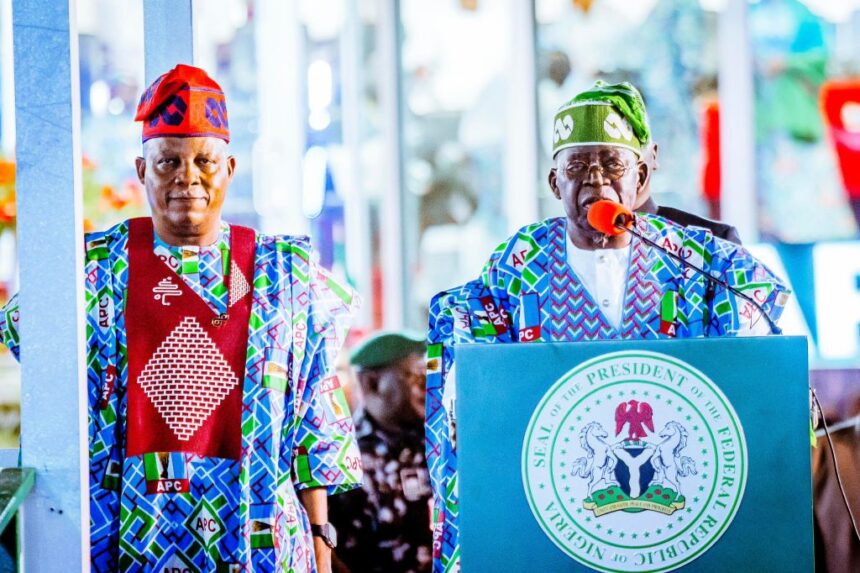

President Bola Tinubu on Friday launched a forceful political counterattack against opposition parties, accusing them of deliberately distorting the newly amended Electoral Act to score partisan points, even as he sought to reassure Nigerians that his administration remains committed to democratic integrity and competitive politics.

Speaking before party faithful at the high-stakes national convention of the All Progressives Congress in Abuja, Tinubu framed the controversy over the Electoral Act as a defining test of Nigeria’s democratic maturity, warning that persistent misrepresentation of the law risks eroding public trust in the electoral system.
The President dismissed opposition criticisms as both “misleading and harmful,” insisting that the legislation was the product of due process rather than executive imposition. According to him, the amendments followed extensive legislative scrutiny, including public hearings, and were duly passed by the National Assembly of Nigeria.
“It is a disservice to Nigerians to reduce a law born out of national consensus to mere political propaganda,” Tinubu declared, arguing that the Act represents a collective effort to strengthen electoral credibility rather than undermine it.

Mounting political tension
Tinubu’s remarks come against a backdrop of intensifying political friction, as opposition parties raise concerns about the implications of recent defections into the APC and the broader balance of power ahead of future elections.
Critics have warned that the growing dominance of the ruling party—already in control of the presidency, a parliamentary majority, and most state governments—could weaken democratic competition. But Tinubu rejected suggestions that his administration is steering Nigeria toward authoritarian consolidation.

“We do not seek a one-party state,” he said firmly, emphasizing that a vibrant opposition remains essential to governance. “Democracy thrives on contestation. A credible opposition sharpens leadership and improves policy outcomes.”
Rather than accept claims of political overreach, the President portrayed the steady influx of defectors into the APC as evidence of increasing confidence in his administration’s direction and reform agenda.
Warning signs within the ruling party
In a notable shift inward, Tinubu also cautioned his own party against complacency and internal decay, warning that political dominance alone does not guarantee stability.
He identified internal divisions, unchecked ambition, and the erosion of discipline as the real threats to party survival—often more damaging than electoral defeat.
“Political parties falter when ego overrides ideology and ambition replaces discipline,” he warned, urging delegates to prioritise unity over factional interests.
The President’s message appeared aimed at pre-empting post-convention fractures, as the APC navigates leadership contests and competing power blocs within its expanding ranks.
Economic reforms under scrutiny
Beyond politics, Tinubu used the platform to mount a robust defence of his administration’s economic reforms, which have drawn mixed reactions amid rising living costs and public discontent.
Acknowledging the hardship triggered by policy changes, he argued that difficult decisions—such as subsidy removal and market liberalisation—were necessary to stabilise the economy and reposition it for growth.
“No nation prospers by avoiding hard truths,” Tinubu said, maintaining that early signs of recovery are beginning to emerge.
He pointed to declining inflation trends, renewed investor confidence, and improvements in trade balances as indicators that the economy is gradually transitioning from crisis to stability. He also cited a rebound in the stock market and Nigeria’s improved global financial standing as evidence that reforms are gaining traction.
Party leaders rally behind Tinubu
Top party figures closed ranks behind the President, reinforcing the administration’s narrative of reform-driven progress.
Convention chairman and former Katsina governor, Aminu Bello Masari, described the gathering as a “historic moment” to reaffirm party values and chart a unified path forward, while stressing that leadership must be anchored on service and responsibility.
Minister of Finance, Wale Edun, went further, crediting Tinubu’s “courage to act” with reversing years of economic mismanagement. He argued that the administration’s reforms—particularly in foreign exchange and petroleum markets—have laid the groundwork for long-term poverty reduction.
Similarly, Imo State Governor Hope Uzodinma, speaking on behalf of APC governors, said the party remained aligned with the President’s “Renewed Hope” agenda, pledging continued collaboration to deliver economic growth, infrastructure, and social protection.
A defining political moment
Friday’s exchanges underscore the sharpening political divide ahead of future electoral contests, with the Electoral Act emerging as a new battleground in Nigeria’s evolving democratic landscape.
For Tinubu, the stakes are clear: defend the legitimacy of the rules governing elections, consolidate political support, and sustain public confidence in both governance and reform
For the opposition, the challenge remains how to counter a ruling party that continues to expand its reach—while convincing Nigerians that the playing field remains fair.
As the APC tightens its grip on power, the broader question persists: whether Nigeria’s democracy will be strengthened by consolidation—or strained by it.