
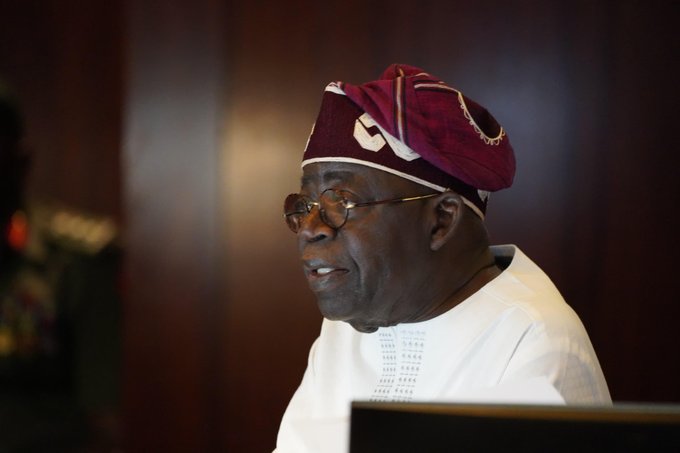
President Bola Tinubu marked the third anniversary of his administration on Friday with a sweeping defence of his government’s economic reforms, insisting that the painful decisions taken since 2023 had rescued Nigeria from fiscal collapse and placed the country on the path to recovery.

In a nationwide address commemorating three years in office, the Nigerian leader acknowledged the hardship triggered by the removal of petrol subsidies and the unification of the foreign exchange market but maintained that the reforms were unavoidable.
“Together, we chose reform over ruin and decisiveness over hesitation,” Tinubu declared. “The easy choices would have been politically convenient. But leadership demands courage, especially when the right decisions are difficult.”
The President said his administration inherited an economy weighed down by mounting debt, dwindling revenues, multiple exchange-rate systems, crippling fuel subsidies, insecurity, and declining investor confidence.

According to him, Nigeria spent as much as N18.4 billion daily on petrol subsidies at the peak of the regime, amounting to over N4 trillion in 2022 alone. He also blamed multiple foreign exchange windows for creating opportunities for “rent-seeking and speculative practices” that allegedly cost the country more than N8 trillion over three years.
Tinubu argued that failure to act decisively would have plunged the country into deeper economic crisis, worsening poverty, and fiscal instability.
Despite widespread public anger over soaring inflation and rising living costs that followed the reforms, the President insisted that “the sacrifice has not been in vain.”

He pointed to what he described as growing signs of economic recovery, citing a surge in stock market performance, improved public finances, and renewed investor confidence.
“The economy is now more competitive and better positioned for sustainable growth than it was in 2023,” he said.
Tinubu claimed that the Nigerian Exchange All Share Index had climbed from 53,000 points in 2023 to 250,000 this year, while market capitalisation rose from N30 trillion to N160 trillion.
The President also highlighted infrastructure projects across the country, saying more than 2,700 kilometres of highways and major roads were currently under construction, reconstruction, or rehabilitation.
Among the flagship projects he listed were the Lagos-Calabar Coastal Highway, the Sokoto-Badagry Super Highway, the Abuja-Kaduna-Zaria-Kano Road, and the East-West Road.
He added that rail modernisation projects were progressing nationwide to improve logistics and economic integration.
In the energy sector, Tinubu said reforms had attracted fresh foreign investment into the oil and gas industry, while domestic refining capacity had improved significantly through the operation of modular and large-scale refineries.
He disclosed that the N5 billion NLNG Train 7 project was nearing completion and would boost Nigeria’s liquefied natural gas production and export earnings.
On electricity, Tinubu admitted that the power sector remained burdened by years of debt, poor investment, and inadequate infrastructure, but said his administration was confronting the crisis through grid expansion, renewable energy investments, and settlement of legacy obligations.
“No modern economy can grow in darkness,” the President stated. “When power improves, businesses expand, industries grow, jobs are created, and families prosper.”
Tinubu also outlined interventions in agriculture, education, healthcare, housing, and telecommunications.
He said agricultural support programmes had reached millions of farmers through improved access to seedlings, fertilisers, mechanisation, irrigation, finance, and markets.
The President revealed that the Nigerian Education Loan Fund had disbursed over N282 billion to more than 1.5 million students to improve access to tertiary education.
He further announced that the Renewed Hope Housing Programme and the Federal Housing Authority were delivering more than 10,000 housing units across 14 states and the Federal Capital Territory, while creating over 300,000 jobs.
In healthcare, Tinubu said thousands of primary healthcare centres were being revitalised and health insurance coverage expanded for vulnerable citizens.
The President also sought to reassure Nigerian youths, promising greater investment in technology, technical education, innovation, entrepreneurship, and digital skills development.
“To our young people, I want you to know this nation believes in you,” he said. “You are not a problem to be managed. You are the engine of Nigeria’s future.”
On security, Tinubu said military and security agencies had intensified operations against terrorists, kidnappers, bandits, oil thieves, and other criminal groups.
While acknowledging that insecurity remained a major challenge, he claimed that many communities and highways were becoming safer and more economically active.
“We will not relent until every Nigerian can live, work, travel, and dream in safety,” he vowed.
Tinubu, however, conceded that many Nigerians were yet to fully feel the benefits of the reforms in their daily lives.
He promised that his administration would continue efforts to reduce food prices, lower transportation costs through compressed natural gas and electric vehicle initiatives, and create more jobs and business opportunities.
Calling for national unity and patience, the President urged Nigerians to reject “cynicism and division” and remain hopeful about the country’s future.
“History tests nations before it elevates them,” Tinubu said. “Nigeria is passing through such a test. But I believe with all my heart that we shall emerge stronger, fairer, more united, and more prosperous than ever before.”
He concluded by reaffirming his commitment to building “a Nigeria that is secure, prosperous, inclusive, and respected worldwide.”