

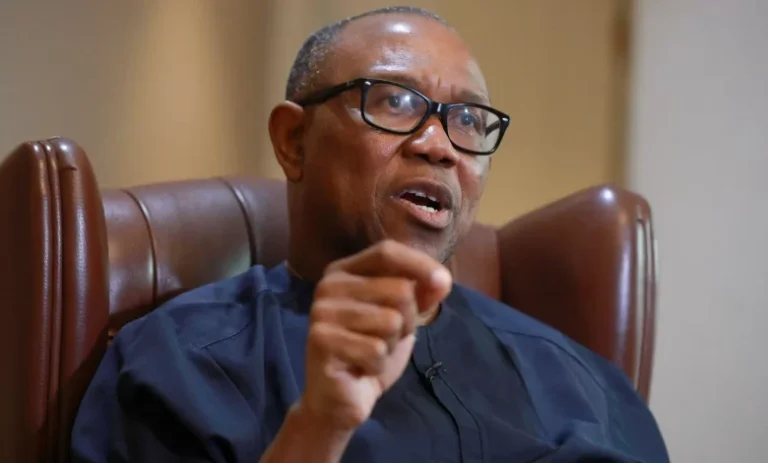
Peter Obi has pledged to increase Nigeria’s electricity generation and distribution capacity by at least 10,000 megawatts (MW) within four years, up from the country’s current output of about 4,000MW.

Obi made the commitment on Saturday, May 30, 2026, while accepting his nomination as the presidential candidate of the Nigerian Democratic Congress (NDC) at the party’s convention in Abuja.
The former Anambra State governor outlined plans across key sectors including power, healthcare, education, agriculture, security and governance, which he said would form the foundation of his administration if elected president in 2027.

Obi, who announced Senator Rabiu Kwankwaso, former Governor of Kano State, as his vice-presidential candidate, said Nigeria’s power shortfall continues to cripple businesses, choke industries, and stall overall economic growth.
Peter Obi, in his usual style of comparing Nigeria’s performance with that of other nations, said the country currently has the highest number of citizens without access to electricity in the world.

“We currently generate and distribute a mere 4,000 megawatts (MW) of electricity for a population exceeding 200 million,” he said.
Obi noted that Nigeria’s electricity output remains significantly below that of comparable countries.
He said nations such as South Africa and Egypt each generate and distribute more than 40,000MW of electricity despite having populations that are less than half of Nigeria’s.
“Over the next four years, I commit to ensuring a minimum of 10,000 MW power increase generation and distribution,” Obi stated.
The NewsMatrics reports that Nigeria’s installed generation capacity actually exceeds 12,000 MW but the transmission network can only wheel between 4,000 MW and 5,000 MW resulting in huge shortfalls, rolling blackouts and persistent grid collapses.
Beyond the power sector, Obi unveiled plans to reform healthcare, tackle insecurity, improve education and address rising hunger across the country.
On healthcare, he lamented that Nigeria’s health insurance coverage remains around 10 per cent, compared with over 90 per cent in countries such as Indonesia.
He pledged to more than double national health insurance coverage to above 20 per cent within four years and increase healthcare spending to at least 10 per cent of Gross Domestic Product (GDP), up from the current level of below five per cent.
Obi also promised that every one of Nigeria’s 8,809 wards would have a functional primary healthcare centre, while at least 50 per cent of the country’s estimated 30,000 primary healthcare facilities would become fully operational by the end of his first term.
Addressing insecurity, the NDC candidate said Nigeria’s security situation had deteriorated significantly, noting that the country moved from being the eighth most terrorism-affected nation globally in 2022 to fourth in 2026.
He said his administration would adopt an intelligence-driven, technology-enabled and community-focused approach to security while addressing underlying causes such as poverty, unemployment and marginalisation.
On education, Obi said investment in schools, teachers, technology and vocational training would remain central to his development agenda, arguing that no nation can rise above the quality of its educational system.
He also expressed concern over worsening hunger levels, citing data showing that Nigeria slipped from 109th position on the Global Hunger Index in 2023 to 115th in 2025.
According to him, more than 35 million Nigerians are projected to face acute hunger and food insecurity this year despite the country’s vast agricultural resources.
Obi said transforming Nigeria from a consumption-driven economy to a production-focused one through large-scale investment in agriculture remains the most reliable pathway to reducing poverty and food insecurity.
He further promised targeted tax incentives, affordable financing and other support measures for micro, small and medium-sized enterprises (MSMEs) to tackle youth unemployment, which he said exceeds 40 per cent.
The former governor also pledged to reduce the cost of governance, strengthen transparency and accountability in public spending, uphold the rule of law and protect democratic institutions.
Nigeria’s power sector has faced persistent challenges for decades, including inadequate generation capacity, ageing infrastructure, weak transmission networks, mounting debts and chronic inefficiencies.
The national grid suffered multiple collapses in recent years, highlighting the fragility of the country’s electricity system. In January 2026 alone, the grid collapsed twice within five days, while similar incidents were recorded in 2025 and 2024, when the grid reportedly failed at least 12 times.
In a bid to revive the sector, President Bola Tinubu recently appointed Joseph Olasunkanmi Tegbe as Minister of Power following the resignation of Adebayo Adelabu, who stepped down to pursue elective office.
The administration also appointed Rilwan Lanre Babalola to lead efforts aimed at restoring stability and improving performance across the electricity value chain.