
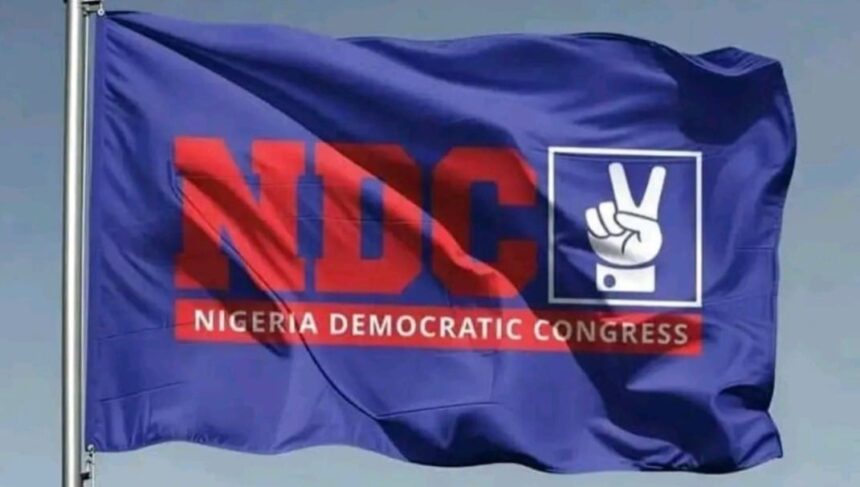

The opposition National Democratic Congress (NDC) is grappling with a widening internal crisis following its nationwide primary elections, as disputes over candidate selection, allegations of manipulation, delayed release of results and growing factional tensions threaten to undermine the party’s rising political profile ahead of the 2027 general elections.

The turmoil comes at a critical period for the NDC, which has emerged as one of the fastest-growing opposition platforms in Nigeria after attracting prominent political figures and support groups from across the country. The party’s growing influence has been largely driven by the influx of supporters associated with former presidential candidate Peter Obi and former Kano State governor Rabiu Musa Kwankwaso, whose Obidient and Kwankwasiyya movements have significantly expanded the party’s grassroots reach.
However, what was expected to be a defining moment for the party’s democratic credentials has instead become a source of controversy.
Although the party’s National Executive Committee announced the ratification and endorsement of the May 29 primary elections, official results have yet to be publicly released, fueling suspicion among aspirants, party leaders and supporters across several states.

Kano emerges epicentre of crisis
The most intense dispute has erupted in Kano State, where tensions between members of the Kwankwasiyya Movement and longstanding NDC officials have exposed deeper struggles over control of the party structure.
At the centre of the disagreement are allegations that supporters of Kwankwaso dominated the nomination process and sidelined existing party members.

The controversy escalated after an unofficial list of purported candidates surfaced on social media, prompting accusations that influential figures were attempting to predetermine the outcome of the primaries.
Party insiders say a power-sharing arrangement brokered by the NDC’s national leader, Seriake Dickson, allocated 60 per cent of the party structure in Kano to the Kwankwasiyya Movement and 40 per cent to legacy party officials following Kwankwaso’s entry into the party.
However, state party leaders have alleged that the understanding was abandoned once the nomination process began.
North-West Vice Chairman Mohammed Rabiu Serina and Kano State Chairman Hussaini Isa Mariga reportedly accused Kwankwaso’s loyalists of monopolising nomination forms and excluding established party members from key contests.
The situation worsened after state officials allegedly revised candidate nominations submitted by the Kwankwasiyya bloc and forwarded an alternative list to the national leadership.
Sources within the party claim that Kwankwaso rejected the alterations and warned that he could leave the party if the revised list is ultimately adopted.
Party moves to calm tensions
Amid growing unrest, the NDC leadership has repeatedly denied allegations of candidate imposition.
In a statement, party spokesman Osas Director insisted that no official results had been released in Kano or any other state and urged members to disregard lists circulating online.
According to him, reconciliation efforts are already underway, including meetings involving leaders of the Kwankwasiyya Movement and long-serving party officials in Kano.
“The NDC leadership will not impose candidates in Kano State or anywhere in the country,” Director stated, maintaining that the party remains committed to transparency and internal democracy.
Dickson has also sought to reassure members that ongoing consultations will preserve unity within the party.
He stressed that both the Kwankwasiyya and Obidient movements remain critical components of the NDC’s future political strategy and disclosed plans to formally integrate their coordinators into party structures nationwide.
South-East complaints deepen concerns
The controversy is not limited to Kano.
In the South-East, some members of the Obidient Movement have raised concerns over the treatment of aspirants during the primary process.
Several aspirants alleged that they were pressured into paying substantial sums despite earlier assurances that only expression-of-interest fees would be required at the preliminary stage.
The discontent spilled into the open when a group known as the Concerned Youths of Nsukka Local Government Area staged a peaceful protest at the party’s headquarters, demanding transparency in the selection of candidates.
The protesters warned that the imposition of candidates could damage the party’s electoral prospects and alienate grassroots supporters who joined the NDC because of its promise of internal democracy.
Stakeholders demand answers
A coalition of party stakeholders led by co-convener Uche Uzomba has also questioned the prolonged delay in announcing the results of the primaries.
The group argued that the uncertainty risks eroding public confidence in a party that has consistently presented itself as a credible alternative to Nigeria’s traditional political establishments.
The stakeholders urged the leadership to provide a clear explanation regarding the status of the primary election outcomes and cautioned against actions that could be perceived as undermining democratic processes.