

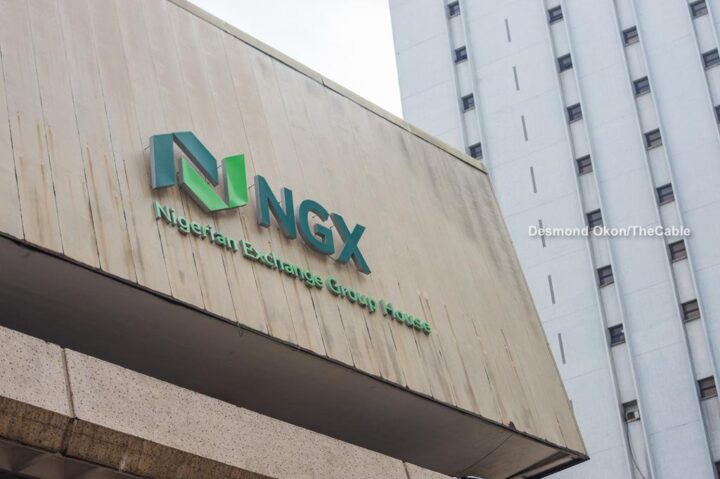

Nigeria’s equity market suffered one of its sharpest single-day setbacks in recent weeks on Monday, with investors wiping N1.32tn ($860m) off the value of listed companies as an aggressive round of profit-taking swept through industrial, banking and consumer goods stocks.

The sell-off, led by steep declines in heavyweight counters such as BUA Cement, FCMB Group and First HoldCo, pushed the benchmark NGX All-Share Index down 0.84 per cent to 241,749.11 points, from 243,798.76 points on Friday.
Market capitalisation fell to N155.13tn from N156.44tn, extending the previous session’s losses and highlighting growing investor caution after a prolonged rally that has made Nigerian equities among the world’s best-performing asset classes this year.

Despite the setback, the market remains up 55.35 per cent year-to-date, underlining the scale of gains accumulated since the start of 2026.
The breadth of Monday’s decline pointed to widespread selling pressure. Forty-six stocks closed lower compared with just 19 gainers, reflecting broad-based profit-taking across sectors.

“The weakness appears largely technical rather than fundamental,” said market analysts, noting that banking and industrial stocks have posted substantial gains in recent months and are now experiencing a natural phase of portfolio rebalancing.
The biggest drag on the market came from BUA Cement, one of the exchange’s most capitalised companies, which plunged 9.99 per cent to N306.20 from N340.20.
Given the stock’s substantial weighting in the benchmark index, its decline amplified the broader market downturn.
Consumer goods companies also faced heavy selling. PZ Cussons Nigeria fell 10 per cent to N81.00, making it the session’s steepest percentage loser, while Cadbury Nigeria dropped 8.95 per cent and NASCON Allied Industries shed 8.91 per cent.
The losses reflected investors locking in gains after strong performances by several consumer-facing stocks earlier in the year.
Industrial goods bore the brunt of the sell-off, with investors reducing exposure to some of the market’s strongest performers amid concerns that valuations have become stretched following months of sustained appreciation.
Banking shares, which have been among the principal beneficiaries of Nigeria’s high-interest-rate environment and ongoing recapitalisation exercise, also retreated sharply.
FCMB Group fell 6.48 per cent to N10.10, while First HoldCo declined 5.20 per cent to N65.60.
Among the tier-one lenders, Zenith Bank lost 3.25 per cent to close at N107.20, GTCO slipped 1.43 per cent to N124.20, and UBA eased 0.61 per cent to N40.75.
Market participants attributed the declines to profit-taking rather than concerns over earnings prospects.
Nigeria’s major banks have reported robust profitability in recent quarters, supported by elevated interest rates, foreign exchange gains and improving asset quality. However, the sharp rally in banking stocks has prompted some investors to crystallise gains ahead of half-year earnings releases.
Elsewhere, AXA Mansard Insurance dropped 4.88 per cent to N11.70, while conglomerate Transcorp fell 2.47 per cent to N39.50. Oil producer Oando slipped 2.26 per cent to N39.00, while Unilever Nigeria and NGX Group declined 1.88 per cent and 1.37 per cent respectively.
While share prices weakened, market activity strengthened markedly, suggesting that institutional investors remained active in repositioning portfolios.
Trading volume rose 18.66 per cent to 523.54m shares, while deal count jumped 33.39 per cent to 59,945 transactions.
The value of shares traded reached N22.28bn.
FCMB Group emerged as the most actively traded stock by volume, with 102.24m shares exchanged, accounting for almost one-fifth of total market turnover.
By value, Seplat Energy led the market with N3.62bn worth of shares changing hands, representing 16.23 per cent of total transaction value.
International Breweries and Access Holdings were also among the most actively traded counters, contributing 5.11 per cent and 4.73 per cent respectively to total market volume. Stanbic IBTC Holdings and Zenith Bank ranked behind Seplat on the value chart.
The sharp increase in turnover suggests that investors are rotating capital rather than exiting the market altogether, a trend often associated with portfolio rebalancing during periods of heightened volatility.
Despite the broad market weakness, a handful of stocks continued to attract buying interest.
Nigerian Infrastructure Debt Fund (NIDF) stood out after breaking above its previous 52-week high of N148.50 to close at N163.30, reflecting sustained demand for income-generating assets.
FTN Cocoa Processors also reached a new annual high, climbing to N3.00 from a previous peak of N2.91.
Other gainers included International Breweries, Nigerian Aviation Handling Company (NAHCO), UACN and DAAR Communications.
The consumer goods sector was the only segment of the market to post a modest positive performance, supported by selective buying in a handful of counters despite weakness elsewhere.
Analysts expect the market to remain volatile in the near term as investors digest recent gains and position for the next wave of corporate earnings.
While Monday’s sell-off highlighted concerns about elevated valuations in some sectors, the underlying investment case for Nigerian equities remains supported by strong corporate earnings, improving macroeconomic indicators and the continued search for inflation-beating returns.
For now, investors appear to be taking a more selective approach, shifting capital away from stocks that have delivered outsized gains and into counters offering fresh value opportunities.
The coming weeks, particularly the release of half-year results and interim dividend announcements, are likely to determine whether Monday’s retreat proves to be a temporary pause in the market’s rally or the start of a broader correction.