


With less than a year to Nigeria’s 2027 general elections, political scientist Prof. Sylvester Odion Akhaine has warned that the country’s democracy risks deeper erosion unless the Independent National Electoral Commission, the media, political actors and voters work together to deliver credible polls.

Akhaine, a professor of political science, said Nigeria’s electoral history had been characterised by manipulation, violence, vote-buying, judicial controversies and abuse of state power, insisting that only free, fair and transparent elections could restore public confidence in democratic governance.
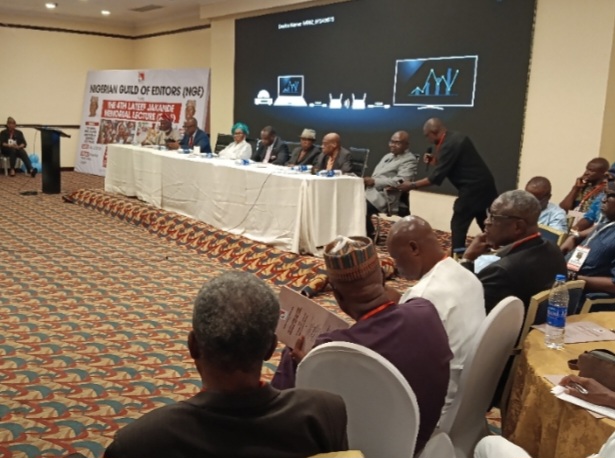
He spoke on Thursday while delivering the Fourth Annual Lateef Jakande Memorial Lecture organised by the Nigerian Guild of Editors in Lagos. The lecture was titled, “Media, INEC, Voters and the Path to Credible Elections.”
The academic described the build-up to the 2027 elections as a defining moment for the country’s democracy, arguing that credible elections were impossible unless all critical stakeholders fulfilled their constitutional responsibilities.
He said, “For credible elections to take place in our country, the media, INEC and voters have a role to play.”
Akhaine painted a grim picture of Nigeria’s democratic environment, arguing that the country suffers from “state capture,” weak institutions, declining political culture and widespread public distrust in governance.

According to him, executive dominance over other arms of government, insecurity across large parts of the country and the monetisation of politics have weakened democratic institutions and produced an elite recruitment process that rewards wealth rather than merit.
He warned that citizens increasingly viewed themselves as subjects rather than active participants in governance, creating a dangerous disconnect between the electorate and democratic institutions.
The professor stressed that elections remain the cornerstone of representative democracy because they provide citizens the opportunity to choose leaders, hold governments accountable and ensure peaceful transfer of power.
He, however, lamented that Nigeria’s electoral history had fallen far short of these democratic ideals.
Tracing elections from the colonial era to the Fourth Republic, Akhaine argued that almost every electoral cycle had been dogged by controversy.

He recalled allegations surrounding the 1959 elections, the violence that marred the 1964 and 1965 polls, the “12 two-thirds” constitutional controversy after the 1979 presidential election and widespread vote-buying during the aborted Third Republic.
According to him, the country’s democratic journey has remained troubled since the return to civil rule in 1999.
“Since the commencement of the Fourth Republic, we have had seven general elections and the eighth is in the offing. None of the general elections could be said to have been free and fair; they were variously dogged by malpractices that robbed them of any credibility,” he said.
Akhaine cited the controversial 2003 elections, the widely criticised 2007 polls and recurring allegations of electoral fraud as evidence that Nigeria had yet to establish an electoral system capable of producing outcomes widely accepted by citizens.
He noted that credible elections were undermined by ballot stuffing, voter intimidation, gerrymandering, vote-buying, abuse of incumbency and manipulation of public perception.
The professor urged INEC to consolidate recent electoral reforms by strengthening technological innovations, guaranteeing transparent result management and protecting its institutional independence.
While acknowledging improvements such as electronic accreditation and result transmission, he renewed calls for deeper reforms, including implementing recommendations of the Justice Mohammed Uwais Electoral Reform Committee, particularly removing the President’s power to appoint the INEC chairman.
He argued that greater institutional independence would strengthen public confidence in election management.
Akhaine also assigned a critical responsibility to the media, warning journalists against becoming tools of propaganda or misinformation as political campaigns intensify.
He said the constitutional responsibility imposed on the media to hold government accountable would become even more important ahead of the 2027 elections.
The professor warned that the explosion of social media, fake news, artificial narratives, trolls and disinformation posed fresh threats to electoral credibility.
Quoting political scientist Francis Fukuyama, he cautioned that accurate information no longer automatically triumphs over falsehood in the digital age.
“The media must stand by the truth,” he said, adding that journalists must remain faithful to facts while resisting political pressure and moderating inflammatory narratives capable of undermining public confidence in elections.
He equally challenged voters to reject financial inducements and ethnic or sectional considerations in choosing leaders.
According to him, sustained voter education is essential to reducing vote-buying and encouraging informed participation in the electoral process.
He called on INEC, civil society organisations and the media to intensify civic education campaigns before the 2027 polls.
Akhaine maintained that Nigeria’s democratic future would depend on collective commitment by electoral authorities, journalists, political parties and citizens to protect the sanctity of the ballot.
“If these critical stakeholders play their role, it is my conviction that the Nigerian democratic train would be steered on the right course,” he said.