


Absence of ADC candidate raises questions as major contenders pledge issue-based campaigns ahead of crucial presidential election

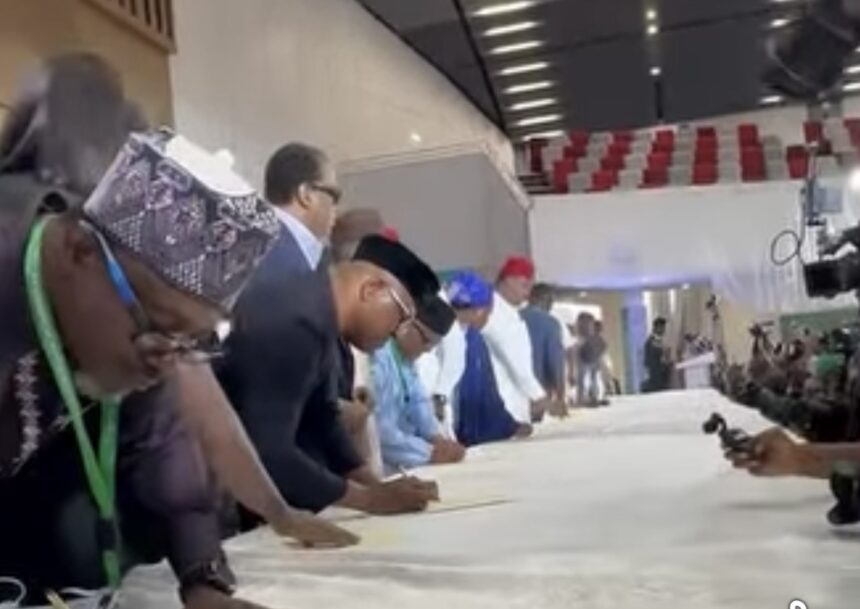
Former Vice-President Atiku Abubakar was conspicuously absent on Tuesday as President Bola Tinubu, Peter Obi, Omoyele Sowore and other presidential candidates signed the first National Peace Accord ahead of the 2027 general election in Abuja. The African Democratic Congress (ADC), the platform on which Atiku is campaigning for the presidency, was also notably absent from the ceremony.
The absence is politically significant. Atiku is one of the principal opposition contenders seeking to unseat Tinubu in 2027 and has emerged as the presidential candidate of the ADC after the opposition coalition adopted the party as its platform. The ADC has formally presented Atiku and former Rivers State governor Rotimi Amaechi as its presidential and vice-presidential ticket.

The accord was signed in Abuja by participating presidential, governorship and National Assembly candidates, political party chairmen and other political leaders. INEC Chairman Joash Amupitan was also present.
Tinubu did not attend personally but was represented by George Akume, Secretary to the Government of the Federation, who delivered the President’s address.
The National Peace Committee, led by former Head of State Abdulsalami Abubakar, Sultan of Sokoto Muhammad Sa’ad Abubakar and Catholic Bishop Matthew Hassan Kukah, convened the event as part of efforts to prevent the kind of violence, inflammatory rhetoric and political tensions that have repeatedly accompanied Nigerian elections.

While Peter Obi, the Nigeria Democratic Congress (NDC) presidential candidate, and Sowore of the African Action Congress signed the pact, Atiku’s absence immediately stood out because of his position in the emerging opposition contest.
Atiku’s 2027 campaign is already being framed as a major challenge to Tinubu’s re-election bid. He won the ADC presidential primary in May, defeating Amaechi and businessman Mohammed Hayatu-Deen, before the former Rivers governor was subsequently selected as his running mate.
The ADC has also moved to establish the legal foundation for the ticket. In July, Atiku welcomed a Court of Appeal judgment restoring the registration of the ADC and other affected parties after a Federal High Court had ordered their deregistration.
INEC subsequently published the nomination documents of Atiku and Amaechi in August, although the commission stressed that publication did not constitute the final list of candidates.
Against that background, the absence of the ADC flag bearer from an event specifically designed to secure commitments from presidential candidates to peaceful and issue-based campaigns is bound to attract political attention.
It also comes at a delicate stage in the opposition’s preparations, with the coalition still seeking to consolidate its structure and present itself as a credible alternative to the ruling All Progressives Congress.
Representing Tinubu, Akume acknowledged the intensity of Nigerian political contests but urged politicians to place the national interest above their personal ambitions.
He said elections since the return to democracy in 1999 had generated considerable anxiety because of the intense struggle for political power.
However, he argued that improvements in electoral management and technology had strengthened the credibility of the process and increased voters’ confidence that their ballots could count.
Akume appealed to politicians to avoid exploiting religion and ethnicity for electoral advantage.
“We may exchange occasional political jabs, but as members of the same household, nation and family, we must never resort to divisive, primordial sentiments, religion and ethnicity as tools for seeking power,” he said.
He urged candidates to campaign on policies and competing ideas rather than personal attacks, stressing that victory or defeat should not come at the expense of Nigeria’s stability.
Obi’s participation was particularly notable because he remains one of the major figures in the opposition landscape and was a central participant in the political realignment that followed the 2023 presidential election.
Speaking at the ceremony, the NDC candidate said he was participating in the political process because he wanted to change it.
He also told Nigerians that they should reject candidates who violate the principles contained in the peace accord.
His position effectively places the responsibility for enforcing the pact partly on the electorate: politicians who campaign violently or exploit divisive sentiments, he suggested, should pay a political price at the ballot box.
Sowore also signed the accord, adding another opposition voice to the commitment against electoral violence.
The signing comes against a history of Nigerian elections in which peace agreements have often struggled to restrain political actors once campaigns become intense.
That history explains why the latest initiative is being viewed with a degree of caution. The National Peace Committee has facilitated similar agreements in previous election cycles, seeking commitments from candidates to accept democratic rules, restrain inflammatory rhetoric and respect the outcome of the electoral process.
But the real test has never been the ceremony itself. It has been whether political parties and their supporters honour the commitments when the contest becomes fiercely competitive.
That challenge could become particularly acute in 2027.
Tinubu is seeking another term in office, while Atiku is returning to the presidential contest as the opposition coalition’s principal candidate. Obi, who made a strong showing in the 2023 election, is also positioning himself as a major alternative, while other candidates will seek to exploit dissatisfaction with the established political order.
The election is therefore likely to be intensely contested across regional, ethnic, religious and economic fault lines.
The peace accord consequently carries significance beyond the signatures put on paper in Abuja.
For Tinubu’s administration, it is an opportunity to demonstrate that an incumbent seeking re-election can oversee a competitive election without abusing state power or allowing political institutions to be weaponised.
For the opposition, it is equally a test of whether its leaders can compete aggressively while respecting democratic rules and avoiding the politics of permanent confrontation.
And for the electorate, the most important question will be whether the promises made in Abuja translate into restraint on the campaign trail.
Atiku’s absence gives the development an additional political edge. His ADC ticket represents one of the principal challenges to Tinubu’s 2027 ambition, making his participation—or non-participation—in initiatives designed to guarantee a peaceful election a matter of more than ceremonial interest.
Ultimately, however, the credibility of the 2027 contest will not be determined by who signed a document in Abuja. It will be determined by whether the candidates, parties, security agencies, electoral officials and supporters respect the rules when the stakes become highest.
For a country with a long history of election-related tension, that is the real peace accord Nigeria needs.