

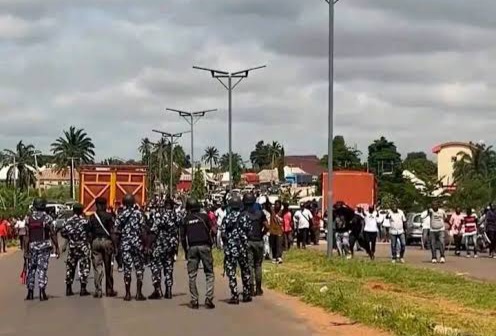

The presidential candidate of the Nigeria Democratic Congress, Peter Obi, and the Benue State Government on Tuesday traded accusations after youths blocked his convoy and prevented him from visiting Yelwata, where more than 200 people were killed in a June 2025 massacre.

The confrontation occurred along the Gboko Road in Makurdi, near the Nigerian Air Force Base and Makurdi Airport, where the youths barricaded the road and chanted, “We don’t want Peter Obi.”
The blockade disrupted traffic for several hours and forced Obi’s convoy to turn back to the airport before he eventually returned to Jos, Plateau State.

Obi, who said he had travelled to Benue to sympathise with families of victims of the Yelwata massacre, alleged that the youths had been mobilised by a government aide to stop him from reaching the community.
But the Benue State Government denied any involvement, accusing the former Anambra State governor of failing to formally notify the government of his visit and of attempting to turn the incident into a political controversy.

The police account, however, appeared to contradict a key part of the state government’s position.
The Benue State Commissioner of Police, Cletus Nwadiogbu, confirmed that the command had been notified of Obi’s movement and that security personnel had been deployed for the visit.
The CP said he had directed the Assistant Commissioner of Police, Operations, to personally lead the security team accompanying Obi.
“I also asked the AC Operations to personally lead the men, but unfortunately, on his arrival, we heard that the youth blocked the road because they didn’t want to see him,” Nwadiogbu said.
He added that the police were investigating why the youths blocked the presidential candidate’s convoy.
“We have tactically managed the situation for now, but we are not letting it go. We must get to the bottom of it to know why the youths said somebody cannot move,” he said.
The command’s spokesperson, DSP Peter Aondongu, had earlier confirmed that the police were aware of Obi’s visit and provided security for the movement.
“The reason the convoy was blocked by some youths is still unknown. We are monitoring the situation and investigating the circumstances surrounding the incident,” he said.
Obi, speaking at the scene in a video posted by News Central Television on X, said he was informed that youths had been mobilised to prevent him from proceeding to Yelwata.
“I was told that youths, led by an SA to the government, have decided to block the road and make sure I don’t go there,” he said.
The former Anambra governor condemned the development as unacceptable, arguing that the youths themselves were victims of poverty and insecurity and should not be used for political purposes.
“The rascality they are bringing into this country is totally unacceptable. People are being killed every day in Benue,” Obi said.
He insisted that his visit was humanitarian and that relevant security authorities had been informed of his itinerary.
Obi had planned to visit families of victims of the June 13–14, 2025 Yelwata attack, one of the deadliest recent attacks in Benue.
More than 200 residents were reportedly killed while homes and property were destroyed, triggering nationwide condemnation and renewed concerns over worsening insecurity in the state.
NDC: Visit was not campaign rally
The Benue governorship candidate of the NDC, Prof Terhemba Shija, said the party had duly notified the police and the Department of State Services of Obi’s visit.
He argued that the visit was intended to enable Obi to sympathise with the bereaved families and was not a campaign rally.
“Is Obi not a presidential candidate? INEC has lifted the ban on campaign and we duly informed the police and DSS about his visit to the state. They deployed police and DSS to be with us,” Shija said.
He described the blockade as a sign of fear, arguing that there was no justification for stopping Obi from visiting victims of the massacre.
Benue govt denies involvement
The state government rejected the allegation that Governor Hyacinth Alia or his administration sponsored the youths.
The Commissioner for Information and Orientation, Solomon Iorpev, said Obi should have formally written to the state government before visiting, particularly because of his status as a former governor and presidential candidate.
“A high-profile person who has been a former governor of a state is coming into the state; he should have written a letter to the state government,” Iorpev said.
According to him, the government was responsible for ensuring the safety of high-profile visitors but could not effectively do so without prior notification.
He said he did not know the identity of the youths who blocked the road, suggesting that the incident might have coincided with the movement of youths from the state’s 23 local government areas.
The Chief Press Secretary to Governor Alia, Kula Tersoo, also dismissed Obi’s allegation as unfounded.
Tersoo said the governor had no connection with the incident and accused Obi of attempting to drag the state government into what he described as an internal political dispute within the NDC.
He said the governor did not use political thugs and relied on recognised security agencies to maintain law and order.
The CPS maintained that the state remained open to political actors who visited peacefully.
Outrage over blockade
The incident has drawn condemnation from opposition figures and civil society organisations, with critics warning that political intolerance could undermine the 2027 elections.
The Peoples Democratic Party governorship candidate in Benue, Chief Michael Aondoakaa, described the incident as an assault on democracy and Nigerians’ constitutional right to freedom of movement.
He called for an impartial investigation and prosecution of anyone found responsible.
Former Sokoto State governor, Aminu Tambuwal, also condemned the blockade, describing it as “unacceptable” and “undemocratic.”
He warned that allowing political actors or their supporters to determine who could enter parts of the country would be dangerous for democracy.
“Political differences must never become an excuse for intimidation, violence or brigandage,” Tambuwal said.
The NDC equally demanded an immediate investigation and prosecution of those responsible.
The National Electoral Accountability Consortium and Tap Initiative for Citizens’ Development also urged the police to conduct a prompt and transparent investigation.
The groups said political disagreement was legitimate but warned that violence and intimidation must not become part of electoral competition.
Obi moves to Plateau
After abandoning the Yelwata visit, Obi travelled to Plateau State, where he visited communities affected by attacks and internally displaced persons.
He criticised the continued existence of IDP camps, saying displaced Nigerians should be returning to their ancestral homes rather than spending years in camps.
“As long as you are in an IDP camp, Nigeria is in an IDP camp. It is when you go home that Nigeria is at home,” Obi told displaced persons.
He called on the Federal Government to take decisive action against killings, kidnappings and displacement, insisting that prayers alone could not solve the security crisis.
“Government must act. The people coming to kill are not from the moon. We know them. The Nigerian government should be able to deal with it,” he said.
The Benue controversy comes as political activities intensify ahead of the 2027 general election, with opposition parties seeking to penetrate states regarded as strongholds of rival political parties.
The incident has consequently raised fresh concerns about political tolerance, freedom of movement and the ability of presidential candidates to campaign and engage voters across the country without intimidation.