

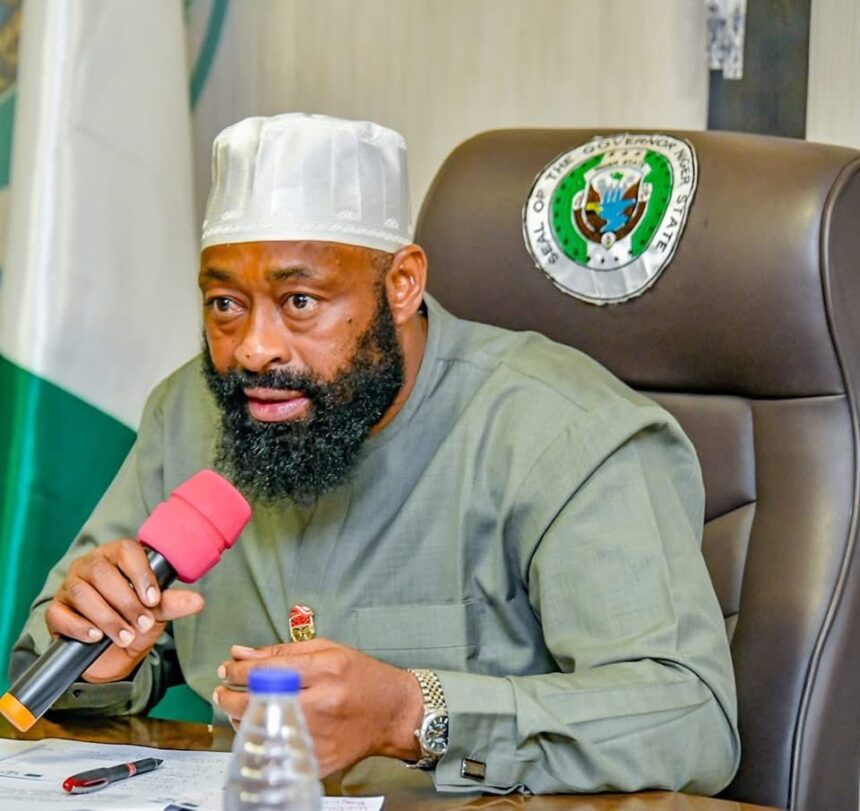

Governor of Niger state, Umar Bago, says male children are abandoning junior secondary schools in the state for artisanal mining, which they consider more lucrative than education.

Bago spoke on Channels Television’s Sunday Politics programme, where he described artisanal mining as a menace in the state.
The governor’s remark follows the death of 37 suspected illegal miners in the custody of the Nigeria Security and Civil Defence Corps (NSCDC).

The victims were among scores of suspects arrested during operations conducted on September 15 and 16 around Lt Gen Mohammed Inuwa Wushishi Estate in Minna, the Niger state capital.
Following the development, the federal government suspended Suberu Aniviye, the Niger state NSCDC commandant, and 23 other officers, ordering a full investigation into the circumstances surrounding the deaths.

Bago said a report by the United Nations Children’s Fund (UNICEF) on Shiroro and other LGAs in the state projected that there could be no male children in JSS2 by 2027 because of artisanal mining.
“We know that gold mining in Niger state has become habitual,” he said.
“The UNICEF report on Shiroro and other LGAs says by 2027, there will not be a single male child in Grade 8, that is JSS2, Grade 7, because all of them are into artisanal mining. They have left classrooms and are not in schools. This is a problem for us.”
The governor said the situation was difficult to tackle because the state government lacked direct control over security agencies and could not unilaterally order arrests or other operations against miners.
He said many of the children were unwilling to return to school after experiencing the financial gains from mining.
“But these people, because they have tested the mining money, cannot leave the site,” Bago said.
“We need decisive action. We need an executive order from the presidency, from the ministry of mineral resources, to ban mining in certain locations where we have seen they are problematic. Once that is done, it can be enforced.”
Bago lamented that many residents in areas known for agricultural practices have all taken to mining.
He cited Shiroro as an example, saying the area had historically been largely agrarian before residents abandoned farming for artisanal mining.
“The amount of energy they dissipate in this mining business, if they put half of it into farming, they will do better,” he said.
“Shiroro used to be one of the biggest local governments that was agrarian, but they have abandoned farming for mining. It’s a menace, and there must be deliberate action.”
Asked whether his administration would take stronger action against parents who allow their children to stay out of school and engage in mining, Bago said the government would consider the matter.
“We are going to look at that because it’s a very tall order,” he said.
The governor said the scale of illegal economic activities in Niger made the problem difficult to address, noting that the state occupies about 10 percent of Nigeria’s landmass and has extensive mineral resources.
“Mining, poaching and logging are serious businesses,” he said.
“Niger state has the largest concentration of forests and trees in West Africa, and people are there doing logging.
“It’s not just about digging the ground. Even cutting trees, making charcoal, killing animals and selling their hides and woods — all these things are happening.”
Bago said illegal mining, poaching and logging also contributed to insecurity in the state, adding that foreigners were involved in financing and operating some of the activities.
“You have expatriates from other countries in our domain operating and funding these activities, and you are limited because you are constrained,” he said.
According to him, security agencies were aware of the activities but faced limitations because some of the foreign operators had licences.
“The military knows about it. The DSS knows about it. The police know about it. They are constrained because these expatriates have licences,” he said.
“So it’s not about the governor. The governor is limited to only his cabinet. The governor is just a chief security officer of a state by mouth. It’s rhetorical. There’s no power. You can’t give any order.”