

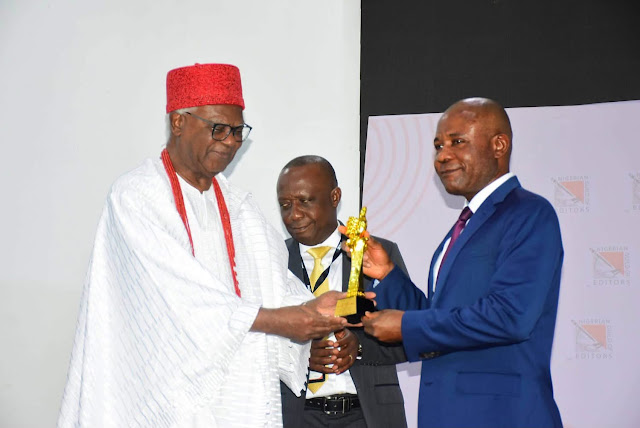

The Nigerian Guild of Editors has called for constitutional and electoral reforms that would require a presidential candidate to secure at least 50 per cent of votes cast to win an election.

The Guild also proposed that electoral disputes be concluded before the swearing-in of declared winners, arguing that prolonged litigation over election results could undermine public confidence in the democratic process.
The recommendations were contained in a communiqué issued at the end of the 22nd All Nigeria Editors Conference held in Enugu from September 24 to 26, 2026.
The communiqué was signed by the NGE President, Eze Anaba, and the General Secretary, Onuoha Ukeh.

The conference, with the theme, “The Ballot, the Media and the Task of Keeping Democracy Alive,” brought together more than 500 editors, publishers and senior media practitioners, alongside political, traditional, religious, academic, regulatory and development-sector leaders.
The editors called for a constitutional framework providing for a run-off where no presidential candidate secures up to 50 per cent of the votes cast.

They also demanded reforms to the appointment of the Chairman, National Commissioners and Resident Electoral Commissioners of the Independent National Electoral Commission, as well as State Electoral Commissioners.
The Guild further called for a review of restrictions on ordinary voters challenging election results and advocated constitutional provision for independent candidacy.
It expressed concern over the growing role of electoral tribunals in determining political outcomes, saying elections should remain the ultimate means of determining winners.
The editors said electoral disputes should be resolved within clearly defined timelines and, preferably, before the swearing-in of declared winners.
The Guild said voter apathy was being fuelled by poor governance, electoral violence and intimidation, administrative shortcomings, declining confidence in the electoral process and concerns over the relationship between election results and subsequent judicial decisions.
It noted that judicial interventions in some electoral disputes had created perceptions among sections of the public that court decisions could displace outcomes recorded at the ballot box.
The NGE, however, stressed the need to preserve judicial independence while advocating electoral adjudication that is timely, transparent, predictable and impartial.
The editors also raised concerns over the growing threat posed by artificial intelligence, deepfakes, voice cloning and automated networks to electoral information ahead of the 2027 general elections.
They warned that fabricated election results, cloned voices of public officials, forged documents, manipulated result sheets and fake reports attributed to established media organisations could be generated and distributed rapidly.
According to the Guild, the greater danger was the erosion of public trust when citizens could no longer distinguish authentic information from fabricated content.
It consequently urged newsrooms to institutionalise fact-checking and verification systems and incorporate digital-verification, deepfake-detection and forensic tools into their editorial operations.
The Guild reaffirmed the Nigerian Media Code of Election Coverage (Revised 2022), jointly endorsed by major media professional bodies, and urged news organisations to adopt the code and train their journalists ahead of the 2027 elections.
It also called on governments and political actors to guarantee equitable access to media space for both government and opposition voices while respecting editorial independence.
The NGE stressed that editorial neutrality did not require journalists to remain silent in the face of verified wrongdoing or create false equivalence between established facts and unverified claims.
It urged journalists to practise evidence-based journalism by reporting both verified government achievements and failures without exaggeration or suppression.
The Guild further declared that election security must include the protection of journalists covering elections.
It urged security agencies and political actors to ensure that journalists were not threatened, attacked or obstructed from independently observing and reporting electoral activities.
The editors also urged INEC to sustain nationwide readiness assessments, strengthen cybersecurity and electoral technology partnerships, guarantee the technical integrity of the Bimodal Voter Accreditation System and protect the commission’s institutional independence.
They insisted that electoral technology must remain subject to human oversight, transparency, accountability and legal verification.
On terrorism reporting, the Guild endorsed the principle, “Inform, Don’t Amplify,” urging newsrooms to report terrorist attacks responsibly without inadvertently providing publicity, recruitment opportunities or propaganda platforms to terrorist organisations.
It advised journalists to identify terrorist claims as such until independently verified and avoid reproducing propaganda, recruitment messages, slogans or graphic material without compelling editorial justification.
The Guild reaffirmed that the Nigerian media should remain “pro-Nigeria, pro-Ballot and pro-People”, rather than align with any political party.
It said the credibility of Nigeria’s democracy ultimately depended on citizens being able to make informed choices, vote freely and have confidence that their votes would be accurately counted and respected.
The conference was chaired by the Obi of Onitsha, Igwe Nnaemeka Alfred Achebe, while the Archbishop Emeritus of Abuja, John Cardinal Onaiyekan, delivered the keynote address.
Vice-President Kashim Shettima participated virtually as Special Guest of Honour, while Enugu State Governor, Peter Mbah, was the Chief Host.