

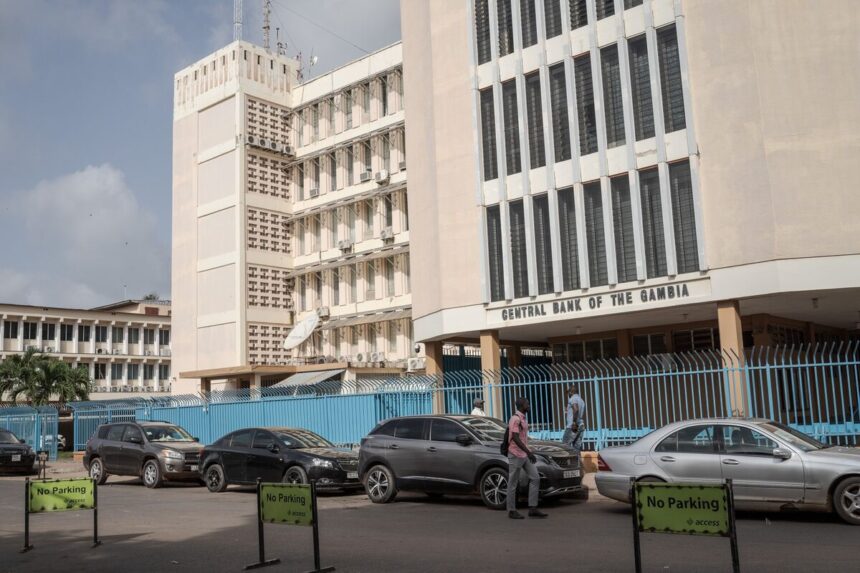

A new employment directive by The Gambia’s central bank could cost 57 Nigerian banking professionals their jobs, following an order requiring commercial banks in the country to replace affected foreign employees with qualified Gambian nationals by December 31, 2026.

The Nigerians in Diaspora Commission (NiDCOM) disclosed this on Tuesday, expressing concern over the potential impact of the policy on Nigerians working in the West African country.
The directive, issued by the Central Bank of The Gambia (CBG) in a circular dated September 16, 2026, requires commercial banks to gradually replace non-Gambian employees while ensuring skills transfer and uninterrupted operations.

According to NiDCOM, the 57 Nigerians potentially affected work in four Nigerian-origin banks operating in The Gambia: Access Bank, FirstBank, Guaranty Trust Bank (GTBank) and Zenith Bank.
The commission’s Chairman and Chief Executive Officer, Abike Dabiri-Erewa, said the affected professionals reportedly possess valid residency and work permits and have made significant contributions to the Gambian banking industry.
She acknowledged The Gambia’s right to promote local employment and develop its workforce but urged the authorities to implement the policy fairly.
“While NiDCOM recognises Gambia’s right to promote local employment and develop its workforce, such policies must be implemented fairly and in a manner that respects existing employment arrangements, legitimate work authorisations and the principles of African solidarity and regional integration,” she said.

The Gambian central bank said the directive followed a meeting with managing directors of commercial banks operating in the country on August 27, 2026.
According to the regulator, an industry-wide study revealed a relatively high concentration of non-Gambian nationals in the banking sector, alongside employees covered by existing expatriate arrangements.
Consequently, it directed banks to adopt a phased replacement programme, giving preference to suitably qualified Gambian nationals and making appropriate provisions for knowledge and skills transfer.
The circular, signed by the CBG’s Second Deputy Governor, Dr Paul J. Mendy, instructed all commercial banks to complete the exercise by December 31, 2026, in compliance with the country’s labour laws and employment guidelines.
The deadline leaves affected Nigerian lenders with less than two months to review their staffing arrangements and implement the required changes.
A list of licensed banks published by the Gambian central bank identifies Access Bank (Gambia) Limited, First Bank Gambia Limited, GTBank (Gambia) Limited and Zenith Bank Gambia among the institutions operating in the country.
The development comes as Nigerian financial institutions deepen their presence across African markets, with foreign subsidiaries becoming increasingly important contributors to group earnings.
Research by Nairametrics showed that four Nigerian banking groups generated a combined N1.949 trillion in profit before tax from their foreign subsidiaries in 2025, representing 54.77 per cent of their combined group profit of approximately N3.56 trillion.
United Bank for Africa (UBA) led the pack, recording N671.1 billion in pre-tax profit from its international operations across 20 African countries and the United Kingdom. The figure represented about 92 per cent of its group pre-tax profit of N729.785 billion before adjustments.
Access Holdings followed with N571.305 billion from its 15 offshore subsidiaries, representing a 24.2 per cent increase over the previous year.
GTCO’s foreign subsidiaries generated N375.322 billion in pre-tax profit, up from N273.142 billion in 2024, while Zenith Bank recorded N331.758 billion from its four foreign subsidiaries in Ghana, Sierra Leone, The Gambia and the United Kingdom.