

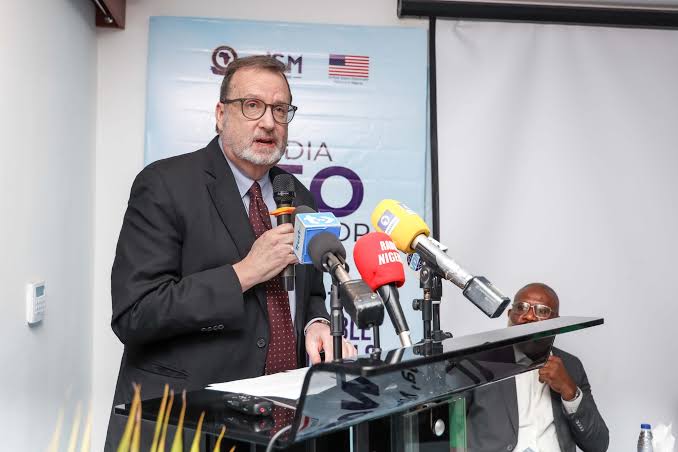

The heads of missions from the United States, United Kingdom, Finland, Norway, and Canada jointly urged the Nigerian government to reform the 2015 Cybercrimes Act, warning that its misuse threatens freedom of expression and hampers Nigeria’s digital and economic potential.

In a joint statement to mark Democracy Day, the diplomats congratulated Nigerians on 26 years of democratic governance and highlighted free expression as a cornerstone of democracy, citing President Bola Tinubu’s 2024 remarks emphasising the need for “diverse perspectives and viewpoints.” They noted that Nigeria’s constitution enshrines the right to freedom of expression, which is vital for healthy democratic debate and civic participation.
While acknowledging the Cybercrimes Act’s original intent to combat cyber fraud and cyber attacks, which cost Nigeria an estimated $500 million annually, the envoys expressed concern over the law’s broad and vague provisions.

They referenced Nigeria’s National Human Rights Commission’s warning that the Act’s ambiguous terms like “false information,” “cyberstalking,” “harassment,” and “insult” create room for abuse, leading to arrests and prosecutions of journalists, activists, bloggers, and ordinary citizens for expressing dissent.
The envoys highlighted the case of activist and author Dele Farotimi, who faced 12 counts of cybercrime after exposing alleged judicial corruption in a book and podcast. Farotimi was detained, transported across state lines in handcuffs, and charged, though the charges were eventually withdrawn. His experience exemplifies how the Act can be weaponised to stifle free speech and undermine democratic engagement.

They warned that misuse of the Cybercrimes Act not only weakens democratic accountability but also risks deterring investors and innovators critical to Nigeria’s economic growth. The law’s vague language creates uncertainty for businesses and investors, hindering digital industry development and Nigeria’s reputation abroad.
The heads of mission welcomed Nigeria’s Minister of Information and National Orientation, Mohammed Idris’s commitment to collaborate with the National Assembly and stakeholders to review the Act. They called on lawmakers to narrow the definitions of key terms to prevent erroneous use against critics and ensure the law aligns with constitutional values and international human rights standards.
They emphasised that reform is essential for Nigeria to realise its potential as a democratic digital powerhouse, balancing citizen protection with human rights, including free expression. The diplomats urged that the review process be prioritized, transparent, and inclusive of public consultation, citing support from the Council of Europe’s Global Action on Cybercrime project, which provides funding and technical assistance for the review.
The statement was signed by Richard M. Mills, Jr., U.S. Embassy; Richard Montgomery, British High Commission; Sanna Selin, Embassy of Finland; Svein Baera, Embassy of Norway; and Pasquale Salvaggio, Canadian High Commission
Their call underscores the critical need to protect free speech as a fundamental democratic right while fostering a conducive environment for economic innovation and growth in Nigeria’s digital age.