
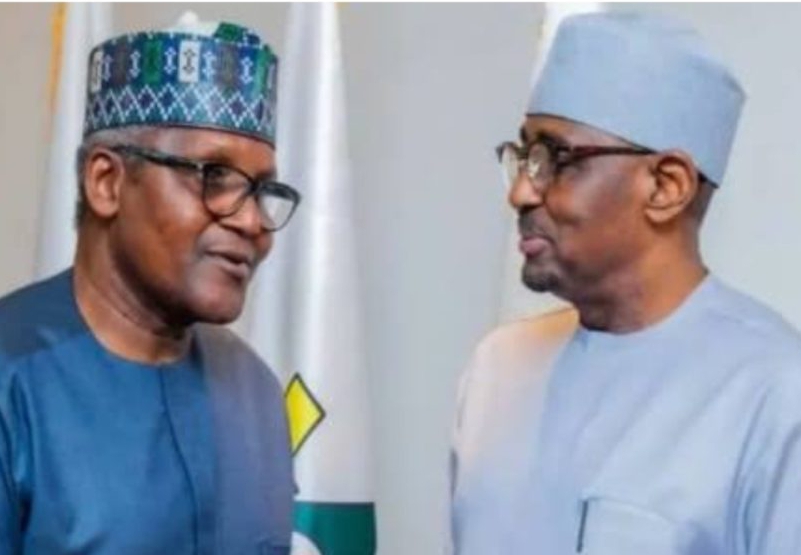
The Chief Executive Officer of the Nigerian Midstream and Downstream Petroleum Regulatory Authority (NMDPRA), Farouk Ahmed, has forcefully rejected allegations that he used illicit funds to finance his children’s education abroad, describing the claims as “misleading, ill-timed and driven by interests unsettled by regulatory reforms in the petroleum sector.”

Ahmed was responding to public allegations and a petition sent to the Independent Corrupt Practices and Other Related Offences Commission (ICPC) by billionaire mogul, Aliko Dangote alleging that he was corrupt and living above his means by spending about $7 million on his children’s education in Switzerland within six years and also in the United States as a public official, which demands an official in investigation.
The allegations stem from Dangote’s accusations that the regulator has been trying to sabotage his $20 billion refinery by issuing “reckless” import licenses while his tanks were full on unsold products.

The feud began after Dangote’s July 2024 refinery launch, pitched as ending import dependence, but NMDPRA’s recent actions – including exposing market adulteration – have fueled accusations of bias. Industry analysts view Farouk’s stand as a litmus test for post-PIA independence.
In a detailed statement released on Tuesday, Ahmed said the allegations—particularly claims that he spent about $5 million on Swiss secondary education for his children—were designed to cast doubt on his integrity at a time when the regulator is tightening oversight of fuel imports, licensing and product quality.

“I welcome scrutiny of my finances,” Ahmed said, “but these claims demand context that only three decades of public service can provide.”
Ahmed traced his career to 1991, when he joined Nigeria’s petroleum administration through a competitive civil service process, rising from a junior engineer in the former Department of Petroleum Resources (DPR) to head of the NMDPRA following the passage of the Petroleum Industry Act (PIA).
According to him, his professional journey cut across technical divisions including crude oil marketing, gas supply monitoring and downstream operations—areas he described as governed more by engineering standards and market realities than political considerations.
By 2012, Ahmed said he was appointed General Manager of the Crude Oil Marketing Division, overseeing Nigeria’s oil revenue flows during a period of global price volatility. He later became Deputy Director in 2015, a role that placed him at the centre of downstream regulation amid fuel scarcity and pricing disputes.
His appointment as NMDPRA chief executive in 2021, he said, came with a clear mandate to implement the PIA without favour or regulatory capture.
“Reforming a sector long characterised by opacity and preferential treatment was bound to create resistance,” he said.
Responding directly to the education funding claims, Ahmed said three of his four children received merit-based scholarships covering between 40 and 65 per cent of tuition costs, details he said are verifiable by investigators.
He added that his late father, a Northern Nigerian businessman who died in 2018, had established education trust funds for his grandchildren, in line with extended family traditions.
“When scholarships, family support and my own savings over three decades are properly accounted for, my financial contribution is entirely consistent with my income and service record,” he said.
Ahmed disclosed that his annual compensation as NMDPRA CEO is about ₦48 million, inclusive of allowances, a figure he said is reflected in publicly available audited reports. He added that he has submitted annual asset declarations to the Code of Conduct Bureau (CCB) since entering public service.
In a rare move, the NMDPRA boss said he had authorised educational institutions attended by his children to release financial records to authorised Nigerian investigators.
Ahmed suggested that the resurgence of the allegations coincided with recent regulatory actions by the NMDPRA, including enforcement measures that uncovered substandard petroleum products and the introduction of stricter licensing and pricing transparency rules.
He dismissed claims that the agency’s fuel import licensing approvals amounted to “economic sabotage,” insisting that the decisions were in line with Section 7 of the PIA, which mandates the regulator to ensure supply security and prevent scarcity.
“No responsible regulator can rely on a single-source supply model, regardless of ownership,” Ahmed said, adding that import licences are issued when domestic supply falls short.
Since 2021, he noted, the authority has published monthly supply reports, launched public data portals on pricing and licensing, and subjected itself to international audits. He said these reforms have reduced fuel queues, curbed diversion through depot-to-station tracking and enforced quality standards without discrimination.
In a move reminiscent of recent high-profile regulatory disputes in the sector, Ahmed formally invited oversight agencies to investigate him.
He called on the CCB to review all his asset declarations since 1991, urged the Economic and Financial Crimes Commission (EFCC) to examine his financial transactions, and asked the National Assembly to exercise its oversight powers over his tenure.
“I will cooperate fully and answer all questions under oath if required,” he said, adding that any probe should be professional and free from “predetermined conclusions driven by commercial interests.”
Ahmed acknowledged that the reforms he is spearheading have created both winners and losers in the petroleum industry, arguing that resistance from those who benefited from past opacity was inevitable.
“What I cannot accept is the weaponisation of my family’s privacy to advance commercial agendas,” he said. “If the price of regulatory independence is personal attacks, I accept that price.”
He concluded by reaffirming his commitment to the NMDPRA’s mandate, insisting that transparency and independence, though contentious, are in Nigeria’s long-term interest.
“Investigate everything,” Ahmed said. “My record—financial and professional—will withstand any legitimate inquiry.”