
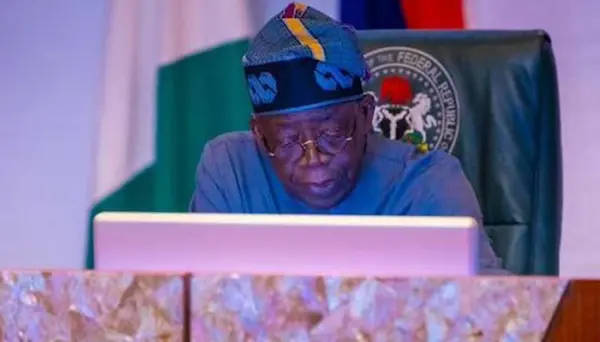

President Bola Tinubu has forwarded the names of two new heads of Nigeria’s key petroleum regulatory agencies to the Senate for confirmation following the abrupt resignations of their predecessors.

Bayo Onanuga, Special Adviser to the President on Information and Strategy, confirmed the developments in a statement from the State House.
The move comes after Farouk Ahmed stepped down as Chief Executive of the Nigerian Midstream and Downstream Petroleum Regulatory Authority (NMDPRA), and Gbenga Komolafe resigned from the Nigerian Upstream Petroleum Regulatory Commission (NUPRC).

Both officials, appointed in 2021 by former President Muhammadu Buhari, helmed the agencies established under the Petroleum Industry Act (PIA) to oversee midstream, downstream, and upstream operations in Nigeria.
Ahmed has been embroiled in controversy since the weekend after Aliko Dangote, chairman of his eponymous 650,000bpd refinery in Lagos accused him of corruption.

Dangote had petitioned the ICPC to probe how Ahmed as a public servant was was able to afford $7 million in school fees to educate his children in elite Swiss schools and Harvard University.
In separate letters to the Senate, President Tinubu urged expeditious approval for Oritsemeyiwa Amanorisewo Eyesan to lead the NUPRC and Saidu Aliyu Mohammed to head the NMDPRA. The nominees bring decades of high-level experience in Nigeria’s volatile energy sector, signaling the administration’s push for continuity and expertise amid ongoing reforms to boost local refining, gas utilization, and investment.
Eyesan, a University of Benin economics graduate, boasts nearly 33 years at the Nigerian National Petroleum Company (NNPC) and its subsidiaries. She retired in 2024 as Executive Vice President, Upstream, after serving as Group General Manager for Corporate Planning and Strategy from 2019 to 2023. Her tenure focused on strategic upstream development, positioning her as a steady hand for the NUPRC’s role in exploration and production regulation.
Mohammed, 68, hails from Gombe State and earned a Bachelor’s degree in Chemical Engineering from Ahmadu Bello University in 1981. On the same day as his nomination, Seplat Energy announced his appointment as an independent non-executive director. His illustrious career includes stints as Managing Director of the Kaduna Refining and Petrochemical Company and the Nigerian Gas Company, alongside chairmanships of the West African Gas Pipeline Company, Nigeria LNG subsidiaries, and NNPC Retail.
Mohammed also held the position of Group Executive Director and Chief Operating Officer for the Gas & Power Directorate at NNPC, where he shaped critical policies like the Gas Masterplan and Gas Network Code, and contributed to the PIA’s framework. He spearheaded major infrastructure projects, including the Escravos-Lagos Pipeline Expansion, the Ajaokuta-Kaduna-Kano (AKK) Gas Pipeline, and expansions at Nigeria LNG Train 7.
The resignations and nominations arrive at a pivotal moment for Nigeria’s oil industry, grappling with production shortfalls, subsidy removal aftershocks, and global energy transitions. Industry watchers anticipate the Senate’s swift action, given the agencies’ mandates to enforce PIA provisions on host community trusts, domestic gas pricing, and midstream investments.