

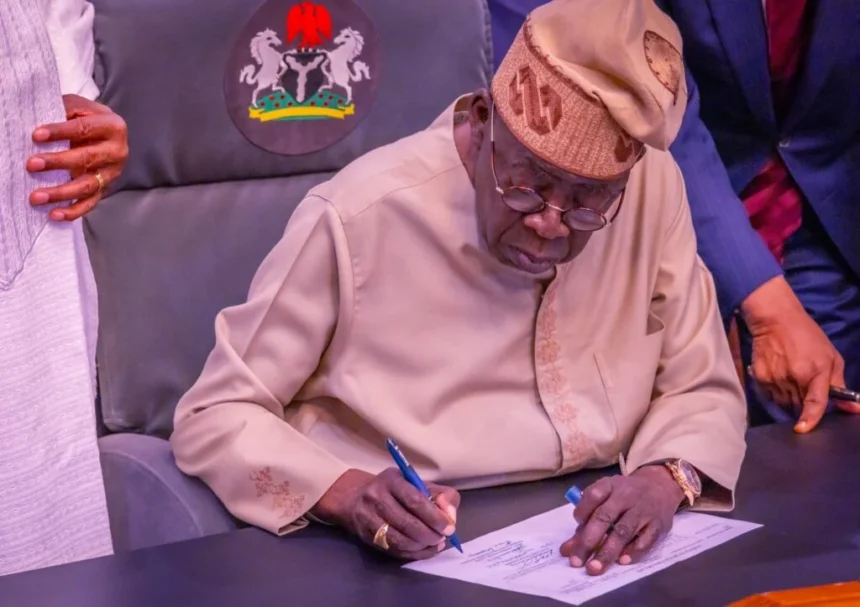

In a decisive move to reclaim Nigeria’s oil wealth, President Bola Ahmed Tinubu has signed an executive order compelling Nigerian National Petroleum Company Limited to remit oil and gas revenues directly into the Federation Account, effectively shutting down a series of deductions that have drained trillions of naira from federal, state and local government allocations.

The order, gazetted on February 13, represents one of the most aggressive fiscal interventions in Nigeria’s oil sector since the passage of the Petroleum Industry Act (PIA). At its core, it dismantles financial privileges embedded in the law that allowed NNPC to withhold substantial revenues before funds reached the Federation Account—the constitutional pool shared by the three tiers of government.
At stake is an estimated N1.42 trillion in 2025 alone—previously earmarked for two major deductions: a 30 per cent management fee on profit oil and profit gas from production and risk-sharing contracts and another 30 per cent Frontier Exploration Fund, designed to finance speculative exploration in frontier basins.

Under the new order, both deductions are scrapped.
The presidency argues that these entitlements far exceed global norms and have significantly weakened net oil revenue inflows. By eliminating them, the administration expects a substantial boost in distributable revenues and strengthen public finances at a time when Nigeria faces mounting fiscal pressures.
Beyond stripping NNPC of its management fee and exploration fund, the order restructures the entire remittance architecture of Nigeria’s upstream oil sector.
Operators under production sharing and related contracts must now pay Royalty Oil, Tax Oil, Profit Oil, and Profit Gas directly into the Federation Account, bypassing NNPC as intermediary.

Gas flaring penalties, previously paid into the Midstream and Downstream Gas Infrastructure Fund (MDGIF), will also flow straight to the Federation Account. Future spending from the MDGIF will be subject to public procurement rules, tightening oversight and accountability.
The executive order signals deeper discomfort within the presidency about NNPC’s hybrid role as both commercial operator and concessionaire.
Under the current framework, NNPC influences operating costs while simultaneously functioning as a commercial entity, a structure critics say creates competitive distortions and weakens accountability.
Tinubu’s intervention seeks to accelerate NNPC’s transition into a fully commercial enterprise, as envisioned by the PIA, while reinforcing federal control over mineral revenues under Section 44(3) of the Constitution.
To ensure swift implementation, Tinubu has constituted an inter-ministerial committee chaired by the Finance Minister and Coordinating Minister of the Economy. Members include the Attorney-General, Ministers of Budget and Petroleum Resources, the Chairman of the Nigeria Revenue Service, and the President’s Special Adviser on Energy.
The Nigerian Upstream Petroleum Regulatory Commission (NUPRC) will serve as the operational interface with licensees in integrated upstream and midstream arrangements.
This latest directive fits squarely within Tinubu’s reform playbook. Since assuming office in May 2023, he has prioritised fiscal consolidation, most notably through the removal of petrol subsidies, long blamed for draining public finances.
Nigeria, Africa’s largest oil producer, has long grappled with a troubling gap between crude production figures and actual government receipts. Subsidy regimes, crude theft, opaque accounting practices, and layered deductions have all contributed to weakened public revenues.
With this order, Tinubu is sending a clear message: oil revenues belong first in the national treasury.
Whether the move triggers legal, operational, or political resistance remains to be seen. But one thing is certain—the era of automatic deductions at NNPC has ended, and Nigeria’s oil cash flow is now firmly under presidential watch.