

Leaders of the major opposition political parties in Nigeria have rejected the Amended Electoral Act 2026, recently signed into law by President Bola Ahmed Tinubu.

Consequently, they asked the National Assembly to immediately commence a fresh process of amendment, accusing the ruling All Progressives Congress (APC) of plot to use the amendment to rig the 2027 elections.
ad
President Tinubu recently signed the Electoral Act into law, after an amendment by the National Assembly.

However, the process was dogged by controversy and protests from the opposition and civil society organisations, who insisted on the real time transmission of election results against the manual proviso included by the lawmakers.
Terrorists kill 22 in Kebbi, Adamawa
Schoolmates celebrate Walida’s release
Some opposition lawmakers also disagreed with the majority All Progressives Congress, APC lawmakers and staged a walk out in the process.

Addressing a press conference in Abuja on Thursday, the National Chairman of the New Nigeria People’s Party, NNPP, Alhaji Ajuji Ahmed, said leaders of Nigeria’s major opposition political parties have a shared aspiration to save democracy and Nigeria from impending failure and collapse.
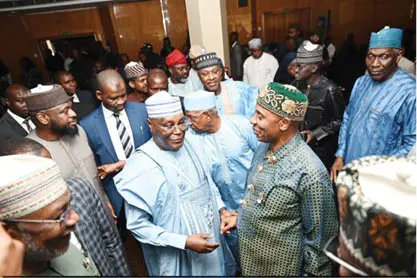
Some of the opposition leaders present at the briefing were former Vice President Atiku Abubakar, former Senate President and Chairman of the African Democratic Congress (ADC) David Mark, former Anambra governor and presidential candidate of the Labour Party in the 2023 general elections, Peter Obi and former governor of Rivers State Rotimi Amaechi. The opposition leaders comprised members of the African Democratic Congress (ADC) and the New Nigeria People’s Party (NNPP).
While describing the Electoral Act as “anti-democratic Electoral Act, 2026”, Ahmed said the opposition considered several provisions of the Act signed into law by President Tinubu as a “major offensive by the APC administration to subvert the will of the people in the 2027 general elections.”
The leaders, however, assured Nigerians that the opposition are standing in unity and shall “meet the ongoing shenanigans with equal resolve. We urge the people not to be deterred or be discouraged.”
The opposition said they are therefore, “unequivocally, saying that the new Electoral Act is anti-democratic, and its implementation will undermine electoral transparency and sanctity of the ballot which are fundamental to free, fair and credible elections and the bedrock of participatory democracy.
“This obnoxious Electoral Act, is without doubt enacted to undermine democracy in Nigeria and it is part of the on-going design by the Tinubu-led APC to disorganise and weaken opposition, corrupt the electoral system, compromise democratic institutions and foist a totalitarian one-party rule on Nigeria.
“Therefore, we, as patriotic leaders, standing shoulder to shoulder with Nigerians, reject the new Electoral Act.”
Giving some of the reasons for the rejection, Ahmed said the introduction of the proviso in Section 60(3), which allows wide and undefined discretionary powers to the presiding officer, overrides and negates the purpose of introducing electronic transmission of election results from polling units.
“This negation is unambiguously intended to provide a blank cheque to those who seek to manipulate election results by delaying the electronic transmission of results from the polling units to the IREV on the pretext of network failure.
“The premise of the proviso in Section 60(3) is the unavailability or possibility of network failure. We find this premise dubious and inconsistent with reality. The immediate past INEC Chairman, Prof. Mahmud Yakubu, stated on record that the BVAS equipment, which operates offline, had worked with over 90% success rate across the nation, and in the event of network failure at the point of transmission, the transmitted results would be delivered successfully whenever network is available,” he said.
The opposition said this position has been further confirmed recently by the former INEC Commissioner, Festus Okoye, that every polling unit in Nigeria has internet access.
Apart from the two former Independent National Electoral Commission, INEC officers, the Nigerian Communications Commission (NCC) said as at 2023, they had achieved more than 95% 2G coverage, which is more than sufficient for transmission of election results from polling units, adding that the capacity for 24 hour coverage of the entire country goes to show that denying mandatory real-time transmission of election results from the polling units on the basis of lack of communication network is not supported by evidence.
The opposition parties said the no-network argument is “fraudulent and is merely part of the APC game-plan to rig the election in 2027.
“Indeed, we find it quite ironic that the same APC that strongly agitated for electronic voting only a few years ago is now opposed to the use of technology for mere transmission of results. The game at hand is very clear.”
While also accusing the National Assembly of hijacking the independence of political parties, the opposition leaders said the amendment to Section 84 of the Act, limiting political parties to direct primaries and consensus for the purpose of selection of candidates is “clearly an overreach on the constitutionally guaranteed autonomy of political parties in the exercise of their internal affairs.
“The National Assembly cannot hide under the provision of Section 228(b) of the Constitution to restrict political parties to only two methods of nomination. There is nothing undemocratic about indirect primaries, which create an electoral college for the selection of candidates in an objective, transparent and orderly manner.”
They insisted that the mode of nominating candidates should be strictly the internal affairs of political parties, “there can only be one reason for this particular amendment: to create chaos and disorder in the ranks of opposition political parties in the hope that they would not be able to present a candidate and President Tinubu would be the only serious candidate in the 2027 Presidential election.
“What they are working towards is the coronation of Tinubu in 2027. Therefore, we find this amendment in bad faith and we reject it outright. In the coming days, we shall explore every constitutional means to cure this indirect hijack of the independence of political parties.”
They commended the opposition lawmakers, who despite “intimidation and harassment stood firmly against anti-democratic forces in both chambers and in defence of democracy.
“In the same token, we condemn the transactional conduct of those lawmakers who initially supported the progressive provisions of the legislation only to capitulate when it mattered most.
“At the appropriate time, the people would remember those who stood in defence of their democratic aspirations and those who sold the will of the people for a mess of pottage.”
Verdict on FCT council elections
Speaking on the recently held Federal Capital Territory council elections, the opposition said many Nigerians were surprised by the “desperate haste with which President Tinubu signed this anti-democratic law without even bothering to study it.”
Ahmed said Nigerians also wondered at the speed from the president on this electoral law, while he “continues to prevaricate, waiver and dawdle over other serious legislations, policies and actions that could actually improve the lives of citizens. But then, the FCT local government elections came and it all became clear.”
He said the most important lesson that the opposition learnt from the FCT election is that “President Tinubu and his APC do not care about free and fair election”, adding that “it is quite clear that the very fear of free and fair election is what led them to mutilate the electoral law and insert loopholes that they could exploit for rigging and manipulation, especially at the collation stage.
“We saw it clearly in the FCT election where votes claimed by the APC outstripped the total number of accredited voters by several folds. We, in the opposition therefore, condemn that election as disgustingly fraudulent. But more importantly, it provides practical evidence of what the APC intends to achieve with Section (60) 3 of the new Act.”
The opposition, therefore, considers the” blatant rigging of the FCT election as a wake-up call. “We have given the new INEC chairman the benefit of the doubt. The FCT election was his litmus test and from what we have seen, he has failed to convince us that anything would change under his watch, therefore, telling us that we can only trust in our capacity and determination to protect our votes.”
Attacks on opposition leaders
The leaders also said the recent assault on leaders of the African Democratic Congress (ADC) in Edo State highlights the growing acts of political violence and intolerance in Nigeria.
While condemning the development, they said “Democracy thrives on healthy competition of ideas, not on thuggery, and unprovoked criminal unleashing of raw violence on the opposition.
“We have seen this in Lagos State. Only last Saturday, one of the ADC party agents was brutally killed during the FCT election. This culture of intolerance, thuggery, and violence against opposition party leaders, therefore, poses a potent danger to democracy and national stability. This is dangerous and completely unacceptable.
“It is quite ironic indeed that the APC, a political party that rode to power under an atmosphere of political liberty and tolerance has now committed itself to re-establishing the dangerous culture of violence and thuggery that we thought our politics had outgrown as a democracy.
“We reiterate that no political grievance can justify the use of violence, the shedding of blood and the killing of citizens. We, and all compatriots, as well as those who cherish the institutionalisation of democracy in Nigeria will, therefore, never accept a return to the days of politics based on violence. We will not be cowed. We will not be intimidated.”
Weaponisation of judiciary
The opposition leaders said while the judiciary is supposed to be the final arbiter in election cases, “unfortunately, we have witnessed in recent years how the very institution that is meant to protect democracy has been weaponised against democracy itself.
“We, therefore, wish to remind the judiciary that partisan politics is for the executive and the legislature, not the judiciary. The judiciary must stop being complicit in undermining our democracy. What we have witnessed in recent times represents strong evidence that our judiciary is in dire need of reform and the temple of justice is in need of deep cleansing.”
The leaders said a situation where elections are rigged and those who participate in such criminality are quick to say “if you are not happy, go to court” has done immeasurable damage to our democratic progress and it must be stopped.
They insisted that “electoral outcomes must be decided by the people, and not the courts”.
They also urged Nigerians to be alert as the country is “being pushed to the precipice by the very institutions that are vested with the constitutional powers to uphold and defend our democracy.
“The trust deficit widens exponentially on a daily basis. Citizen disengagement, voter apathy, the erosion of rule of law, and the desecration of our institutions have become emblematic of our democracy. Majority of our people are losing faith in democracy. This is a very dangerous trend that we can only arrest by truly handing power back to the people.”
According to the opposition, the APC government and their accomplices in the legislature only used the electoral act to provide “a legal pretext for the corruption of the electoral system”, adding, “we demand that the National Assembly immediately commences a fresh amendment to the Electoral Act 2026, to remove all obnoxious provisions and ensure that the Act reflects only the will and aspiration of Nigerians for free, fair, transparent and credible electoral process in our country. Nothing short of this will be acceptable to Nigerians”.
Also present at the briefing were; former Cross River State governor, Liyel Imoke, former governor of Osun State and the National Secretary of the ADC, Rauf Aregbesola, former National Chairman of the ADC, Ralph Nwosu, Salihu Lukman, Senator Dino Melaye, Buba Galadima, among others.