

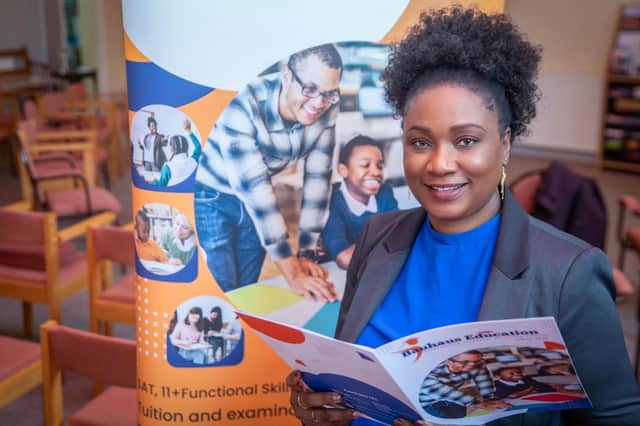

A Nigerian-led education centre in Northampton, United Kingdom is celebrating a decade of helping young people rediscover confidence in learning and achieve academic success, after supporting hundreds of students since its founding in 2016.

Bauhaus Education, located at Notre Dame Mews in the town centre, marked its 10th anniversary this year, reflecting on a journey that began modestly but has grown into a recognised provider of personalised academic support for students across the United Kingdom.
Founded by education specialist Tutu Alaka, the centre was built on the belief that every young person should have the opportunity to succeed regardless of their starting point.
When the organisation began in 2016, Alaka was still teaching full-time and could only run tutoring sessions during limited hours. Early classes were held at community libraries in the town, including the Weston Favell Library and the Central Library, with just a small number of students and two tutors.

Within two years, the initiative expanded enough to secure its first permanent location at Notre Dame Mews in Northampton’s town centre. Today, the Ofsted-registered centre supports learners from Key Stage 2 through A-Level and has expanded its reach with a second learning centre in Nottingham. The organisation also provides online learning services to students across the UK.
To commemorate its milestone, Bauhaus Education has launched a year-long campaign titled “Decade of Discovery,” highlighting the achievements of students and the evolution of the centre over the past 10 years.
Alaka, who assumed the role of chief executive full-time in September 2025, said the early years of the organisation were demanding but rewarding.
“Those early days were exhausting and uncertain, but they were also deeply affirming,” she said. “Bauhaus was built slowly, deliberately, and with purpose, and that foundation still shapes who we are today.”

According to Alaka, the centre was established to address a gap she observed repeatedly during her teaching career: many students needed more individualised attention than mainstream schools could realistically provide.
“Too many capable young people were being let down by a system that was well-intentioned but overstretched,” she said. “Mainstream schools simply do not have the capacity to provide sustained, one-to-one, wraparound support. Bauhaus was created to sit in that gap.”
Students arrive at the centre through several pathways. Many are enrolled by parents seeking additional academic support for their children, while others are referred by schools and local authorities. The centre works with learners facing a wide range of challenges, including those at risk of exclusion, students with special educational needs and disabilities (SEND), and young people with Education, Health and Care Plans.
As an approved examination centre for AQA and Pearson Edexcel, Bauhaus Education enables students to prepare for and sit formal qualifications within a supportive learning environment.
A core part of the organisation’s teaching model is rooted in cognitive science, focusing on how the brain processes and retains information. Tutors use structured retrieval practice and spaced learning techniques designed to transfer knowledge from working memory into long-term memory.
Alaka explained that helping students understand the science behind learning is a powerful confidence-builder.
“When students understand that forgetting is not failure but simply how the brain works, anxiety begins to reduce,” she said. “They stop thinking they are not clever and start thinking they need the right strategy.”
Over the past decade, the centre has also seen significant changes in the needs of the students it supports. According to Alaka, rising levels of anxiety, school refusal and emotional stress have become increasingly common among young learners, particularly following disruptions caused by the COVID-19 pandemic.
In response, Bauhaus Education has adopted a trauma-informed approach that places emotional wellbeing alongside academic progress.
“We have seen a clear increase in the complexity of need,” she said. “Many students arrive disengaged not because they lack ability, but because school has stopped feeling safe or manageable.”
One example she recalled involved a student who initially resisted tuition and believed he had already failed academically. After several weeks in the centre’s supportive environment, his outlook began to change. His grades in English, mathematics and science eventually improved by more than two grade levels, enabling him to proceed to sixth form education. Years later, he graduated from university with a first-class degree.
Stories like this have shaped the organisation’s philosophy, Alaka said, emphasising the importance of trust and relationships in the learning process.
“The students who appear hardest to reach are often those who have shut down completely,” she said. “By the time they reach us, they are not resisting learning; they are protecting themselves. Progress begins with trust.”
As part of the anniversary celebrations, the centre plans to publish a monthly education blog offering advice to parents, students and teachers on topics such as revision techniques and managing exam stress. It will also host community events and share success stories from former students.
Bauhaus Education is also recruiting additional tutors across Northamptonshire and expanding its online teaching network nationwide in an effort to reach more learners.
Looking ahead, Alaka said her ambition is for the organisation to become a leading model for alternative education provision in the UK.
“The vision is for Bauhaus to be more than a provider,” she said. “We want it to become a benchmark that demonstrates alternative education can be rigorous, compassionate and transformative, and that young people thrive when systems are built around them, not the other way around.”