

Nigeria’s opposition landscape is rapidly mutating into a high-stakes chessboard of shifting alliances, deepening internal crises and open institutional confrontations, as political heavyweights begin early positioning for the 2027 presidential election.

At the centre of the unfolding drama is a quiet but consequential realignment effort involving the Peoples Democratic Party (PDP) bloc led by Oyo State Governor Seyi Makinde and key figures in the African Democratic Congress (ADC), signalling what insiders describe as a determined push to forge a united front against President Bola Tinubu ahead of 2027.
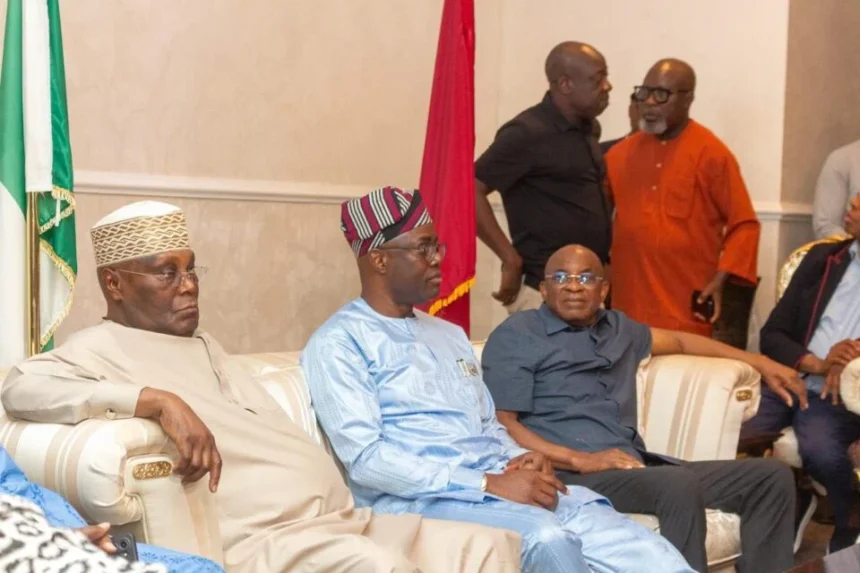
At a closed-door meeting in Abuja on Wednesday hosted by former Senate President David Mark, opposition leaders from across party lines converged in what sources say was far more than a “solidarity visit.” Present were political heavyweights including Atiku Abubakar, Peter Obi, Rotimi Amaechi, Rabiu Musa Kwankwaso and Aminu Tambuwal, a lineup that underscores the seriousness of ongoing coalition talks.
Multiple insiders confirmed that discussions went beyond optics, focusing on a potential merger or strategic alliance, power-sharing formulas, and the thorny question of which political platform PDP, ADC, or a third force that could serve as the coalition’s vehicle.

“The opposition leaders are determined to prevent a drift toward a one-party state,” one source said. “They resolved to work and strategise together on all fronts to ensure there is a credible alternative for Nigeria.”
The urgency is driven by looming timelines from the Independent National Electoral Commission (INEC), which will soon begin formal processes ahead of the 2027 polls.
Yet, even as talks of unity gather momentum, the opposition remains deeply fractured.
The PDP is locked in a bitter internal power struggle, with the camp of Federal Capital Territory Minister Nyesom Wike tightening its grip following recent court victories. That faction has flatly disowned any alliance talks with the ADC, insisting that individuals at the Abuja meeting acted in personal capacities.

“The PDP categorically states that it has not held any meeting with the ADC,” a statement from the party’s leadership declared. “Any persons reported to have participated did so purely in their individual capacities and cannot be deemed to represent the party.”
The ADC, touted as a possible coalition platform, is itself in disarray. The party has splintered into multiple factions following a protracted leadership crisis involving David Mark, Rauf Aregbesola and other contenders. The situation worsened after INEC moved to de-recognise the Mark-led leadership, citing a subsisting court order.
Publicly, Makinde downplayed the strategic implications of the Abuja meeting.
“We came here to visit the leadership of the ADC. We are on a solidarity visit,” Makinde told journalists. “We have seen what has been happening within the political space… so we came to show solidarity and to commit to a truly democratic space in our country.”
But statements issued after the meeting hinted at deeper concerns.
PDP spokesman Ini Ememobong warned of “the growing and shared threat confronting opposition political parties,” adding that there was a need for “vigilance in the face of actions capable of undermining democratic principles and political plurality.”
On the ADC side, leaders described the situation in even starker terms, warning of an “existential threat” to Nigeria’s multi-party system.
The political tension spilled onto the streets of Abuja, where opposition leaders led hundreds of supporters in a protest to INEC headquarters, accusing the electoral body of partisanship and attempting to weaken opposition parties.
In a strongly worded letter, ADC leaders demanded the resignation of the INEC chairman, accusing the commission of abandoning neutrality.
“INEC is not a court of law. It has no mandate to interpret judgments to suit a preferred narrative,” the party said. “Its duty is clear: to act strictly within the bounds of the Constitution with absolute neutrality.”
The letter went further, warning: “Any action that tilts the electoral playing field… strikes at the very heart of democratic pluralism. This is not only improper; it is dangerous.”
Atiku Abubakar framed the protest as a defence of democracy. “Our patriotic stance is aimed at safeguarding our democracy and preventing the enthronement of a dictatorship,” he said.
Similarly, Peter Obi struck a cautionary note: “We are saying that our democracy must not be killed. We say no to a one-party system.”
Despite public denials and internal chaos, the convergence of political actors, many of whom were rivals in previous elections, points to a pragmatic recalibration driven by necessity.
Another insider revealed that concrete conditions for cooperation had already been discussed. “Yes, they have agreed to work together,” the source said. “They deliberated on arrangements on how they will operate as a team… and will reconvene soon to finalise issues, including the choice of platform.”
Earlier meetings in Minna involving Makinde, Atiku and others appear to have laid the groundwork for the current expanded talks, suggesting a deliberate and phased approach to coalition-building.
Still, significant hurdles remain: unresolved court cases within both PDP and ADC, competing ambitions among political heavyweights, and the challenge of forging trust in a historically fragmented opposition.
Observers says what is emerging is not yet a unified coalition, but a fluid, high-risk political realignment shaped by urgency, mistrust and ambition.
For now, the opposition is fighting on two fronts, battling internal fragmentation while attempting to construct a viable alliance capable of challenging the ruling establishment.
One thing, however, is already clear: the road to 2027 has begun in earnest.