
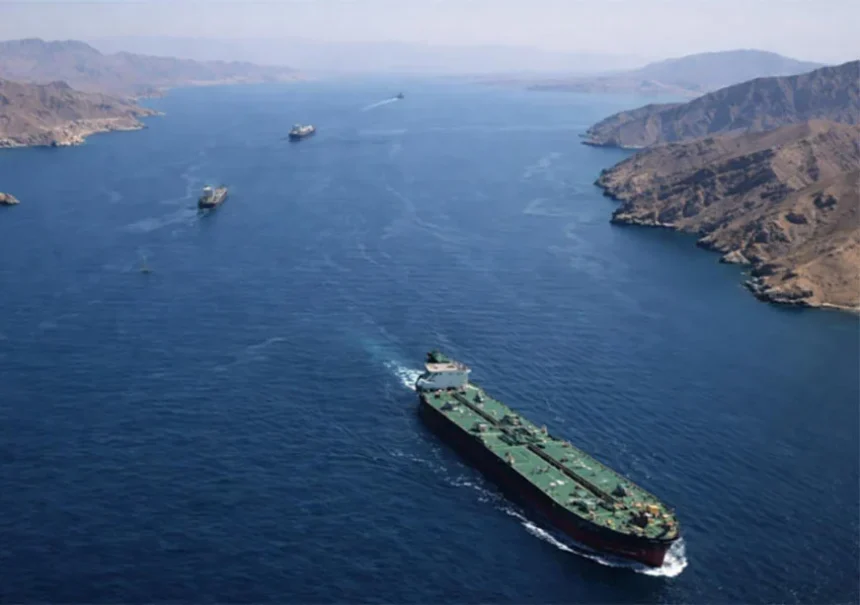

Global crude oil prices climbed by over 7 per cent on Monday following an order by U.S. President Donald Trump directing the Navy to begin a blockade of all ships entering or leaving the Strait of Hormuz.

Brent crude futures are now trading at $101.91 per barrel, while West Texas Intermediate rose to $104.16 per barrel.
Trump ordered the closure of the Strait of Hormuz, a crucial waterway through which about 20% of the world’s oil passes, after talks between the United States and Iran collapsed in Islamabad, Pakistan, in the early hours of Sunday.

Responding to the media in the early hours of Monday, Trump said that the blockage would go into effect tomorrow by 10:00.
“We have a blockade going into effect, that’ll be 10:00 tomorrow. Other nations are working so that Iran will not be able to sell oil. And, that will be very effective.”

According to data from Oil Price, a market intelligence platform that monitors global energy markets, Brent crude futures rose by $6.70 to $101.91, representing a 7.05% increase.
Similarly, U.S. West Texas Intermediate rose by 7.86%, or $7.59, and now trades at $104.16 per barrel at the time of reporting.
The steep rise in oil prices follows a sharp decline on April 8, when Iran and the U.S. reached a ceasefire.
Global oil prices dropped significantly, with Brent crude and WTI falling by more than 15%, pushing Nigerian crude and major oil contracts below $95 per barrel.
However, prices have now surged back above the $100 mark, where they had been trading for weeks, as tensions in the Middle East escalate.
The hike is primarily driven by reactions to Trump’s order to close the Strait of Hormuz to all ships attempting to enter or leave the waterway.
“Effective immediately, the United States Navy, the finest in the world, will begin the process of BLOCKADING any and all ships trying to enter or leave the Strait of Hormuz,” Trump said in a statement published on his Truth Social account, a social media platform he owns.
His decision comes in response to a failed deal between Iran and the U.S., which lasted for 21 hours, according to Vice President JD Vance, who confirmed that both sides failed to reach an agreement on key issues.
The Vice President, during a press briefing after the talks, hinted that the deal failed because Iran showed no commitment not to pursue nuclear weapons.
“But we need to see an affirmative commitment that they would not seek a nuclear weapon, and they would not seek tools that would enable them to achieve a nuclear weapon. That’s the core goal of the President of the United States, and that’s what we’ve been trying to achieve through these negotiations,” Vance said.
Trump corroborated this in his statement later on.
The rise in oil prices is directly linked to increases in energy costs. Since the war began on February 28, energy prices across the world have surged, as pump prices of gasoline adjust to the fluctuations in crude oil prices.
In Nigeria, the situation is no different.
Since the conflict began, petrol prices in Nigeria have increased by at least 50.19%, rising from N799 per litre to N1,200 per litre at the gantry and N1,153 per litre at the coast.
This has had a cascading effect on the prices of other goods, particularly food.
In a March report, Nairametrics noted that food prices across major Lagos markets surged as rising petrol costs drove up transportation and logistics expenses, triggering widespread increases in staple commodities.
For instance, a medium bag of pepper rose from N32,000 in February to N80,000 in March, while a large bag increased from N58,000 to N140,000, reflecting rises of 141.38% and 150%, respectively.
Similarly, tomatoes recorded sharp increases, with large baskets rising from N40,000 to N60,000 (50%) and oval varieties from N25,000 to N35,000 (40%).