

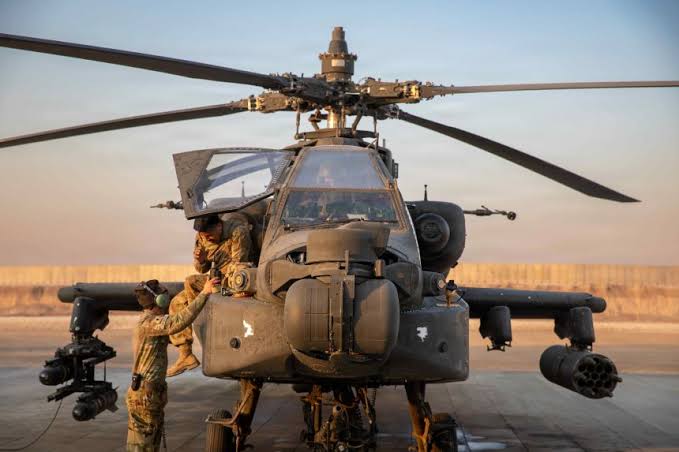

U.S. President Donald Trump on Tuesday said two American military pilots were safe after their helicopter crashed near the strategically important Strait of Hormuz, amid heightened tensions in the Middle East despite a fragile ceasefire between Iran and Israel.

Trump disclosed this while speaking to reporters at New York’s John F. Kennedy International Airport before departing for Washington, D.C.
“The pilots are fine. Nobody injured,” the president said.

The incident followed a report by The New York Times that the crew of a U.S. Apache attack helicopter had been rescued after the aircraft went down near the Iranian-controlled waterway.
However, the cause of the crash remained unclear as of press time. It was not immediately known whether the helicopter had been hit by Iranian fire, suffered a mechanical failure or encountered another problem.

Trump said details of the incident would be made public later on Tuesday.
The White House, the U.S. Department of State and the U.S. Central Command had yet to issue official statements on the crash.
The development comes against the backdrop of a fragile ceasefire between Iran and Israel. Both countries announced on Monday that they had halted attacks on each other following an appeal by Trump, easing fears of a wider regional conflict.
The ceasefire followed renewed exchanges of missile strikes between the two rivals, marking their most direct confrontation since a truce was first announced on April 8.
Despite the pause in hostilities, tensions remain high.
Iran warned that it could resume attacks if Israel continued military operations against Hezbollah, its ally in Lebanon.
On Tuesday, the Israeli military issued an evacuation order for residents of the Lebanese coastal city of Tyre ahead of possible airstrikes. The warning unusually included the city’s Christian quarter, which had previously been exempt from such evacuation notices.
The Israeli military claimed Hezbollah fighters were operating in the area, although it did not provide evidence to support the assertion.
The conflict in Lebanon has become a major point of contention in efforts to secure a broader peace agreement. Israel has continued military operations against Hezbollah despite the ceasefire between Iran and Israel, arguing that the Lebanese conflict should be treated separately.
Meanwhile, Trump indicated that diplomatic efforts involving Tehran were ongoing.
Speaking to reporters, the U.S. president said he could have “an idea” for a potential agreement with Iran within days, although he declined to provide details.
Trump has repeatedly expressed optimism about reaching a deal with Tehran, but negotiations have yet to produce a breakthrough.
According to U.S. and Israeli officials, Trump also held talks on Monday with Israeli Prime Minister Benjamin Netanyahu. In comments reported by Axios, Trump said he urged the Israeli leader to avoid reigniting the conflict with Iran.
“I said, ‘Bibi, you better be careful, or you will be on your own very soon,'” Trump was quoted as saying.
The Strait of Hormuz, where the helicopter crash occurred, remains a critical flashpoint in the crisis. The narrow waterway is one of the world’s most important energy transit routes, historically carrying about one-fifth of global crude oil and liquefied natural gas shipments.
Iran has maintained restrictions on shipping through the strait during the conflict, while Washington has imposed measures targeting Iranian ports and maritime activities.
The United States insists that any future agreement must guarantee that Iran does not develop nuclear weapons. Tehran, on the other hand, has demanded the lifting of international sanctions, access to frozen assets and recognition of its authority over the strategic waterway.
No casualties have been reported from the latest round of exchanges between Iran and Israel, but regional tensions remain elevated despite the ceasefire.