

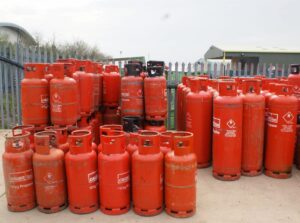

Cooking gas prices have fallen sharply across parts of the Federal Capital Territory, offering relief to households and businesses after months of steep increases that pushed Liquefied Petroleum Gas (LPG) prices to nearly N2,000 per kilogramme.

A market survey conducted across Abuja showed that LPG currently sells between N1,498 and N1,650 per kilogram, depending on location and outlet, marking a significant decline from recent highs recorded in several parts of the country.
The price moderation has reduced the cost of refilling a 5kg cylinder to between N7,490 and N8,250, while a 12.5kg cylinder now costs between N18,725 and N20,625, compared with about N10,000 and N25,000 respectively at the peak of the recent price surge.

However, some roadside retailers continue to sell the product at as much as N1,850 per kilogram, highlighting persistent disparities within the market.
The latest decline comes amid improved product availability, easing wholesale prices and government intervention aimed at addressing supply bottlenecks and alleged market manipulation.
Industry operators say increased supplies at coastal depots have gradually filtered through the distribution chain, leading to lower retail prices in Abuja and other major consumption centres.

According to Abuja-based LPG marketer Bassey Etanem, improved supply conditions have begun to restore competition among retail outlets.
“We are seeing better product availability than what existed a few weeks ago, and this is beginning to moderate prices,” he said.
Retail operators in Kubwa and other parts of the FCT also attributed the decline to increased competition among filling plants as supply conditions improved.
Government intervention
The easing in prices follows recent directives by the Minister of State for Petroleum Resources (Gas), Ekperikpe Ekpo, who ordered the Nigerian Midstream and Downstream Petroleum Regulatory Authority (NMDPRA), security agencies and other regulators to intensify surveillance of the LPG market.
The government directed authorities to investigate cases of product hoarding, diversion and artificial price inflation, while threatening sanctions against operators found manipulating the market.
The minister also reiterated the Federal Government’s commitment to increasing domestic gas supply, reducing import dependence and ensuring that more locally produced LPG is retained for domestic consumption.
Government officials disclosed that a local LPG blending initiative involving Nigeria LNG Limited, indigenous producers and the Port Harcourt LPG facility is being pursued to lower logistics costs, improve supply reliability and stabilize prices.
The interventions followed an emergency stakeholders’ meeting convened on June 22 to address the rapid escalation in cooking gas prices.
Global and domestic pressures
The NMDPRA had attributed the recent spike in cooking gas prices to a combination of international and domestic factors.
The regulator cited supply disruptions and price volatility arising from the Middle East tensions involving Israel and Iran, which affected global LPG markets and increased import costs.
Domestic challenges, including inadequate utilization of locally produced LPG, low import volumes, poor distribution infrastructure, logistics bottlenecks and non-cost-reflective pricing practices by some market participants, also contributed to the price surge.
Industry analysts note that Nigeria remains vulnerable to international price shocks despite being one of Africa’s major gas producers because a significant portion of domestic LPG consumption still depends on imports.
Energy economist Dayo Abegunde said the recent price decline reflects improved supply conditions but warned that long-term stability would require structural reforms.
“The recent decline is encouraging for consumers, but Nigeria must deepen domestic production and strengthen its supply chain to avoid recurring price spikes whenever there are disruptions in the global market,” he said.
Oil and gas analyst Edward Bulus argued that retaining more domestically produced LPG within the Nigerian market would provide greater price stability than temporary enforcement actions.
According to him, investment in storage facilities, transportation infrastructure and distribution networks would have a more lasting impact on affordability.
Inflation implications
The moderation in cooking gas prices could provide some relief for household budgets at a time when energy costs continue to exert pressure on inflation.
Energy prices remain a major driver of transportation costs, food distribution expenses and operating costs for small businesses that rely on gas-powered equipment.
Nigeria’s headline inflation rate rose to 15.93 per cent in May 2026, from 15.69 per cent in April, underlining the continued pressure on household incomes.
Many households had switched to firewood and charcoal during the recent price spike as LPG became increasingly unaffordable.
Consumer groups argue that sustained reductions in cooking gas prices could help ease living costs and encourage a return to cleaner cooking fuels.
Several consumers expressed cautious optimism that the recent decline may signal the beginning of a more sustained downward trend.
Grace Bade, a trader in Abuja, said falling gas prices would provide much-needed relief to families struggling with rising costs of transportation, food, healthcare, rent and education.
Industry stakeholders, however, warn that transportation expenses remain elevated, especially for marketers supplying inland states, and could limit further reductions unless investments are made in storage and logistics infrastructure.
Analysts say the current decline represents an important test of the government’s strategy to expand domestic gas utilization and shield consumers from international market volatility.
While recent price movements have brought relief to consumers, the long-term affordability of cooking gas will depend largely on Nigeria’s ability to increase domestic supply, strengthen distribution networks and reduce its exposure to global supply shocks.