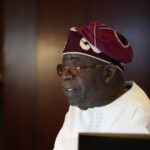

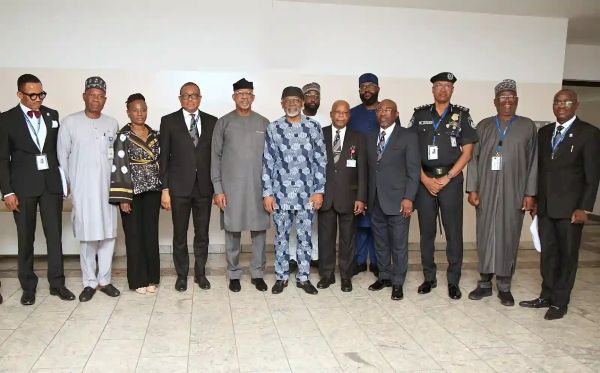

President Bola Tinubu on Tuesday inaugurated a Presidential Working Group to draft the National Policing Bill, a key piece of legislation expected to provide the legal framework for the implementation of state police across Nigeria following the National Assembly’s approval of constitutional amendments creating a dual policing system.
Represented by his Chief of Staff, Femi Gbajabiamila, at the inauguration in Abuja, the President said the proposed legislation would translate the constitutional provisions on state policing into an operational legal framework that defines how the new policing architecture will function.
The move follows the passage by the National Assembly of the Constitution Alteration (State Police) Bill, 2026, which seeks to establish a dual policing structure comprising the Federal Police Service and 36 State Police Services. The constitutional amendment, however, still requires approval by at least 24 state Houses of Assembly before it can become law.
Tinubu said while the constitutional amendment provides the foundation for state policing, the National Policing Bill would address the practical and institutional issues necessary for implementation.
“The Constitution Amendment Bill establishes the framework for dual policing, but it does not operationalise it. That work is left to the National Policing Bill,” the President said.
According to him, the legislation will contain provisions on minimum policing standards, state readiness certification, federal-state coordination, accountability mechanisms, human rights safeguards and fiscal conditions governing state police operations.
Tinubu said the Working Group had been constituted to produce an implementation-ready draft bill that would be transmitted to the National Assembly immediately after the constitutional amendment process is completed.
“We must not wait until the constitutional process is concluded before beginning this important assignment,” he said, explaining that early preparation would prevent delays in rolling out the new policing framework.
Gbajabiamila will chair the committee, whose membership includes the Attorney-General of the Federation and Minister of Justice, Lateef Fagbemi (SAN); the President of the Nigerian Bar Association, Afam Osigwe; the Chairman of the Nigeria Governors’ Forum; the National Security Adviser; the Inspector-General of Police; and the Chairman of the NGF Committee on State Police. The committee will also be supported by a secretariat.
Speaking on behalf of the Nigeria Governors’ Forum, Ogun State Governor Dapo Abiodun pledged the governors’ support for the reform and promised to work towards speedy ratification of the constitutional amendment by state legislatures.
He described state policing as a response to long-standing demands for community-based security and said decentralising policing would strengthen internal security across the federation.
Abiodun also cited the experience of regional security outfits such as Amotekun in the South-West as evidence that sub-national security arrangements can complement federal policing.
According to him, if each state eventually recruits about 6,000 officers, nearly 200,000 additional security personnel could be deployed nationwide to support the existing federal police force.
He commended the Presidency for commencing implementation planning before the constitutional amendment process is concluded, describing the move as evidence of proactive governance.
Attorney-General of the Federation Lateef Fagbemi described the initiative as timely in view of Nigeria’s worsening security challenges, urging governors to facilitate early passage of the constitutional amendment in their respective state assemblies.
“There is no denying the fact that we are in a critical moment security-wise, and all hands must be on deck,” he said.
The President of the Nigerian Bar Association, Afam Osigwe, also endorsed the state police initiative, arguing that Nigeria’s growing population and complex security challenges have outgrown the capacity of a centrally controlled police force.
However, he cautioned that the enabling law must contain strong safeguards against political interference, abuse of power and violations of citizens’ rights.
“We must ensure we do not create a monster. The right legal framework must guarantee accountability and prevent oppression,” he said.
The inauguration marks another milestone in Nigeria’s decades-long debate over the decentralisation of policing. Advocates argue that state police will improve intelligence gathering, community policing and rapid response to local security threats, while critics have warned that governors could misuse state-controlled police forces against political opponents unless robust constitutional and legal safeguards are built into the system.
Successive administrations have resisted calls for state police, citing concerns over abuse and funding constraints. However, rising insecurity—including terrorism, banditry, kidnapping, communal violence and attacks on rural communities—has intensified pressure for policing reforms and greater involvement of sub-national governments in maintaining internal security.
If you’re publishing this in a newspaper, I can also �make it more investigative by highlighting the constitutional hurdles, funding implications, and political concerns surrounding state police.