


The federal government has issued a N729 billion series 2 power sector bond to deepen electricity reforms and unlock long-term investment.

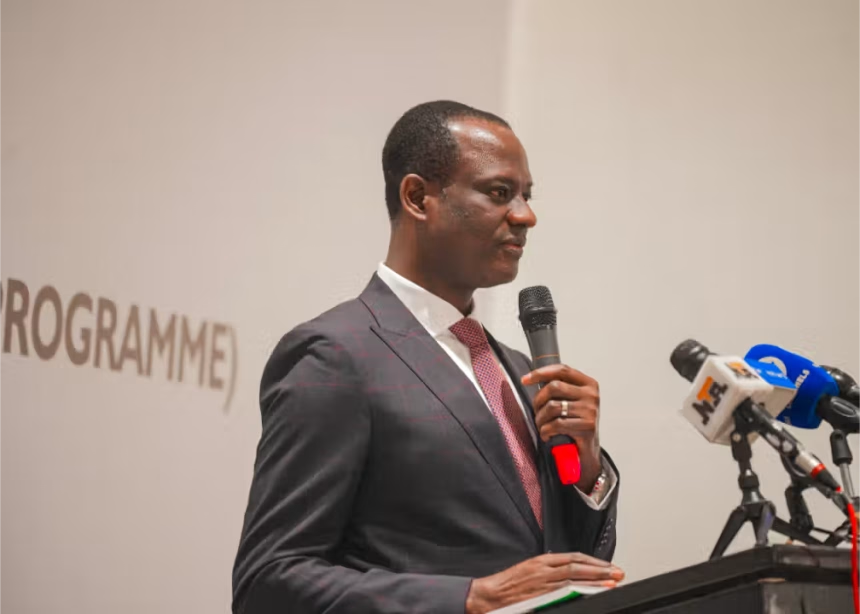
Taiwo Oyedele, the minister of finance and coordinating minister of the economy, announced on Tuesday during the investor forum for the bond issuance in Abuja.
According to a statement by Maryann Duke, senior special assistant on communications and press secretary to the minister, Oyedele said the transaction is a strategic milestone in the implementation of the Presidential Power Sector Debt Reduction Programme, aimed at resolving verified legacy liabilities.

He said the programme is also meant to restore investor confidence, and strengthen the financial foundation of the Nigerian Electricity Supply Industry (NESI).
According to the minister, the initiative demonstrates the federal government’s resolve to honour its commitments through transparent, market-based reforms that improve liquidity across the electricity value chain while creating a more attractive environment for long-term private investment.

Oyedele said there is evidence that Nigeria’s reform programme is delivering measurable results due to the successful execution of the maiden N501 billion Series 1 Bond, which he said was fully subscribed and has already recorded its first scheduled repayment.
“The first series proved that government keeps its commitments. Investors reward execution, not promises, and every commitment honoured today lowers the cost of capital tomorrow,” he said.
The minister said the second tranche will cover settlement of verified obligations to more generation companies (GenCos), gas suppliers and service providers, leading to improve plant availability, strengthen market liquidity and enhance operational stability across the power sector.
He added that reliable electricity remains the foundation of economic growth, industrialisation, digital transformation and job creation, noting that no nation has achieved sustained development without dependable power infrastructure.
During the forum, Oyedele also highlighted broader macroeconomic reforms implemented by the administration of President Ahmed Tinubu.
The minister said the administration has created measures to strengthen fiscal sustainability, improve the investment climate and restore economic stability, adding that Nigeria recorded 3.9 percent economic growth in the first quarter of 2026, and 11.2 percent growth in US dollar terms in 2025.
He said the economic growth reflects growing investor confidence and improving macroeconomic fundamentals.
Speaking on the importance of private capital, Oyedele said public resources alone cannot meet Nigeria’s vast infrastructure financing needs, hence Nigeria’s decision to mobilise long-term private capital through credible institutions, sound policy frameworks and innovative financing structures.
He asked institutional investors to continue partnering with government in supporting reforms that strengthen the economy.
The minister explained that investments in the bond represent investments not only in electricity, but also in productivity, industrial competitiveness, job creation and shared prosperity.
Oyedele also reaffirmed the federal government’s commitment to sustaining reforms that build confidence, strengthen institutions and position Nigeria as a competitive destination for investment.
On Tuesday, Olu Verheijen, special adviser to the president on energy, disclosed that the federal government has settled N333 billion legacy debt owed to eight GenCos.