
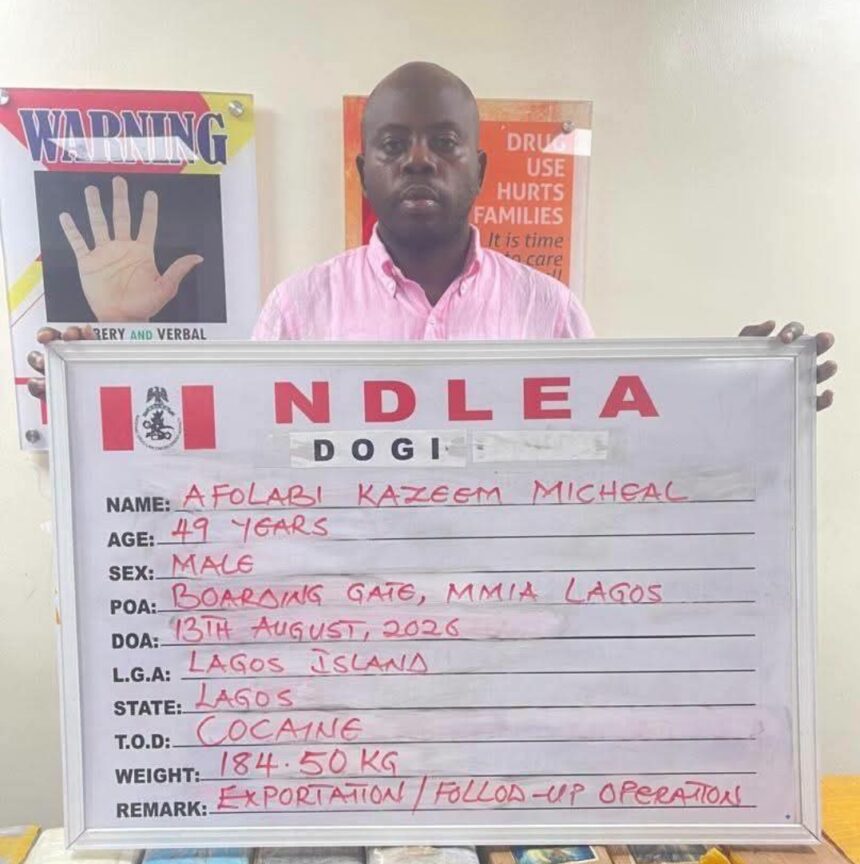

The National Drug Law Enforcement Agency (NDLEA) has arrested a Lagos-based luxury goods dealer and social media influencer, Afolabi Kazeem Michael, popularly known as “KC Luxury,” over his alleged role as the Nigerian arrowhead of an international cocaine trafficking cartel with links to the United Kingdom, Europe and Asia.

The arrest followed the seizure of 184.50 kilogrammes of cocaine concealed in a consignment processed through a courier logistics company in Lagos. The NDLEA said the shipment had an estimated street value of N39 billion if successfully distributed through the cartel’s international network.
The agency’s Chairman/Chief Executive Officer, Brig. Gen. Mohamed Buba Marwa (rtd.), disclosed the details of the operation in Lagos on Tuesday, describing it as one of the most significant narcotics investigations undertaken by the agency in recent times.
According to Marwa, the seizure triggered a Special Investigation Team tasked with going beyond the intercepted consignment to identify the individuals, companies and financial channels behind the shipment.

That investigation, he said, led operatives to two major suspects, including Lawal Mujab Kehinde, a staff member of the logistics company allegedly used by the syndicate, and Michael, whom investigators identified as the cartel’s Nigerian coordinator.
The arrest of “KC Luxury” has given the operation an unusual dimension.
According to the NDLEA, Michael operated publicly as a businessman dealing in gold, jewellery and luxury goods, while allegedly using his affluent image and social media presence to conceal a much darker enterprise.

Investigators reportedly traced a cocaine pipeline allegedly stretching from South America through Nigeria to the United Kingdom, other European countries and Asia.
The NDLEA said Michael allegedly coordinated the Nigerian end of the network, while the courier company provided an important channel through which consignments could be processed and exported.
The agency alleged that logistics-company employee Kehinde maintained a direct and sustained relationship with the cartel’s Nigerian coordinator, packaging and processing consignments destined for overseas markets and receiving cash payments for his services.
But it was Michael’s alleged attempt to leave Nigeria that ultimately brought the investigation dramatically closer to its principal Nigerian suspect.
Marwa said intelligence indicated that Michael was preparing to flee Nigeria aboard a business-class flight to Paris.
On August 13, NDLEA operatives moved in at the Murtala Muhammed International Airport, Lagos, and arrested him at the boarding gate.
The agency said he was found with €7,750, £2,800 and N100,000 in cash, as well as expensive jewellery.
A subsequent search of his luxury apartment on Banana Island, Ikoyi, allegedly led to the recovery of exotic vehicles.
The sequence of events — from the interception of the cocaine shipment to the arrest of an alleged cartel coordinator at an international departure terminal — has raised fresh concerns about the sophistication of Nigeria’s transnational drug networks and the lengths to which traffickers go to conceal their operations.
The NDLEA said the investigation also exposed a changing strategy among international drug trafficking organisations.
According to Marwa, traffickers are increasingly moving away from traditional routes such as seaports because of intensified scrutiny, and are turning instead to courier and logistics companies which they apparently perceive as less heavily monitored.
The 184.50kg seizure demonstrates the scale of what can potentially pass through such channels if adequate controls are absent.
The agency said the use of intermediary companies, false identities and financial facilitators was part of the cartel’s strategy for concealing the real consignors and beneficiaries of its shipments.
Investigators also uncovered alleged financial facilitators who moved billions of naira on behalf of the network.
The case has also assumed an international dimension, with the NDLEA saying some suspected members of the same network in the United Kingdom have been arrested by British authorities.
Marwa described the simultaneous or near-simultaneous action in Nigeria and the UK as evidence of the growing importance of international cooperation in dismantling transnational drug organisations.
He commended the agency’s international partners and the Special Investigation Team, coordinated by its Director of Operations and General Investigation, for tracing the network beyond the original cocaine seizure.
The investigation is expected to focus not only on the seized cocaine and the immediate suspects, but also on the alleged financial infrastructure supporting the network and its overseas connections.
The “KC Luxury” case comes against the backdrop of a broader NDLEA offensive against sophisticated drug networks operating across Nigeria.
Marwa cited the recent dismantling of the Switzerland-based Simon Amadi drug cartel, which allegedly laundered millions of dollars in proceeds through dark-web marketplaces.
He also referred to the takedown of two Nigerian-Mexican methamphetamine syndicates operating clandestine laboratories in forests in Ogun and Oyo states.
The agency’s latest operation therefore represents another attempt to demonstrate that Nigeria’s drug enforcement challenge is no longer limited to street-level dealers or conventional trafficking routes.
Increasingly, investigators are confronting networks allegedly combining international supply chains, courier companies, financial intermediaries, luxury lifestyles and social-media identities.
For the NDLEA, the arrest of “KC Luxury” is intended to send a message to traffickers who believe wealth and social status can provide protection.
Marwa said traffickers could not assume that luxury residences, expensive vehicles, influential contacts or glamorous online identities would shield them from investigation.
“This Agency will find you,” he warned, stressing that investigators would pursue suspects to airports and departure gates if necessary.
The latest case will now move beyond the dramatic arrest of an alleged kingpin. Its wider significance will depend on whether investigators can fully unravel the cartel’s financial channels, identify its international principals and establish how extensively Nigeria was being used as a transit point for cocaine destined for foreign markets.