

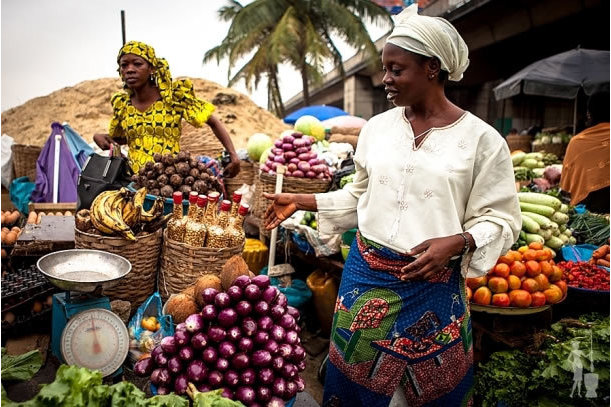

Nigeria’s food inflation rate accelerated sharply to 20.31 per cent year-on-year in July 2026, reaching its highest level in 10 months and highlighting persistent pressure on households and businesses despite a moderation in overall inflation.

The latest figure, contained in the Consumer Price Index (CPI) report released by the National Bureau of Statistics (NBS), represents a significant increase from the 17.52 per cent recorded in June.
The acceleration in food prices contrasts with the broader inflation trend. Headline inflation declined to 15.43 per cent in July from 15.91 per cent in June, indicating that while general price pressures are easing, consumers and businesses operating along the food value chain are yet to experience comparable relief.

Food inflation was last higher in September 2025, when it stood at 20.16 per cent. It subsequently declined sharply, reaching 16.30 per cent in October, 14.21 per cent in November and 10.84 per cent in December.
The downward trend continued into January 2026, when food inflation fell to 8.89 per cent, before reversing direction.
The rate rose to 12.21 per cent in February, 14.31 per cent in March, 16.06 per cent in April and 16.96 per cent in May. It climbed further to 17.52 per cent in June before jumping to 20.31 per cent in July.
The latest increase points to renewed cost pressures across the food supply chain, with implications for household consumption, wage demands, operating costs and consumer-facing businesses.

For manufacturers, retailers, restaurants and other businesses dependent on food inputs, sustained increases in food prices can translate into higher production and operating costs. Businesses may consequently be forced to raise prices, absorb part of the additional costs through lower margins or reduce output.
The divergence between headline and food inflation also suggests that the moderation in overall inflation has yet to translate into meaningful relief in one of the most important components of household expenditure.
Import-duty measures yet to provide broad food-price relief
The Federal Government has introduced several fiscal measures aimed at reducing the cost of essential goods and easing pressure on consumers.
Earlier in 2026, the government commenced reductions in import duties on selected essential goods, including food staples, under the 2026 Fiscal Policy Measures approved by Finance Minister and Coordinating Minister of the Economy, Taiwo Oyedele.
The measures represented a significant adjustment to Nigeria’s tariff regime and were intended partly to reduce the cost of imported inputs and essential commodities.
However, the latest food inflation figures suggest that tariff reductions alone may not be sufficient to reverse the underlying pressures affecting food prices.
Nigeria’s food and beverage imports stood at N1.393 trillion between January and March 2026, according to NBS trade data, compared with N1.671 trillion in the corresponding period of 2025. The figure represents a decline of approximately 16.7 per cent year-on-year.
The decline in imports comes against the backdrop of continuing efforts to encourage domestic agricultural production and reduce the country’s dependence on imported food.
The Central Bank of Nigeria has also reported that Nigeria spent approximately $2.34 billion on food imports in 2025, underscoring the scale of the country’s food supply deficit and the foreign exchange implications of meeting domestic consumption requirements through imports.
Urban consumers face stronger inflation pressure
The NBS data also showed a significant difference between inflation in urban and rural areas.
Urban inflation stood at 16.12 per cent year-on-year in July, while the month-on-month rate declined to 1.90 per cent from 2.13 per cent in June.
The 12-month average urban inflation rate was 16.81 per cent, substantially below the 30.74 per cent recorded in July 2025.
Rural inflation stood at 13.77 per cent year-on-year in July. However, rural month-on-month inflation increased to 0.78 per cent from 0.52 per cent in June.
The corresponding 12-month average rural inflation rate was 16.72 per cent, compared with 27.05 per cent a year earlier.
The relatively higher urban inflation rate has significant implications for businesses because major commercial centres face substantial costs associated with transportation, logistics, warehousing, rent, energy and distribution.
These costs ultimately feed into the prices consumers pay for food and other essential goods.
Government pushes agricultural mechanisation
The Federal Government is also pursuing longer-term measures aimed at increasing domestic food production and reducing structural constraints in agriculture.
The Minister of Agriculture and Food Security, Abubakar Kyari, recently unveiled the National Agricultural Mechanisation Policy and National Agricultural Mechanisation Investment Strategy, designed to establish a commercially viable agricultural mechanisation ecosystem.
The strategy includes plans for a mega tractor assembly plant with a projected capacity of between 2,000 and 4,000 tractors annually.
The government expects greater mechanisation to improve farm productivity, expand cultivated output and strengthen Nigeria’s food security.
However, the July food inflation figures demonstrate the urgency of accelerating such interventions, particularly as rising food prices affect both households and businesses.
The latest data suggest that the challenge is not simply one of inflation but of food supply, agricultural productivity, logistics, storage, transportation and market efficiency.
While the decline in headline inflation provides a positive signal for the broader economy, the sharp acceleration in food inflation shows that businesses and consumers remain exposed to significant cost pressures.
For the economy to achieve sustained disinflation, the improvement in headline inflation will need to be accompanied by a durable moderation in food prices. Otherwise, high food costs could continue to undermine household purchasing power, constrain consumer demand and raise operating costs for businesses across the economy.