

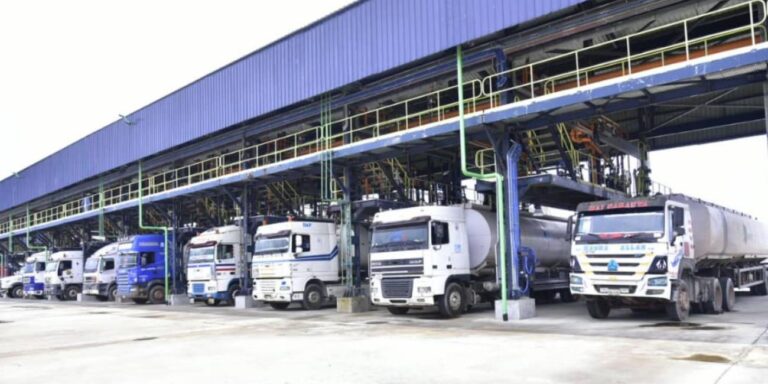

The increasingly bitter battle between the Dangote Petroleum Refinery and petroleum marketers over petrol imports, pricing and market access has entered a potentially disruptive new phase, with the 700,000-barrel-per-day refinery considering restrictions on supplies to major marketers that continue to import Premium Motor Spirit (PMS), popularly known as petrol.

The proposed move, which could take effect as early as this week barring further consultations or last-minute intervention, threatens to deepen an already intense struggle over who controls the supply of petrol in Nigeria’s newly liberalised downstream market.
It also comes at a particularly sensitive time for consumers, with petrol prices rising sharply across major cities and approaching N1,400 per litre in parts of Lagos, Abuja and Kano.
At the centre of the latest dispute is an allegation by the refinery that some major marketers are blending imported PMS with petrol purchased from Dangote before distributing the products to consumers.

Sources familiar with the refinery’s position said Dangote was concerned that such practices could undermine the quality of its products and make it difficult for consumers and other stakeholders to establish the actual source and specifications of petrol being sold in the market.
The refinery is also questioning whether Nigeria currently has sufficient laboratory and quality-control infrastructure to independently test and certify imported petroleum products before they reach consumers.
“It is difficult to understand why we would invest heavily in producing high-quality petroleum products for Nigerians, only for those products to be mixed with imported products of uncertain quality and the resulting product to be associated with the refinery,” a source familiar with the refinery’s position said.

The allegations, however, have been strongly rejected by petroleum marketers, who see the proposed supply restrictions less as a quality-control measure than as an attempt by the country’s dominant domestic refiner to shut out competing supplies and gain greater control over the petrol market.
A major marketer, who spoke on condition of anonymity, dismissed the allegation of blending substandard imported petrol with Dangote’s products.
“He’s just trying to block importation, that’s all. He’s just trying to block importation,” the marketer said.
According to the marketer, the fundamental disagreement is about competition, supply and pricing rather than product quality.
“All he wants is to stop supply through imports so he can sell at a higher price, and he’s the only person selling. That’s monopoly,” the marketer said.
The dispute therefore goes beyond the immediate question of whether marketers should continue importing petrol. It raises a much larger issue about how Nigeria’s downstream petroleum market should function now that the country has a major private refinery capable of supplying a substantial portion of domestic demand.
Battle for control of the downstream market
Dangote Refinery has consistently argued that Nigeria should move decisively away from dependence on imported petroleum products, refine more crude domestically and conserve scarce foreign exchange.
The refinery’s emergence has fundamentally altered the structure of Nigeria’s downstream industry. With a nameplate capacity of 700,000 barrels per day, it is by far the country’s largest refinery and has progressively increased its participation in domestic fuel supply while also exporting petroleum products.
But marketers argue that the existence of a large domestic refinery does not automatically eliminate the need for imports.
They maintain that imports provide an alternative source of supply, support competition and offer a buffer against shortages whenever domestic refining capacity is disrupted or unable to meet market demand.
One marketer cited an alleged operational disruption at the Dangote refinery in July as evidence of the danger of relying excessively on a single supplier, arguing that imported petrol helped prevent a more serious supply crisis.
Another marketer said the refinery’s latest position was not entirely new, claiming that Dangote had already stopped coastal loading to some marketers about three weeks ago.
The marketer further disclosed that the refinery’s gantry price was adjusted three times between August 21 and August 29, with a cumulative increase of N100 per litre, or approximately 8.6 per cent, even as international crude benchmarks moved in the opposite direction.
The claim could not independently establish the reasons for the refinery’s price adjustments, but it illustrates the broader concern among marketers about pricing power in a market increasingly dominated by one major domestic supplier.
The refinery, on its part, has argued that continued importation undermines domestic refining and weakens the economics of local investment. Its position is that a country that has finally secured substantial domestic refining capacity should not continue to rely heavily on imported petrol.
Recent data from the Nigerian Midstream and Downstream Petroleum Regulatory Authority (NMDPRA), however, indicate that petroleum-product imports remain significant even as domestic refining and exports increase.
That reality has exposed the central tension in Nigeria’s downstream reforms amid questions over whether the immediate priority should be maximum utilisation of domestic refining capacity or preservation of multiple supply channels to guarantee competition and security of supply.
Petrol price crisis intensifies
The dispute is unfolding against the backdrop of another uncomfortable reality: petrol is becoming increasingly expensive for Nigerian households and businesses.
Checks across Lagos showed pump prices rising from about N1,280 per litre to between N1,310 and N1,320 at several filling stations.
MRS was selling at N1,310 per litre, while Sunbeth was reported at N1,319. Mobil and Conoil were selling at N1,320, with Heyden at N1,310.
In Kano, major marketers reportedly adjusted prices from about N1,285 to N1,310 per litre, while NNPC retail outlets increased prices from N1,285 to N1,305. AA Rano was selling at N1,355, while Aliko station reportedly increased its price to N1,350.
In Abuja, petrol was selling at about N1,350 per litre at some outlets.
The increases are feeding directly into transportation costs and squeezing the margins of commercial operators.
Kunle Fadipe, who operates between Ikeja and Costain in Lagos, said he spent about N70,000 on petrol at N1,320 per litre and managed only three trips.
Another driver, Imole Oyefunso, who operates between Mile 12 and Ojuelegba, said his fuel expenditure had risen to N32,000 for five trips from about N12,000 previously.
Yet drivers say they are reluctant to increase fares significantly because passenger patronage is already weak.
That leaves operators caught between rising input costs and consumers whose purchasing power is steadily deteriorating.
Another driver, Sunday Chidioke, who buys petrol at N1,310 per litre, said the increase had significantly reduced his profit.
The pressure is likely to intensify if international crude prices remain elevated. Brent crude rose above $90 per barrel on Monday from $88.57 amid renewed tensions in the US-Iran conflict, adding another layer of pressure to the domestic fuel market.
Regulator under pressure
The latest dispute has also put the NMDPRA under renewed scrutiny.
At issue is not simply who should supply petrol but whether the regulator has the institutional capacity and independence to guarantee that every litre entering the Nigerian market meets the required specifications, regardless of whether it is imported or locally refined.
Petroleum economics expert and Professor Emeritus, Wumi Iledare, said the allegations made by Dangote should not be accepted without independent verification.
He said claims that marketers were blending imported PMS with Dangote-supplied products, as well as concerns about the regulator’s ability to independently verify imported-product quality, “remain allegations and should be independently established, not assumed as fact.”
But he said the controversy exposes a much deeper governance challenge in Nigeria’s transition from an import-dependent downstream industry to a competitive domestic refining market.
“Nigeria does not need a regulator that chooses the winner; it needs a regulator capable of ensuring that the best-performing market participant wins,” Iledare said.
He argued that NMDPRA must function as an impartial referee that is independent enough to resist market capture, competent enough to enforce the rules and sufficiently equipped to monitor the market effectively.
“The ultimate test is public value,” he said, stressing that regulation should deliver quality assurance, competitive prices, reliable supply and energy security while encouraging investment.
Where regulatory weakness permits poor-quality products, unfair competition or market distortions to persist, he warned, “government failure becomes market failure, and the ultimate welfare loss is borne by the Nigerian consumer.”
The NMDPRA, however, said its position was clear.
Its Head of Public Affairs, George Ene-Ita, said the regulator has sole responsibility for determining the quality parameters applicable to petroleum products supplied into the Nigerian market, whether locally refined or imported.
At the same time, he said Dangote Refinery, as a business, retains the right to determine with whom it conducts business under the willing-buyer, willing-seller framework.
Competition versus concentration
That position highlights the delicate balance confronting the downstream sector.
A functioning market requires competition, but competition also requires credible rules. Nigeria cannot replace dependence on imported fuel with dependence on a single domestic supplier and simply assume that the outcome will automatically be better for consumers.
At the same time, allowing unrestricted imports to compete with domestic refining capacity could undermine the economics of investments that Nigeria desperately needs to reduce its vulnerability to foreign exchange shocks and international supply disruptions.
The answer, therefore, cannot be to arbitrarily favour either the refinery or the marketers.
The regulator’s responsibility is to ensure that domestic refiners compete fairly with importers, that imported products meet exactly the same quality standards as locally refined products, and that no market participant can manipulate supply, pricing or quality to the detriment of consumers.
The present dispute makes that responsibility even more urgent.
For consumers already paying more than N1,300 for a litre of petrol, the argument between Dangote and the marketers is not an abstract battle between competing commercial interests.
It is a fight whose outcome will determine how much Nigerians pay to move people and goods, how much businesses spend on logistics and whether the country’s much-vaunted transition to domestic refining actually delivers cheaper, safer and more reliable energy.
The danger is that Nigeria could move from one form of market distortion to another; from dependence on imported petrol to excessive dependence on a dominant domestic supplier.
Neither outcome represents genuine downstream reform.
What Nigerians need is not merely Nigerian-refined petrol. They need a genuinely competitive market in which quality is guaranteed, supply is reliable, prices are transparent and no single player, whether importer, refiner or regulator, is powerful enough to dictate the terms of the market.