

Lagos State Governor Babajide Sanwo-Olu has warned that Nigeria’s 36 governors will be crucial to the outcome of the 2027 elections, as voters increasingly judge political leaders by their performance rather than party slogans or federal influence.

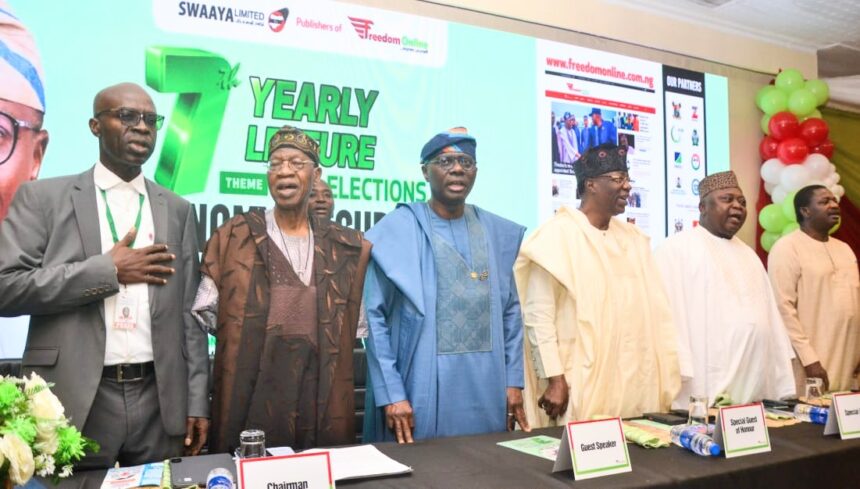
Speaking at the Freedom Online 7th Yearly Lecture in Lagos on Thursday, Sanwo-Olu said Nigerians might not be economists, but they were “excellent accountants” who would take a record of their governors’ performance to the polling units.
“They know whether their State built the road it promised. They know whether the primary health centre has a nurse in it. They will bring that ledger with them to the polling unit,” he said.
The governor, who was the guest lecturer, said the substantial increase in allocations to states and local governments following petrol subsidy removal had also weakened the excuse of inadequate resources.
“Since the subsidy was removed, the monthly allocations to States and local governments have more than doubled in naira terms. The President has done his part; the money is arriving. What is done with it is on us,” he said.

Sanwo-Olu also argued that the traditional influence of “federal might” was losing its potency, pointing to the recent Osun governorship election, where the APC lost to incumbent Governor Ademola Adeleke despite controlling the Federal Government.
“There was a time in this country when ‘federal might’ was a phrase that a ruling party used without irony,” he said. “Under this President, the ruling party can lose a state, in the South-West, in an election year, and the sky does not fall.”
He said the development demonstrated the importance of allowing voters to determine electoral outcomes, stressing that “a mandate is only as strong as the process that produced it.”
Sanwo-Olu, however, identified security as a major threat to the credibility of the 2027 elections, warning that insecurity could prevent candidates from campaigning, disrupt the movement of INEC personnel and materials and discourage voters from turning out.
“In the communities where banditry and insurgency persist, insecurity touches everything,” he said, urging INEC and security agencies to begin preparations early.

He also renewed his support for state policing, arguing from Lagos’ experience that security works best when communities can see and hold accountable those responsible for protecting them.
“The lesson of two decades is not complicated. Security works best when the people who pay for it and the people who depend on it can see, and hold to account, the people who provide it,” he said.
Sanwo-Olu linked security directly to economic performance, arguing that poverty fuels insecurity while insecurity undermines investment, farming, education and job creation.
He defended the Tinubu administration’s economic reforms, particularly subsidy removal, saying recent improvements in growth, inflation, reserves and remittances showed that the reforms were beginning to yield results, although Nigerians had borne significant costs.
The governor said the 2027 election would ultimately test whether Nigeria could consolidate its democratic gains.
“No office in this land is worth the life of a single Nigerian, and no victory won by the wrong means is a victory at all,” he said.
He urged the media, INEC, security agencies, the Federal Government and states to ensure a peaceful and credible election, saying 2027 should be remembered not as an election Nigeria merely survived, but as one at which the country “came of age.”
Former Ogun State governor and special guest of honour, Senator Gbenga Daniel said the connection between economic performance and security would be central to Nigeria’s future, stressing that neither could be achieved in isolation.
“Security is not merely a matter for the military, police and other agencies. It is also an essential part of economic infrastructure. When farmers are afraid to cultivate their land, food production suffers. When roads are unsafe, the cost of transporting goods rises. When businesses spend excessively on protection, their competitiveness declines. When communities live in fear, investment is discouraged,” Daniel said.
He said Nigeria’s enormous youthful population could either become an economic dividend or a source of social instability, depending on the opportunities available to them. “If we give our young people opportunity, they will build Nigeria. If we deny them opportunity, frustration will grow and social stability will suffer,” he said.
Daniel also urged governments to focus on creating the conditions for enterprise and investment to thrive across the country, using Lagos and Ogun as examples of what could be achieved when infrastructure, security and opportunity converge. “If we secure our farms, we strengthen food security. If we secure our roads, we strengthen commerce. If we secure our communities, we attract investment. If we create jobs and invest in our young people, we strengthen social stability and the future of the nation,” he said.
Also speaking at the occasion, former Minister of Information and Culture, Alhaji Lai Mohammed said the media’s influence extends beyond reporting events to shaping how citizens understand the economy, security and the nation’s future. “The media does not merely reflect reality; it helps to construct the reality through which citizens interpret their daily experiences. The choice of headlines, the prominence given to particular voices and the language used to describe events can either build confidence or deepen anxiety,” he said.
He warned that repeated images and narratives of crisis could create the impression that progress was impossible, even when meaningful reforms and investments were taking place. “When every development is presented only through the lens of failure, citizens lose faith, investors become hesitant and our national challenges appear larger and more permanent than they are. This does not mean the media should conceal problems. It means that criticism must be accurate, fair and placed within the proper context,” Mohammed said.
He urged journalists and media organisations to resist the temptation to turn political disagreements into ethnic, religious or regional conflicts, particularly as the 2027 elections approach.
“A responsible media must interrogate power, expose wrongdoing and give voice to the people, but it must also understand the consequences of its choices. The stories we publish can either widen the space for dialogue or close it; they can encourage citizens to demand better governance or push them toward suspicion and hostility. In shaping perceptions, the media is also shaping the possibilities for peace, development and national unity,” he said.