

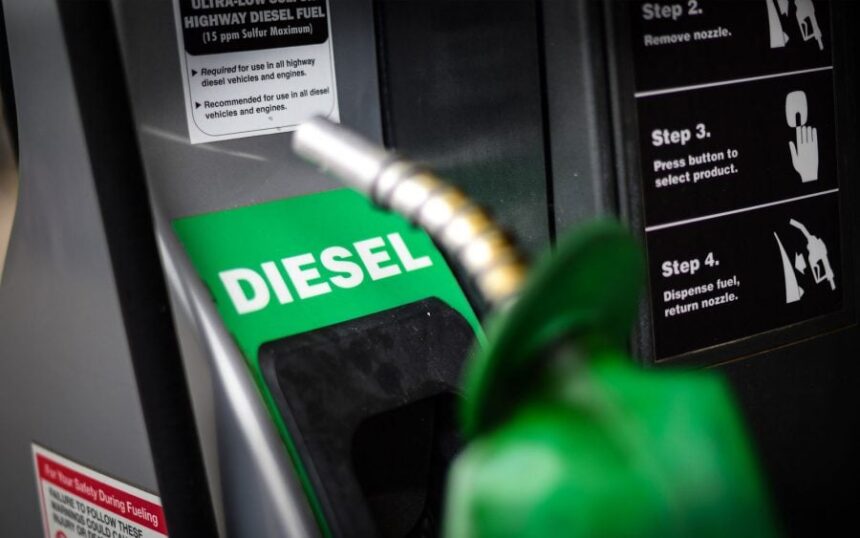

Nigeria’s manufacturing sector is facing a fresh cost shock as diesel prices climb above N2,000 per litre, pushing energy costs beyond half of manufacturers’ operating expenses and forcing some factories to cut production.

Diesel now sells for about N2,100 per litre in Lagos and Ogun, up from N1,700-N1,800 just days ago and about N1,200 in February.
For manufacturers already battling weak demand, high financing and logistics costs, the surge is squeezing margins, slowing production and increasing unsold inventories.

The Manufacturers Association of Nigeria (MAN) said production costs have risen by more than 400 per cent, while power-related expenses have increased from about 40 per cent of operating costs to more than 50 per cent.
Manufacturers’ spending on alternative energy rose from N782 billion in 2023 to N1.1 trillion in 2024 and N1.34 trillion in 2025. MAN said spending in the first half of 2026 was already comparable with the entire 2025 figure.

The crisis is forcing factories to scale back operations.
The Executive Director of Universal Luggage Ltd, Frank Onyebu, said his company had reduced production from three shifts to two, then one, and now operates every other day.
“We used to run three production shifts. As operating costs went up, the shifts reduced to two, then one, and now every other day,” he said.
MAN’s Head of Energy, Ibrahim Usman, said energy had become the biggest threat to the survival and competitiveness of Nigerian manufacturers.
While electricity typically accounts for about 10 per cent of production costs in many countries, he said the figure in Nigeria had exceeded 45 per cent and could now move above 50 per cent.
“There is no way we can be competitive, especially as we are ramping up efforts to export under the AfCFTA,” he said.
The warning comes as Nigeria targets 3.1 per cent real manufacturing growth in 2026, after the sector grew just 1.13 per cent year-on-year in Q4 2025.
The Lagos Chamber of Commerce and Industry (LCCI) said the diesel crisis was “quietly dismantling” Nigeria’s industrial base.
Its Director-General, Dr Chinyere Almona, said diesel had risen from a pre-crisis level of about N900 to above N2,000 per litre, with energy consuming more than 45 per cent of production costs for many businesses.
She warned that companies unable to absorb the increases were raising prices, cutting production or laying off workers.
“A sector that employs over 80 per cent of Nigeria’s non-agricultural workforce is quietly but rapidly contracting,” Almona said.
LCCI called for a time-bound diesel duty waiver for verified manufacturers and industrial MSMEs, faster conversion of industrial clusters to CNG and greater competition in AGO imports.
MAN also urged government to accelerate investment in solar and hydropower and improve transmission infrastructure to deliver cheaper electricity to industrial centres.
The pressure is not limited to diesel. Petrol prices in Lagos and Ogun have risen to N1,300-N1,370 per litre, from about N1,200-N1,220, further increasing transportation and household costs.
For manufacturers, however, the diesel surge presents a bigger problem: factories cannot simply reduce generator use without reducing output.
The result is a damaging cycle of higher energy costs, higher product prices, weaker demand, rising inventories and lower production.
Industry leaders warn that without urgent action to reduce energy costs and improve power supply, Nigeria risks losing manufacturing capacity, jobs and competitiveness just as it seeks to expand production and exports under AfCFTA.