
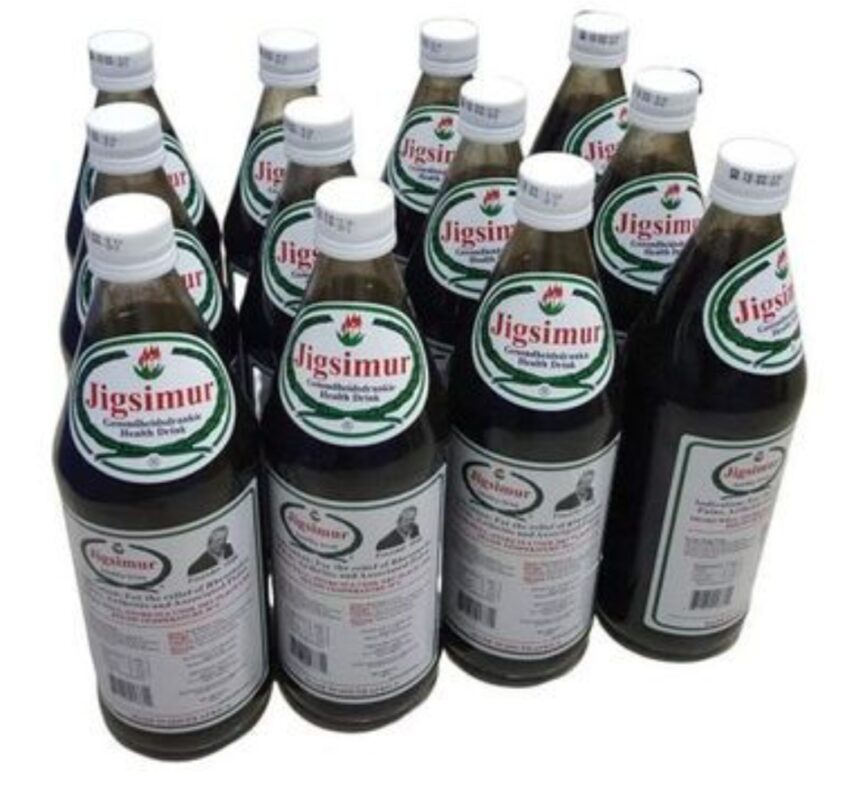

The legal battle over ownership and control of the Jigsimur health drink brand in Nigeria is set to move to the Federal High Court following a ruling by the Administrative Panel Division of the Patents and Designs Registry in favour of Jigsimur SA (Pty) Limited.

The dispute involves two South African companies—Jigsimur SA (Pty) Limited and Jigsimur SA Original Pty Limited—and their Nigerian business counterpart, Jigsimur Plus Limited.
At the centre of the dispute are competing claims over the ownership and protection of the Jigsimur trademark, industrial design, product packaging and distribution rights in Nigeria.

In its ruling delivered on September 2, 2026, the Administrative Panel Division affirmed the right of Jigsimur SA (Pty) Limited to distribute the Jigsimur health drink in Nigeria and barred Jigsimur Plus from relying on the disputed patent rights.
The Panel described its decision as a first-level alternative dispute resolution ruling intended to resolve the disagreement without prolonged litigation.

It also stated that any party dissatisfied with the decision was entitled to appeal to the Federal High Court.
Jigsimur Plus, which maintains that it played a key role in introducing and establishing the product in the Nigerian market, has indicated its intention to challenge the decision, setting the stage for a broader judicial battle over the brand.
The dispute essentially revolves around competing claims about when rights to the Jigsimur brand were acquired, who originally owned those rights and whether rights established or recognised in South Africa can confer proprietary rights in Nigeria.
Competing claims over Nigerian rights
In his written address before the Panel, counsel to Jigsimur Plus, Chief Anthony George-Ikoli, SAN, argued that his client’s rights in Nigeria predated the rights being asserted by the opposing parties.
George-Ikoli said Jigsimur Plus applied to register the Jigsimur trademark in Nigeria in 2018, arguing that the date was crucial because it preceded subsequent registrations and assignments relied upon by the opposing parties.
He maintained that trademark rights were territorial and that the history of the Jigsimur brand in South Africa could not, by itself, confer proprietary rights over the trademark in Nigeria.
According to him, Jigsimur Plus dealt throughout the relevant period with Jigsimur SA Original Pty Limited, which supplied the products and regulatory documentation, possessed South African Health Products Regulatory Authority-related recognition and documentation, authorised distribution in Nigeria and granted powers relating to trademark and design registration.
He further argued that Jigsimur SA Original had empowered Jigsimur Plus to protect the relevant intellectual property rights in Nigeria.
George-Ikoli also contended that CAN AFFORD Products and Projects (Pty) Limited subsequently obtained Nigerian registrations for the Jigsimur name, logo and label on May 14, 2021, under Trade Mark Nos. 43580 and 43581.
According to him, those registrations came three years after Jigsimur Plus’s 2018 application.
He argued that by then Jigsimur Plus had already established substantial goodwill for the product in Nigeria through continuous importation, nationwide distribution, marketing activities, dealer networks and growing consumer recognition.
The senior lawyer also challenged the reliance placed by the opposing parties on a 2016 Power of Attorney and Distribution Agreement.
He argued that authority to protect intellectual property did not necessarily establish a pre-existing proprietary right in Nigeria.
He further contended that there was no evidence that the opposing parties had applied for registration of the Jigsimur trademark in Nigeria before Jigsimur Plus filed its application in 2018.
George-Ikoli also challenged reliance on a 2024 judgment from South Africa, arguing that the judgment could not determine ownership of intellectual property rights in Nigeria.
According to him, ownership and protection of intellectual property rights in Nigeria must ultimately be determined under Nigerian law.
Applicants’ different account
The applicants presented a contrasting history of the Jigsimur brand and its entry into the Nigerian market.
In his written address, counsel to the applicants, Chief Muoneke Paschal Oluchukwu, said CAN AFFORD Products and Projects (Pty) Limited, owned by Perumal Chetty, was appointed distributor of the product in Nigeria in 2012.
He said the relationship was subsequently formalised in an agreement dated January 1, 2016.
According to Oluchukwu, Christian Onunkwor Ekene, a director of Jigsimur Plus, approached Chetty in 2014 with a request to become the sole distributor of the product in Nigeria.
He said Ekene was subsequently introduced to Rouxnel Ungerer to obtain the product and pursue the necessary regulatory approvals from the National Agency for Food and Drug Administration and Control.
The applicants also acknowledged that CAN AFFORD subsequently secured Nigerian trademark registrations for the Jigsimur brand in 2021.
However, they argued that the relationship with Jigsimur Plus later deteriorated following disagreements over the production of different product sizes allegedly without approval from the South African parent company.
The competing narratives have now placed the history of the Jigsimur brand, its Nigerian distribution arrangements and the ownership of its intellectual property rights squarely before the courts.
High Court battle looms
The Federal High Court will now potentially have to determine the competing claims over the Nigerian trademark, the validity and effect of the various registrations and assignments, the parties’ respective distribution rights and the extent to which agreements and judgments originating in South Africa can influence proprietary rights in Nigeria.
The case also raises broader questions for international brands operating in Nigeria, particularly where foreign manufacturers, local distributors and separate entities claim overlapping rights over trademarks and product intellectual property.
For Jigsimur, the dispute is no longer simply a disagreement between business partners over distribution. It has evolved into a legal contest over who has the right to own, protect, distribute and commercially exploit the brand in one of Africa’s largest consumer markets.
With the Administrative Panel’s September 2 decision now facing a challenge before the Federal High Court, the next phase of the dispute could ultimately determine which of the competing parties has the strongest legal claim to the Jigsimur brand in Nigeria.