

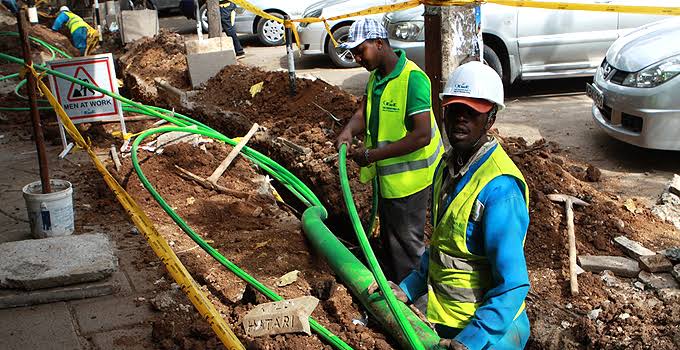

Nigeria’s plan to expand broadband infrastructure with a 90,000-kilometre fibre-optic network is facing a major financing challenge, with the Federal Government expected to attract $1.2bn in private investment to complement an $800m sovereign-backed funding package.

The project, known as Project BRIDGE, is designed to extend high-capacity fibre infrastructure across all 36 states and raise the country’s total fibre backbone from about 35,000km to approximately 125,000km by 2028.
The initiative could reduce a major constraint on Nigeria’s digital economy by expanding the infrastructure required for faster internet, digital payments, cloud computing, e-commerce and artificial intelligence.

But its economic impact will depend on whether the government can secure the additional capital, coordinate state-level approvals, protect fibre infrastructure from damage and ensure that the network translates into affordable broadband access for businesses and households.
Speaking on the initiative, the All Progressives Congress National Chairman, Prof. Nentawe Yilwatda, described the project as a strategic investment in Nigeria’s digital future.
The scale of the ambition is substantial. The proposed network is expected to connect more than 200,000 public institutions, including schools, healthcare facilities and other government establishments, while providing an open-access backbone that telecom operators and other service providers can use to expand their services.

$1.2bn funding gap
The government’s financing package comprises a $500m World Bank facility, $100m from the European Bank for Reconstruction and Development and $200m from the African Development Bank.
The funding is also supported by a €22m grant from the European Union.
However, the $800m package is only part of the financing required. The government is seeking a further $1.2bn from private investors to complete the wider infrastructure programme.
That requirement creates a critical test for the project: whether the government can persuade investors that the network offers a credible commercial opportunity, with predictable revenues, transparent governance and a workable framework for sharing infrastructure.
The proposed ownership structure is intended to help achieve that objective through an independent open-access company, Bridge Open Access.
Under the plan, the government, through the Ministry of Finance Incorporated, would hold between 25 and 49 per cent equity, while private investors would own between 51 and 75 per cent and retain operational control.
The arrangement is designed to attract private capital without placing the entire financial and operational burden on the public sector.
Yet investors are likely to examine more than the size of the market. They will want clarity on pricing, access rights, demand, maintenance obligations, regulation and the protection of their assets.
Without credible answers, the private funding target could prove difficult to achieve.
Businesses stand to gain
For Nigerian businesses, the potential benefits extend beyond faster internet connections.
Reliable, high-capacity fibre can lower the cost and improve the quality of connectivity for banks, fintech companies, manufacturers, retailers, logistics operators and small businesses that increasingly depend on digital services.
It can also strengthen the infrastructure supporting electronic payments, online commerce, remote work, cloud-based business applications and data-intensive services.
Small and medium-sized enterprises could benefit from more reliable connections and access to digital tools that allow them to serve customers beyond their immediate locations.
For financial institutions and technology companies, an expanded fibre backbone could improve the resilience and capacity of the networks supporting digital transactions and online services.
The project could also support investment in data centres and artificial intelligence, sectors that require dependable, high-capacity connectivity.
However, a larger national backbone does not automatically mean cheaper or more accessible internet for consumers.
The commercial benefit will depend on how effectively operators extend connections from the backbone to homes, offices and communities.
Affordability, last-mile infrastructure, electricity supply, access to devices and the cost of data will remain decisive factors.
Lagos, Abuja dominate fibre deployment
Nigeria’s fibre infrastructure remains unevenly distributed, with Lagos and the Federal Capital Territory accounting for more than 18 per cent of deployed fibre, according to figures cited in the project discussion.
The country has about 265,000 fibre-to-the-home subscribers, highlighting the distance between the availability of backbone infrastructure and the level of direct fibre connections to households.
The concentration of infrastructure in major commercial centres reflects the economics of telecom investment: operators tend to prioritise locations where population density, purchasing power and expected demand can support returns.
Expanding fibre into underserved states and communities will therefore require an investment model that balances commercial viability with broader economic and social benefits.
An open-access network could help by allowing several operators to use shared infrastructure rather than requiring each provider to build an entirely separate long-distance network.
That could reduce duplication, lower deployment costs and make expansion into less commercially attractive locations more feasible.
The outcome, however, will depend on fair access terms and effective regulation to prevent the network from becoming a bottleneck controlled by a limited number of interests.
Right-of-way charges threaten rollout
The construction programme must also contend with the cost and complexity of deploying fibre across multiple jurisdictions.
Telecom operators have repeatedly faced challenges associated with right-of-way charges, permits, bureaucratic delays and damage to existing cables during road construction and other public works.
Inconsistent requirements across states and local authorities can increase deployment costs and prolong project timelines.
Harmonising approval processes and making right-of-way policies more predictable would help reduce these obstacles. So would stronger coordination between telecom operators, state governments, road agencies and contractors.
One proposed solution is to incorporate dedicated telecommunications ducts into road construction projects, allowing fibre cables to be installed without repeated excavation.
Clear identification of existing underground cables and stronger protection requirements could also reduce accidental damage, service interruptions and repair costs.
For Project BRIDGE, these issues are not peripheral administrative concerns. Delays and unexpected costs could undermine both the 2028 target and the commercial assumptions on which private investment depends.
Data centres and AI ambitions
The fibre rollout forms part of a broader push to strengthen Nigeria’s position in the digital economy, including artificial intelligence, cloud computing and data-centre investment.
The government has outlined plans to attract $750m in data-centre investment within 24 months, including a $250m target for the first year.
It also aims to increase data-centre capacity from about 50 megawatts to 200MW of IT load over five years.
Such investments could improve the availability of computing and data-storage services within Nigeria, create opportunities for local technology companies and reduce some of the operational constraints facing businesses that depend on digital infrastructure.
But the expansion of data centres brings another major challenge: electricity.
These facilities require dependable power, substantial cooling capacity and resilient connectivity. An unreliable electricity supply can raise operating costs and weaken the competitiveness of Nigerian facilities against established data-centre markets.
The government’s digital infrastructure ambitions will therefore require coordinated investment in power, fibre, data-centre facilities and the policy framework governing the sector.
Digital sovereignty versus competition
The government has also emphasised the importance of digital sovereignty and stronger domestic capacity in data storage and digital services.
Developing local infrastructure could improve resilience, strengthen data governance and create opportunities for Nigerian technology providers.
However, digital sovereignty must not become a justification for policies that restrict competition, increase costs or discourage foreign investment and technical expertise.
Nigeria needs a framework that encourages domestic capability while allowing efficient operators to compete, innovate and invest.
For businesses, the central question is whether the expansion of infrastructure will translate into better services at competitive prices, rather than simply increasing the number of government-backed digital initiatives.
Delivery will determine economic returns
Project BRIDGE has the potential to address one of the structural weaknesses holding back Nigeria’s digital economy: inadequate and unevenly distributed high-capacity connectivity.
But the project’s success cannot be measured by kilometres of fibre laid, financing commitments announced or public institutions listed for connection alone.
The more important measures will be the number of locations actually connected, the reliability and affordability of services, the extent of private investment mobilised, the reduction in deployment costs and the benefits delivered to businesses and households.
The government must also provide clear implementation milestones, transparent procurement, credible oversight and regular reporting on expenditure and results.
Securing the additional $1.2bn in private capital will be essential, but so will creating the regulatory and commercial conditions that allow the infrastructure to operate sustainably.