

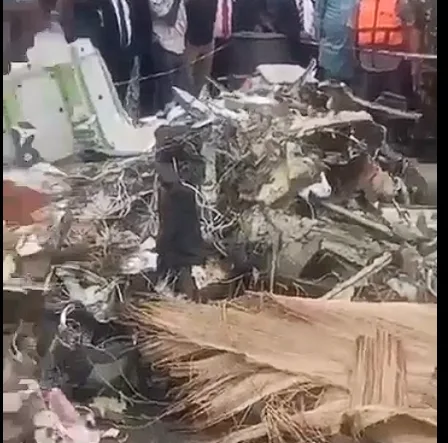

Nine days after crash, remains of 25 victims unrecovered; residents fear water contamination as government plans emergency health measures
Fears of a public health crisis have mounted in Igbokoda, headquarters of Ilaje Local Government Area of Ondo State, following complaints of an increasingly offensive stench from the site of the Nigerian Air Force aircraft crash that killed 25 people on October 5.

With the victims’ remains still unrecovered nine days after the disaster, residents have raised concerns about possible contamination of the river by decomposing human remains and spilled aviation fuel, prompting the Ondo State Government to order emergency environmental and health interventions.
Governor Lucky Aiyedatiwa has directed the state Ministries of Environment and Health to commence extensive fumigation of the Igbokoda River, while the local government has been instructed to arrange water tankers to supply potable water if the river is found to be severely polluted and unsafe for use.
The governor also ordered the distribution of nose masks and other essential health kits to residents as authorities work to assess and contain potential environmental and public health risks.
The directives were announced in a statement issued on Wednesday by the state Commissioner for Information and Orientation, Idowu Ajanaku.

According to the statement, the intervention became necessary following complaints by residents about the strong odour emanating from the crash site and concerns over the river’s safety.
The government said the water supply arrangement would remain in place pending a lasting solution to any pollution identified.
“The governor reiterated the state government’s commitment to providing all necessary support to the Nigerian Air Force in its ongoing evacuation efforts, as well as ensuring the welfare and safety of residents of the affected community,” the statement added.
The emergency measures followed mounting appeals from the community over the slow recovery of victims’ remains and aircraft wreckage from the swampy crash site.

The Igbokoda monarch, Oba Afolabi Odidiomo, had called on the Federal and Ondo State governments to accelerate recovery operations, warning that the suspected contamination was threatening residents’ access to clean water for domestic purposes, including cooking.
“The odour is extremely offensive. So many parts of the human body are floating around in the river. Some of the bodies have not been recovered. They have decomposed, and it is affecting everything,” the monarch said.
He also reported seeing traces of aviation fuel on the water some distance from the crash site and urged the authorities to combine the recovery of the victims’ remains with an urgent environmental clean-up.
A community leader, Segun Omogbemi, said the odour had become increasingly unbearable, while a resident, Veronica Molehin, said it could be perceived around her home, which is not far from the crash location.
The reports have heightened anxiety in a community where the river is an important source of livelihood and water-related activities.
However, the extent of any contamination and its implications for human health remain to be established by the ongoing environmental assessment. The state government has not announced any confirmed disease outbreak linked to the crash.
Recovery delays deepen concerns
The Nigerian Air Force ATR-42 aircraft, with registration number NAF 931, crashed into a swampy area of Igbokoda on October 5 while reportedly undertaking a routine mission from Benin City, Edo State, to Lagos.
All 25 people on board, comprising five crew members and 20 passengers, were reported killed.
The difficult terrain and the aircraft’s submersion in the water have complicated recovery operations, despite the deployment of amphibious equipment and the involvement of military personnel, emergency responders and local divers.
The Ondo State Government had deployed amphibious swamp machines to assist the Nigerian Navy, Air Force and other responders in reaching the crash site.
The state Commissioner for Environment, Tob Loko, said the government had sent a delegation to assess the environmental impact shortly after the crash and was working with the Federal Government to determine the appropriate response.
He acknowledged concerns about pollution and said the authorities were conducting a comprehensive assessment of the environmental and public health implications.
The delay in recovering the victims’ remains has nevertheless intensified pressure on the military and other agencies to expedite the operation, particularly as residents continue to report the worsening odour.
The governor’s latest directives represent an immediate attempt to protect residents while recovery and environmental assessments continue.
Air Force intensifies search, begins investigation
The Nigerian Air Force said it had intensified search and recovery operations and constituted a 12-member board to investigate the circumstances surrounding the crash.
In a statement on Tuesday, the Director of Public Relations and Information, Air Commodore Ehimen Ejodame, said the Chief of the Air Staff, Air Marshal Sunday Aneke, had directed sustained recovery efforts alongside a comprehensive investigation.
Air Vice Marshal E.O.E. Ebiowe is coordinating the investigation and recovery team, while Air Vice Marshal F.O. Ankeli heads the Aircraft Accident Investigation Board.
The board comprises specialists in aviation operations, flight safety, piloting, air traffic control, aircraft engineering, maintenance and medical services. Representatives of the Nigerian Civil Aviation Authority and the Nigerian Safety Investigation Bureau are also members.
Its mandate includes examining operational, technical, environmental, human and organisational factors surrounding the crash, preserving evidence and determining the immediate and underlying causes.
The board will also assess the emergency response, including search and rescue, medical assistance, recovery operations and the management of the crash site, before recommending measures to prevent a recurrence.
The Air Force cautioned against drawing conclusions about the cause of the accident before the investigation is completed.
It also announced a dedicated helpline for victims’ next of kin and said arrangements had been made to meet affected families and provide support.
National Assembly demands accountability
The disaster has also renewed scrutiny of military aviation safety, aircraft maintenance and the adequacy of funding for the Nigerian Air Force.
The Senate on Tuesday called for a comprehensive audit of the Air Force’s aircraft fleet and maintenance funding, directing relevant committees to examine budgetary allocations and establish whether funding gaps or other deficiencies contributed to recurring military aviation accidents.
The resolutions followed a motion sponsored by Senator Osita Ngwu, representing Enugu West.
The lawmakers urged the Air Force and the Nigerian Safety Investigation Bureau to investigate the crash’s immediate and underlying causes and make their findings public. They also directed the relevant Senate committees to visit the crash site and scrutinise the serviceability and airworthiness of military aircraft.
The House of Representatives separately called for an independent investigation into the October 5 incident, saying it should complement, rather than replace, the inquiry announced by the Air Force.
The House also urged the Federal Government to ensure the timely release of approved funds for aircraft maintenance, spare parts and other operational requirements, while calling for an audit of military aircraft and equipment.
An analysis of budget documents showed that the Air Force earmarked approximately N37.10bn for aircraft maintenance across five budget cycles between 2022 and 2026. The figures rose from N2.56bn in the 2022 Appropriation Amendment and the 2023 Appropriation Act to N11.57bn in the 2025 Appropriation Act and N15.56bn in the 2026 Appropriation Bill.
However, the actual amounts released and spent on maintenance could not be established from the available records. The budgeted figures alone therefore do not establish whether funding shortfalls or maintenance failures contributed to the crash.
Aviation experts have also called for stronger independent oversight of military aviation and closer cooperation between the Air Force and civilian aviation safety authorities.
The crash has drawn renewed attention to the need for transparent investigations, effective aircraft maintenance and stronger emergency-response arrangements.