
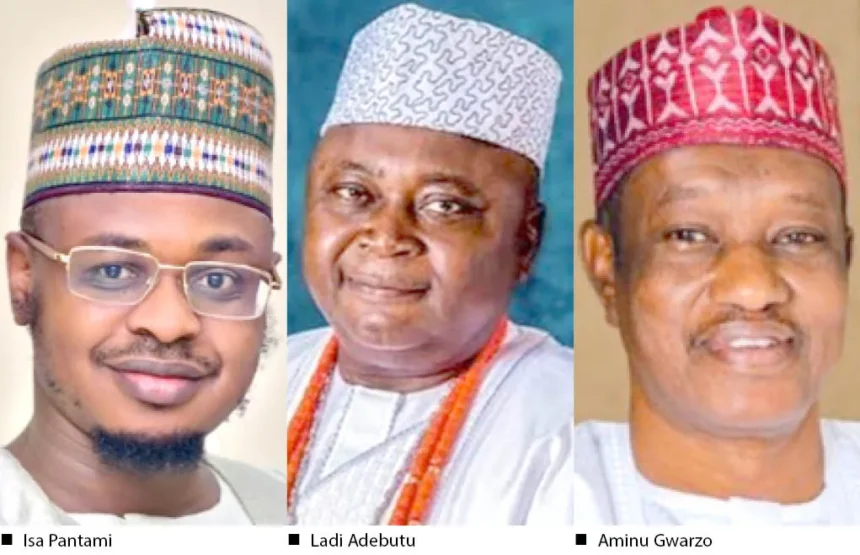

The Independent National Electoral Commission (INEC) is set to determine the fate of prominent governorship aspirants Isa Ali Pantami, Ladi Adebutu and Abdulsalam Gwarzo, whose names were missing from its final list of candidates for the 2027 elections, triggering protests, legal action and fresh uncertainty over their political ambitions.

The commission is expected to consider petitions submitted by the affected candidates and political parties at its meeting on Thursday, October 29, following the expiration of the statutory deadline for challenging the omissions.
The dispute centres on compliance with the Electoral Act 2026, particularly provisions requiring political parties to submit their membership registers before conducting valid primaries.

Pantami, a former Minister of Communications and Digital Economy and the Peoples Democratic Party (PDP) governorship candidate in Gombe State; Gwarzo, the Nigeria Democratic Congress (NDC) candidate in Kano State; and Adebutu, the PDP candidate in Ogun State, are among the prominent politicians affected by the decision.
Other omitted candidates include Senator Danjuma Laah, the NDC governorship candidate in Kaduna State, and Sebastine Hon of the Social Democratic Party (SDP) in Benue State.

An INEC source said that the commission would review the outstanding petitions at its weekly meeting, raising expectations that the prolonged uncertainty over the candidates’ status could soon be resolved.
The source said the relevant departments had examined the submissions and prepared a preliminary report for consideration by the commission’s leadership.
The outcome could determine whether the affected politicians are restored to the list or are forced to pursue further legal remedies to secure recognition as candidates.
Supreme Court ruling at heart of dispute
INEC’s decision to omit the candidates followed the Supreme Court’s September 24, 2026, judgment affirming the constitutionality of Sections 77(5)–(7) of the Electoral Act 2026.
In the case of INEC v. Zenith Labour Party, Appeal No. SC/CV/495/2026, the apex court upheld the statutory requirements relating to the submission of party membership registers before valid primaries can be conducted.
Following the judgment, INEC said some political parties had failed to submit the required registers, resulting in the exclusion of their candidates from the governorship list released on October 10.
The commission maintained that its action was guided by the Supreme Court’s decision and Section 287(1) of the 1999 Constitution, as amended, which requires authorities to give effect to decisions of superior courts.
INEC also explained that the presidential and National Assembly candidates’ lists had been published on September 12, before the Supreme Court delivered its judgment.
The commission subsequently invited affected parties and eligible persons to notify it of alleged errors or wrongful omissions under Section 32(2) of the Electoral Act 2026. The deadline was October 24.
Several petitions were reportedly submitted before the deadline, with INEC officials indicating that the complaints had been forwarded to the chairman for consideration alongside advice from the relevant departments.
The central question is whether the affected parties complied with the statutory requirements and whether the candidates can establish grounds for their inclusion in the final list.
Gwarzo takes INEC to court
In Kano, Gwarzo has moved against INEC in court over the omission of his name and that of his running mate, Rabiu Mustapha.
In an originating summons dated October 20, 2026, the NDC candidate is seeking a declaration that the exclusion of the pair from the commission’s final list was unlawful, unconstitutional and contrary to the Electoral Act 2026.
He wants the court to determine whether INEC can refuse to recognise the party’s nomination and whether the commission should amend and republish the list to include their names.
Among the reliefs sought is an order compelling INEC to recognise Gwarzo and Mustapha as the NDC’s governorship candidates in Kano for the 2027 general elections.
He is also asking the court to declare that the party complied with Sections 77(5)–(7) of the Electoral Act, as interpreted by the Supreme Court, and to restrain INEC from treating the October list as final without their names.
The suit introduces a legal dimension to the dispute, although the commission is also expected to consider the petitions submitted through its administrative process.
Whether the court action will affect the timing or outcome of INEC’s review remains unclear.
Adebutu questions exclusion in Ogun
In Ogun State, Adebutu’s omission has generated political controversy, particularly because his name had appeared on INEC’s preliminary list published in August.
While Adebutu and his running mate, Yemi Sowunmi-Kolapo were excluded from the final governorship list, other PDP candidates contesting seats in the House of Assembly, House of Representatives and Senate were cleared. They include Senator Iyabo Obasanjo, daughter of former President Olusegun Obasanjo.
The contrast has raised questions about the specific circumstances surrounding the governorship candidates’ exclusion.
Adebutu, however, insists that he remains a duly registered member of the PDP and that his documentation was submitted to INEC within the stipulated period.
In a statement published on his X and Facebook accounts, he said the circumstances surrounding his exclusion raised “serious questions” and vowed to pursue the matter through the appropriate channels.
He maintained that he had completed his digital party registration within the required period and that his membership card had been printed and verified.
“My documentation was duly submitted to INEC within the prescribed time. I have not at any point left the PDP, and my commitment to our great party remains unwavering,” he said.
INEC’s review is expected to clarify the circumstances behind his exclusion and whether the commission considers his complaint sufficient to warrant a change to the published list.
Prayers for Pantami as Gombe awaits decision
In Gombe State, supporters of Pantami have turned to religious activities amid uncertainty over his governorship ambition.
A group organised a Qur’anic recitation and prayer session seeking divine guidance and blessings for the former minister as the state prepares for the 2027 election.
The gathering also featured prayers for peace, stability and progress in Gombe and the country.
Pantami’s omission is particularly significant given his profile as a former federal minister and the PDP’s nominated candidate in the state. However, the commission’s decision will ultimately depend on its assessment of the applicable electoral provisions and the representations submitted by the affected parties.
For the candidates, the immediate challenge is to establish that their parties complied with the statutory requirements governing membership registration, primaries and nomination.
If INEC upholds the omissions, the affected politicians may have to intensify their legal challenges, subject to the applicable law and the circumstances of each case.
The dispute has placed the spotlight on the relationship between party nomination procedures, statutory compliance and INEC’s responsibility to enforce electoral laws.
Thursday’s meeting is therefore expected to be a significant step in resolving the controversy, although the ultimate fate of any candidate who remains excluded could depend on subsequent court proceedings.