
The Senate has rejected a proposal to revive the suspended Nigeria Air project, but Senate President Godswill Akpabio has called for a fresh legislative initiative to establish a national carrier for the country.

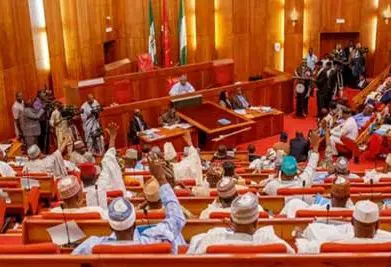
The proposal was rejected during plenary on Tuesday, November 3, 2026, while lawmakers deliberated on Nigeria’s Bilateral Air Services Agreement (BASA) with China.
An additional prayer seeking the revival of Nigeria Air was put to a voice vote but failed to secure the Senate’s approval.
Akpabio initially dismissed the proposal, describing the matter as a dead issue that should not consume the chamber’s time.

“It’s so simple. We don’t have to waste time discussing dead issues,” he said.
However, the Senate President subsequently argued that Nigeria needed a national airline and urged lawmakers to initiate a fresh legislative process to achieve the objective.
“Somebody should bring a motion that will enable Nigeria to revive its own airline. Nigeria should have Nigerian Airways. A national carrier should birth in this country carrying Nigerian flag as it used to be,” he said.

Akpabio recalled that the defunct Nigeria Airways once operated about 40 aircraft across different routes, with approximately 32 aircraft on the ground.
He also expressed concern over the difficulties travellers face in securing private aircraft for charter and the pressure on domestic airlines during the December festive travel season.
The debate over a national carrier followed deliberations on a substantive motion sponsored by the Senate Chief Whip, Senator Tahir Monguno, seeking a review and enforcement of Nigeria’s Bilateral Air Services Agreement with China.
Monguno urged the Federal Government to secure reciprocal aviation access for Nigerian airlines to operate direct flights to China, arguing that improved air connectivity would strengthen trade and economic relations between both countries.
He said more than one million Nigerians live in China, while over 500,000 Chinese nationals reside in Nigeria, making direct air links increasingly important for business, commerce and people-to-people relations.
According to him, direct flights would reduce travel time, improve supply-chain efficiency and limit foreign exchange outflows associated with international travel.
Senator Abdul Ningi, however, questioned whether Nigeria was receiving commensurate benefits from its relationship with China, given the Asian country’s growing influence in the global economy.
Akpabio warned that Nigeria might have to reconsider the privileges extended to Chinese airlines if Nigerian carriers were denied reciprocal access to operate direct flights to China.
The Senate consequently urged the Ministry of Aviation and Aerospace Development to renegotiate the bilateral agreement to secure direct commercial air connections between the two countries.
It also mandated the Ministry of Foreign Affairs to initiate diplomatic discussions with Beijing on facilitating business visas for Nigerian traders and securing reciprocal airport slot allocations.
The Senate Committee on Legislative Compliance was directed to monitor the implementation of the resolutions and report back within four weeks.
How Nigeria Air project collapsed
Nigeria Air was initially unveiled in July 2018 under former President Muhammadu Buhari’s administration but was suspended two months later amid concerns about its viability.
The project was subsequently revived through a proposed partnership with Ethiopian Airlines, which won the bid to manage the carrier in 2022.
Under the proposed ownership structure, Ethiopian Airlines was to hold 49 per cent equity, the Federal Government five per cent, SAHCO 15 per cent, while other investors would own the remaining 31 per cent.
The airline was unveiled in May 2023 by former Aviation Minister Hadi Sirika.
However, the proposed arrangement ran into legal and regulatory difficulties. In August 2024, the Federal High Court in Lagos declared the proposed sale to Ethiopian Airlines invalid and legally ineffective following a suit by the Airline Operators of Nigeria and other industry stakeholders.
Aviation Minister Festus Keyamo subsequently disclosed that the arrangement would have required Nigeria to pay Ethiopian Airlines approximately $112 million over three years for the use of its surplus aircraft, despite the aircraft being presented as part of its equity contribution.
Keyamo also criticised provisions granting Ethiopian Airlines tax exemptions and indemnities, as well as control over key management positions, including the chief executive and chief financial officers.
He argued that the terms were not in Nigeria’s best interest and announced the suspension of the project in 2024.
Sirika is also facing prosecution over alleged money laundering and contract fraud linked to the national carrier project.
Nigeria Airways, the country’s former state-owned national airline, operated from 1958 until its liquidation in 2003.
Although the airline enjoyed considerable growth during its early years, mismanagement, corruption and overstaffing contributed to its eventual collapse.
By the time it ceased operations, its debts had reportedly risen to about $528 million, while its operational fleet had dwindled dramatically. Passenger numbers also fell from 2.1 million in 1985 to just 10,000 in the first quarter of 2003.
The collapse left thousands of former employees without their pensions, gratuities and severance benefits for years. In September 2026, the Federal Government commenced an N18 billion severance settlement covering about 2,700 former workers.