

African women entrepreneurs are demonstrating stronger business performance in reinvestment and job creation, underscoring the economic cost of denying women access to capital and leadership opportunities, billionaire businessman and philanthropist, Tony Elumelu, has said.

Elumelu, Chairman of Heirs Holdings and founder of the Tony Elumelu Foundation (TEF), said women entrepreneurs supported by the foundation had recorded impressive business outcomes, including higher rates of reinvestment and recruitment, compared with their male counterparts.
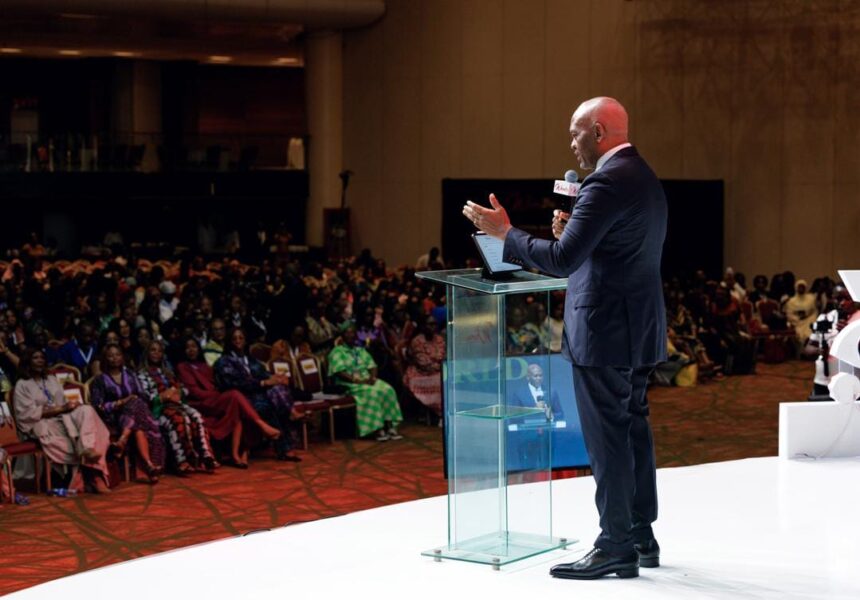
He made the observation while delivering the keynote address at the 25th annual conference of the Women in Management, Business and Public Service (WIMBIZ) in Lagos on Friday.

Speaking on the theme, The Geography of Opportunity: Why the World Needs What Africa Has, Elumelu disclosed that his foundation had disbursed more than $120m in seed capital to 24,633 young entrepreneurs across all 54 African countries over the past 15 years, with women accounting for 48 per cent of beneficiaries.
The beneficiaries, he said, had collectively created more than 1.5 million jobs and generated over $4.2bn in revenue.
He stressed that the substantial participation of women in the programme was not the product of affirmative action or gender quotas, but the outcome of an objective selection process based on the quality of applicants’ business plans.

“Our women entrepreneurs succeed, reinvest and re-hire at rates our male entrepreneurs should envy,” he said.
According to him, the results demonstrate that investing in women is not merely a social responsibility but a sound economic decision capable of generating jobs, expanding businesses and strengthening African economies.
Elumelu illustrated the impact of relatively modest seed funding with the experiences of three Nigerian women entrepreneurs who received $5,000 each from the foundation and went on to build businesses with significant economic and social impact.
One of them, Princess Adeyinka Tekenah, who received the grant in 2015, established Happy Coffee, an integrated coffee business sourcing beans from women farmers in Taraba State.
Operating in a country that imports about 90 per cent of its coffee, Tekenah has built a business that has created more than 1,000 jobs and organised the first Lagos Coffee Festival.
Elumelu said she was working towards making the company Nigeria’s first publicly listed coffee brand.
Another beneficiary, Olamide Ayeni-Babajide, used her $5,000 grant in 2016 to establish a recycling business that transforms waste tyres into useful products.
The company’s revenue has grown more than 20-fold, while it has trained about 15,000 people, most of them women and girls.
Similarly, Nkem Okocha, who received funding in 2015, established Mama Moni, a financial technology social enterprise providing access to credit for low-income women entrepreneurs in rural communities and urban slums.
Through its digital platform, Mama Moni connects socially conscious investors with disadvantaged women seeking loans to establish or expand their businesses.
“Three women. Fifteen thousand dollars between them. Thousands of jobs. Now tell me the world does not need what Africa has,” Elumelu said.
He disclosed that the foundation received 265,529 applications for its entrepreneurship programme in 2026 but could only support 3,200 beneficiaries, representing approximately one in every 83 applicants.
For him, the disparity highlights the enormous pool of entrepreneurial talent across the continent and the urgent need to mobilise more capital to support viable businesses.
He argued that Africa’s development ambitions would remain constrained if women, who constitute approximately half of its human capital, continued to face barriers to financing and economic leadership.
“Women’s economic leadership is not a concession to fairness. It is a requirement for competitiveness,” he said.
“No serious economy can afford to systematically underutilise half its talent. A continent that ignores half its talent is competing with one hand tied behind its back.”
Elumelu also cited the growing presence of women in senior executive positions across companies within his business group as evidence that women could successfully lead major businesses in traditionally male-dominated sectors.
He listed eight women serving as chairpersons or chief executives across Heirs Holdings and its subsidiaries, including Owen Omogiafo, President and Group Chief Executive of Transcorp Plc; Uzo Oshogwe, Managing Director of Transcorp Hotels; Somachi Chris-Asoluka, Chief Executive Officer of TEF; and Dr Awele Elumelu, Chairperson of Transcorp Hotels and Avon HMO.
Others include Agatha Obiekwugo of Afriland Properties, Catherine Nwosu of Africa Prudential, Dr Odiri Ogini of United Capital Asset Management, Adetola Fasuyi of United Capital Wealth Management and Esther Adeola Balogun of UCEE Microfinance Bank.
He also highlighted the representation of women in senior positions across United Bank for Africa’s African operations, including regional and country chief executives.
Elumelu singled out Omogiafo’s appointment in 2020 as President and Group Chief Executive of Transcorp, describing her emergence as the company’s first female chief executive as an example of the value of developing and promoting internal talent.
He said women occupied 80 per cent of Transcorp’s senior management positions by the time she assumed the group leadership role.
His wife, Dr Awele Elumelu, also featured prominently in his account of women’s leadership within the group. A medical doctor by training, she co-founded Heirs Holdings and the Tony Elumelu Foundation and chairs several businesses, including Avon HMO, Avon Medical and Heirs Energies.
Elumelu challenged corporate leaders to reconsider the barriers preventing qualified women from attaining senior positions, arguing that businesses stood to gain from recognising and deploying available talent regardless of gender.
“The women you promote will not thank you with loyalty alone. They will thank you with results,” he told male business leaders at the conference.
Beyond corporate appointments, he called for a broader rethink of Africa’s economic development strategy, insisting that women’s access to finance must become central to efforts to unlock the continent’s entrepreneurial potential.
He identified electricity, local value addition and capital as major constraints to Africa’s economic transformation, arguing that inadequate infrastructure and limited access to financing continued to undermine businesses across the continent.
He also urged African investors, banks, pension funds, insurance companies and family offices to channel more domestic capital into businesses, particularly those capable of creating jobs and expanding production.
According to him, the continent must move away from excessive dependence on foreign aid towards investment, trade and the development of indigenous businesses.
He called for greater use of the African Continental Free Trade Area to expand opportunities for women-owned businesses and other African enterprises, stressing the need for better transport infrastructure, payment systems, customs procedures and predictable regulations to facilitate cross-border trade.
Elumelu said advocacy had helped women gain entry into business and leadership spaces, but access to capital would determine how many could advance to positions of greater influence.
“Advocacy got women into the room. Capital will get them to the head of the table,” he said.
He disclosed that the Tony Elumelu Foundation had so far funded 13,360 African female entrepreneurs, adding that he expected the number to increase substantially.
He urged women not to wait for favourable circumstances before pursuing their ambitions, but to establish businesses, seek board positions, deploy capital and create opportunities for other women.
He also challenged WIMBIZ to make its next 25 years more consequential by ensuring that more women progressed from entrepreneurship and professional management into the highest levels of corporate and economic leadership.