

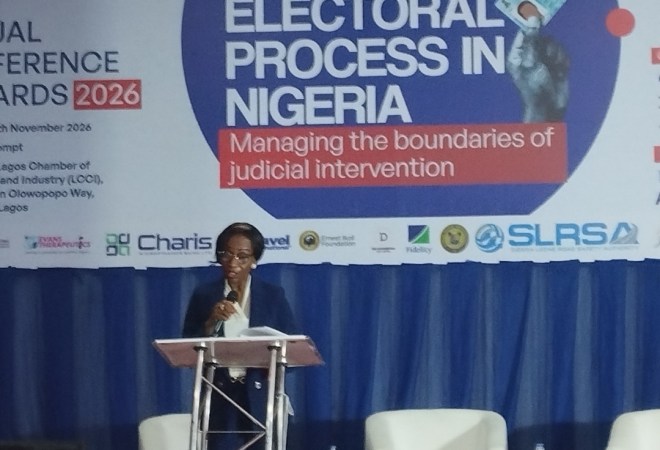

The supremacy of the electorate in determining who governs must never be sacrificed on the altar of legal technicalities, political manipulation or judicial pronouncements, a retired Justice of the Court of Appeal, Hon. Justice Oludotun Adefope-Okojie, has declared.

She warned that Nigeria’s democracy was being dangerously undermined by a growing practice in which politicians who lose elections seek to secure power through the courts, turning the judiciary into an alternative electoral arena where mandates are sometimes conferred on candidates who were rejected at the polls.
Adefope-Okojie, who delivered the 2026 Gavel International Annual Lecture in Lagos on Tuesday, argued that the ballot box, not the courtroom, must remain the ultimate source of political authority in a democracy.

Speaking on the theme, Electoral Process in Nigeria: Managing the Boundaries of Judicial Intervention, she insisted that the constitutional authority of the courts to adjudicate electoral disputes did not give them the licence to substitute their preferences for the choices of voters.
“The Constitution places sovereignty in the people and makes the Courts the guardians of that sovereignty, not its holders,” she declared.
According to her, judicial intervention is legitimate only to the extent that it protects the electorate’s choice. It loses its legitimacy when it replaces that choice with a judicially imposed outcome.
She said: “A judgment that corrects a stolen mandate honours it. A judgment that confers a mandate the voters never gave, however lawful in form, diminishes it.”
The retired appellate judge expressed concern that Nigeria had developed an electoral culture in which political parties manipulate their internal processes, impose candidates, substitute duly nominated aspirants and conduct flawed primaries, only for the resulting disputes to overwhelm the courts.
She blamed political parties for much of the crisis, accusing them of disregarding their own constitutions in selecting candidates and exploiting judicial reluctance to intervene in their internal affairs to perpetrate injustice.

According to her, flawed party congresses, wrongful substitution of successful candidates and the imposition of preferred aspirants have fuelled much of the pre-election litigation, while ballot snatching, vote buying, rigging, manipulation and falsification of results have generated disputes after elections.
The consequence, she said, is an aberration in which candidates who should have been rejected by voters sometimes end up occupying public offices through court decisions.
She lamented that some legislators at federal, state and local government levels were not necessarily the choices of their constituents and, consequently, had little incentive to feel accountable to the electorate.
The scale of Nigeria’s electoral litigation, she said, was particularly alarming when compared with other democracies.
Citing figures from the 2023 general elections, Adefope-Okojie disclosed that 1,209 election petitions were filed against 1,280 contested offices, representing approximately 94 petitions for every 100 seats.
She contrasted this with Ghana, which recorded about six petitions per 100 parliamentary seats following its 2020 elections, and Kenya, where the ratio fell from approximately 21 per 100 elective seats in 2017 to fewer than seven in 2022.
More troubling, she noted, was that only 103 of Nigeria’s 1,209 petitions arising from the 2023 elections succeeded, meaning that more than nine out of every 10 petitions failed.
For her, the figures reflected a profound crisis of confidence in the electoral process rather than evidence that the courts were successfully correcting widespread electoral fraud.
She maintained that the solution was not to shut the doors of the courts against aggrieved candidates but to ensure that judicial intervention did not undermine the fundamental democratic principle that political power derives from the consent of the governed.
Adefope-Okojie identified two dangerous tendencies in electoral adjudication: substitutive justice and abdicative justice.
She explained that substitutive justice occurs when courts install or remove office-holders on grounds that voters did not determine, without returning the electoral question to the electorate.
Abdicative justice, on the other hand, occurs when courts decline to examine credible evidence of electoral malpractice because of technical, evidential or jurisdictional obstacles that petitioners may find practically impossible to overcome.
She argued that both tendencies undermine democracy: one replaces the people’s verdict with a judicial decision, while the other allows a potentially fraudulent electoral declaration to stand.
“The first two types [corrective and protective justice] are what the Constitution requires. The last two are the twin failures. A healthy jurisprudence avoids both these latter ones: it does not substitute, and it does not abdicate,” she said.
The jurist cited controversial electoral disputes, including the 2019 Zamfara elections, the 2020 Bayelsa governorship election and the 2023 Plateau elections, as examples of the dangers associated with judicial decisions whose consequences may displace the choices made by voters.
In the Zamfara case, the Supreme Court held that the APC had not conducted valid primaries and consequently had no candidates for the elections. Votes cast for the party were treated as wasted, paving the way for the declaration of candidates of the PDP as winners despite the APC having secured the overwhelming majority of votes.
In Bayelsa, the disqualification of the APC deputy governorship candidate over alleged false information resulted in the removal of the governor-elect, who had won the election alongside him, and the emergence of the runner-up.
In Plateau, the Court of Appeal removed several elected lawmakers over issues relating to their party’s structures. Although the Supreme Court subsequently restored the governorship election victory of the PDP candidate, the affected legislators had no further right of appeal against the appellate court’s decisions.
Adefope-Okojie argued that such outcomes exposed the need for courts to consider the democratic consequences of their decisions, particularly when determining the appropriate remedies in election disputes.
Where a candidate’s qualification is defective but the votes cast do not establish that another candidate was the people’s choice, she said, the appropriate remedy should ordinarily be a fresh election rather than the automatic declaration of the runner-up.
“The preferred remedy is a fresh election, not a judicial declaration of a winner,” she maintained.
She cited Kenya’s 2017 presidential election, which was annulled by the country’s Supreme Court over irregularities in the transmission and verification of results, as an instructive example.
Rather than declare the challenger the winner, the Kenyan court ordered a fresh election, allowing voters to make the final decision.
She also referenced Malawi’s annulment of its 2019 presidential election over widespread irregularities, which led to a fresh poll won by the opposition candidate.
According to her, these experiences demonstrate that courts can decisively confront electoral malpractice without arrogating to themselves the power to determine who should govern.
The retired justice also criticised what she described as excessively onerous evidential requirements imposed by Nigerian courts on election petitioners.
She argued that requiring petitioners to establish irregularities polling unit by polling unit, sometimes involving thousands of documents and witnesses within a limited period, makes it practically impossible to prove even serious electoral malpractice.
With approximately 176,000 polling units nationwide, she questioned the rationale for demanding that electoral officials from virtually every affected polling unit personally appear in court to authenticate documents that have been duly certified.
She maintained that such an approach undermines the provisions of the Evidence Act and the Electoral Act, which permit properly certified public documents to be admitted in evidence.
She also urged courts to give practical effect to provisions of the Electoral Act 2026 allowing documentary evidence to be tendered and taken as read, rather than dismissing petitions because witnesses who are subpoenaed, particularly officials of the Independent National Electoral Commission (INEC), have not frontloaded witness statements.
She welcomed the statutory recognition of the Bimodal Voter Accreditation System (BVAS) and the INEC Result Viewing Portal (IReV) as sources of electronic evidence but warned that the undefined communication-failure exception could become a loophole for frustrating electoral accountability.
Adefope-Okojie further called for a fundamental reconsideration of the legal framework governing election petitions, particularly the exclusion of ordinary voters from directly challenging disputed election outcomes.
She observed that under Section 137 of the Electoral Act 2026, as under the previous legislation, the right to file an election petition is restricted to candidates and political parties, leaving the electorate whose sovereignty is at stake without direct standing.
She said this omission had contributed to the tendency of election disputes being treated primarily as contests between politicians and political parties, with insufficient consideration for the millions of voters whose choices could be affected by the eventual judgment.
She urged the judiciary to adopt popular sovereignty as its guiding principle, insisting that electoral laws should, wherever their provisions are ambiguous, be interpreted in favour of giving effect to the free choice of the electorate.
The judge also called for greater integrity, transparency and political neutrality in the selection of election tribunal members, warning that public confidence in the judiciary was essential to the legitimacy of electoral judgments.
She urged the Chief Justice of Nigeria, the President of the Court of Appeal and heads of courts to ensure that only judges with unquestionable integrity, sound knowledge and demonstrable political neutrality are appointed to election tribunals.
With the 2027 general elections approaching, she said the judiciary must be particularly conscious of the need to avoid political interference, conflicting orders and judgments that could create the impression that the courts were determining electoral winners.
She nevertheless acknowledged that the judiciary remained indispensable to Nigeria’s democracy, noting that courts had, on several occasions, corrected stolen mandates and restored the legitimate choices of voters where the electoral process failed.
But she insisted that the ultimate objective of electoral adjudication should be to strengthen the credibility of elections to the point where judicial intervention becomes increasingly unnecessary.
“The test of a good election judgment is not only whether it applies the law correctly, but whether, at the end of it, the person who holds office is the person the lawful votes chose, or, if that cannot be known, whether the choice has been returned to the voters,” she said.
She added that courts should declare a candidate the winner only where the lawful votes clearly establish that person’s victory. Where the evidence cannot reliably establish the electorate’s choice, the matter should be returned to the voters through a fresh election or rerun.
“It is not the duty of the Courts to award seats,” she declared.
Adefope-Okojie urged political parties to conduct credible primaries, INEC to discharge its constitutional responsibility impartially and the National Assembly to strengthen the legal and institutional safeguards necessary to protect electoral integrity.
She concluded that Nigeria must move away from a democracy in which politicians routinely seek judicial validation of electoral victories and return to one in which elections are genuinely won and lost at the ballot box.
“The final aim of electoral adjudication should be its own decline: a democracy in which elections are won and lost at the ballot box, not in the courtroom.”