

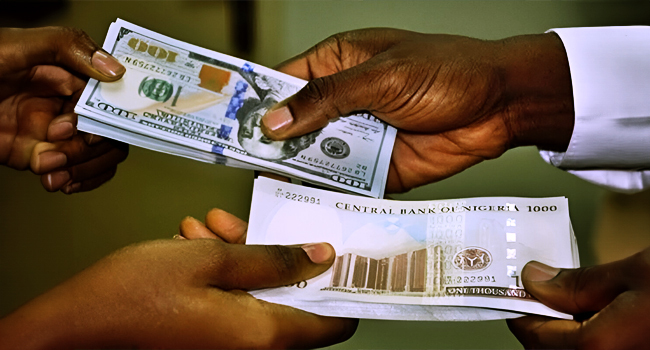

Nigeria’s naira weakened further on Thursday, closing at N1,388 to the dollar, its weakest closing level in eight months, as interbank foreign exchange turnover surged by 59.14 per cent to $800.31 million.
The latest depreciation brings the currency closer to the N1,400/$ threshold, with the exchange rate touching an intraday high of N1,397/$, according to Central Bank of Nigeria (CBN) trading data.

The naira last closed at the same level on March 5, underscoring renewed pressure on the currency despite a sharp increase in foreign exchange trading activity.
Data from the Nigerian Foreign Exchange Market (NFEM) showed that the official exchange rate depreciated to N1,376.58/$ on Thursday from N1,363.23/$ on Wednesday, representing a loss of N13.35 or 0.98 per cent.
The closing rate also weakened by N8.01, or 0.58 per cent, from Wednesday’s N1,379.99/$.
The depreciation occurred amid a substantial increase in interbank dollar transactions, raising questions about the effectiveness of rising market activity in supporting the naira.

FX turnover rises 59%
Interbank foreign exchange turnover climbed to $800.31 million across 184 transactions on Thursday, up from $502.88 million recorded in 148 deals the previous day.
This represents a 59.14 per cent increase in trading value and a 24.3 per cent rise in transaction volume.

The latest figure is also more than 11 times the $68.66 million recorded across 79 transactions on Monday, representing an increase of approximately 1,065 per cent.
Thursday’s trading range was between N1,370/$ and N1,397/$, with a simple average of N1,382.87/$.
Despite the surge in activity, the naira continued to lose ground. Its closing rate weakened by N28, or 2.06 per cent, from N1,360/$ on Monday.
The official NFEM rate also depreciated by N19.39, or 1.43 per cent, from N1,357.19/$ on Monday.
Meanwhile, the CBN recorded NFEM turnover of $1.183 billion across 350 transactions on Wednesday. The separate NFEM turnover and transaction count for Thursday had yet to be disclosed.
Analysts warn of further depreciation
Head of Research at IRON Capital Partners, Abiodun Ogunniyi, warned that the naira could depreciate towards N1,400/$ before the end of the year if the underlying pressures persist.
He identified tighter monetary conditions in advanced economies, political uncertainty ahead of the 2027 general elections and rising demand for imported goods as major factors weighing on the currency.
According to him, the exchange-rate outlook remains unfavourable in the absence of significant changes in these conditions.
Ogunniyi also raised the possibility of CBN intervention in the foreign exchange market before the end of November or, at the latest, in December.
He noted that the gap between the official and parallel market rates had widened to between N80 and N90, compared with approximately N21 to N24 a month earlier.
The widening differential, he said, was a source of concern, particularly as the International Monetary Fund considers a parallel-market premium exceeding five per cent an indication of significant distortions in the foreign exchange market.
Analysts at Coronation Merchant Bank also warned of renewed exchange-rate volatility, attributing the naira’s vulnerability to a mismatch between dollar availability and liquidity reaching the market.
In their fourth-quarter thematic report, titled Reserves Up, Liquidity Down – Is Naira Volatility Back?, the analysts described the currency as fundamentally undervalued but tactically vulnerable.
They warned that relatively modest foreign exchange orders could trigger significant exchange-rate movements when market liquidity is thin.
Declining reserves add to pressure
The naira’s renewed weakness comes amid a decline in Nigeria’s external reserves, raising further concerns about the sustainability of foreign exchange supply.
Gross external reserves fell by $390.94 million in 16 days to $54.87 billion as of November 12, marking their largest decline in six months.
The development has coincided with renewed pressure in the parallel market, where the naira weakened to N1,445/$ on November 12 from N1,430/$ in the previous session, widening the gap with the official rate to N86.50.
Chief Executive Officer of the Centre for the Promotion of Private Enterprise, Muda Yusuf, had also warned that electioneering activities and increased festive-season demand could intensify pressure on the foreign exchange market.
The combination of declining reserves, rising dollar demand and exchange-rate volatility has heightened expectations about the CBN’s next policy response.
The apex bank’s Monetary Policy Committee is scheduled to meet on November 23 and 24, with the meeting expected to take place against the backdrop of renewed currency weakness and concerns about foreign exchange liquidity.
Market participants will be watching for signals on monetary policy, foreign exchange supply and possible intervention as the naira approaches the N1,400/$ mark.