

Bolaji Abdullahi, National Publicity Secretary of the African Democratic Congress (ADC), has alleged that Peter Obi, the 2023 presidential candidate of the Labour Party, defected to the National Democratic Congress (NDC) to sidestep the demands of coalition politics, which he says require compromise, negotiation, and power-sharing.

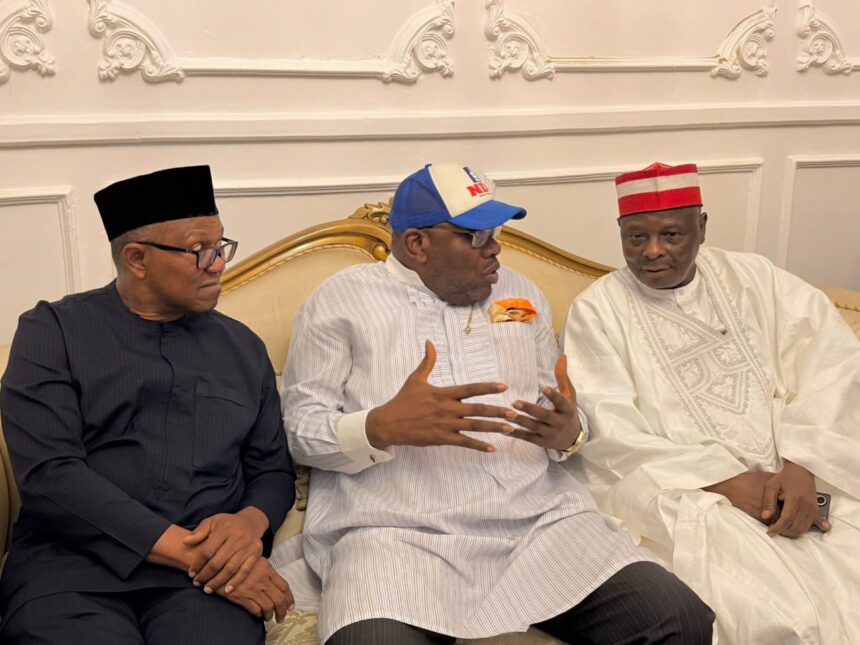
Obi, alongside former Kano State governor Rabiu Musa Kwankwaso, formally aligned with the NDC on Sunday, marking a significant shift in Nigeria’s evolving opposition landscape ahead of the next electoral cycle. The move came after weeks of speculation over realignments among opposition figures seeking a viable platform to challenge the dominance of the ruling party.
Obi had earlier announced his resignation from the ADC, a party that has recently positioned itself as a potential coalition hub for opposition forces. Kwankwaso, leader of the Kwankwasiyya movement and former presidential candidate of the New Nigeria Peoples Party (NNPP), had also signalled ongoing consultations before confirming his move.

Speaking on Prime Time, a programme on Arise Television, on Monday, Abdullahi described Obi’s exit from the ADC as a calculated and long-planned decision. He argued that the former Anambra State governor preferred a political platform that could guarantee him the presidential ticket without the uncertainties of internal competition.
According to Abdullahi, coalition platforms such as the ADC are inherently complex, requiring aspirants to negotiate with multiple stakeholders and accommodate divergent interests—conditions he believes Obi is unwilling to navigate.

“The kind of party Peter Obi needed was the one he has now joined,” Abdullahi said. “A party structure that can assure him of the presidential ticket without subjecting him to rigorous internal bargaining.”
He further claimed that Obi not only sought the party’s presidential nomination but also the latitude to determine his running mate—demands that, he suggested, were incompatible with the ADC’s coalition-driven framework.
Nigeria’s opposition politics has been characterised by fragmentation since the 2023 general election, in which Obi emerged as a major third-force candidate, galvanising a large youth-driven support base but ultimately finishing behind the candidates of the two dominant parties. Since then, efforts to build a broad-based opposition coalition have faced persistent challenges, including leadership tussles, ideological differences, and competing presidential ambitions.
The ADC, though historically a smaller party, has in recent months attempted to reposition itself as a unifying platform for disaffected politicians and emerging political blocs. Obi’s brief association with the party had raised expectations among his supporters that a formidable coalition could emerge.
Abdullahi, however, downplayed the impact of Obi and Kwankwaso’s departure, describing it as a setback but not a crippling blow to the party’s ambitions.
“Personally, I’m not happy they left,” he said. “But in a way, it brings some relief. We can now focus on building the party without the intense pressure that came with managing competing high-profile interests.”
He added that the ADC would not engage in political hostility with the defectors, insisting that differences in strategy should not translate into animosity.
“We are not going into a dogfight with them. They are not our enemies,” Abdullahi said.
The emergence of the NDC as a new rallying point for Obi and Kwankwaso introduces fresh dynamics into Nigeria’s opposition politics. Analysts say the development could either deepen fragmentation or, conversely, trigger new alliances depending on how political actors reposition in the months ahead.
For now, the shifting allegiances underscore a familiar pattern in Nigerian politics, where party platforms often serve as vehicles for ambition, and where the struggle to build enduring coalitions remains one of the opposition’s most persistent challenges.