

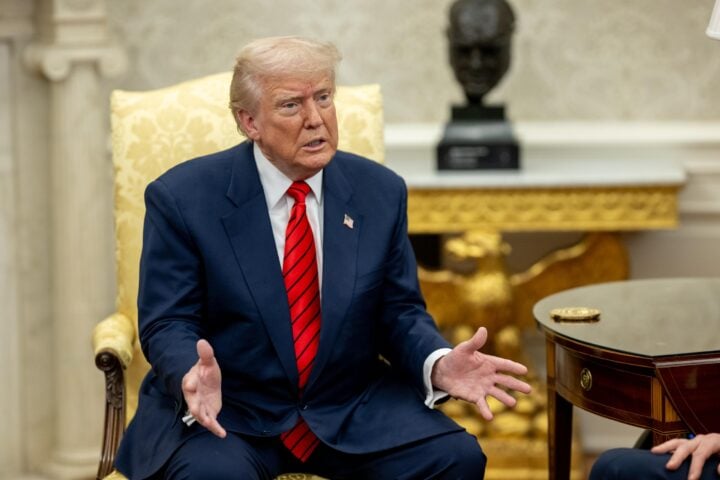

Crude oil prices surged on Monday after U.S. President Donald Trump rejected Iran’s latest peace proposal, describing it as “totally unacceptable.”
This has reignited fears over the future of the Middle East conflict and possible disruptions to global oil supply.

Brent crude futures added $4.04 and now trade at $105.33 at the time of filing this report. For the West Texas Intermediate (WTI), it climbed by $4.43, or 4.64%.

Last week, both contracts recorded 6% weekly losses on hopes for an imminent end to the 10-week-old conflict that would allow oil transit through the Strait of Hormuz.
On Monday, May 10, Donald Trump, in a post on Truth Social, his social media platform, said that Iran’s counterproposal to a U.S. peace deal was “totally unacceptable.”

“I have just read the response from Iran’s so-called representatives. I don’t like it — Totally Unacceptable,” he said.
In an earlier post, Trump claimed that Iran had been playing games with not only the United States but the rest of the world. The President also added that Iran had been killing U.S. citizens for 47 years.
“For 47 years, the Iranians have been ‘tapping’ us along, keeping us waiting, killing our people with their roadside bombs,” he wrote.
With the description of Iran’s deal as unacceptable, it remains unclear how the conflict in the Middle East would progress, or whether the U.S. would offer a counterproposal that could break the gridlock in the negotiations.
Although the details of Iran’s counterproposal were not made public, The Wall Street Journal reported that Iran had offered to transfer some of its stockpile of highly enriched uranium to a third country while rejecting calls to dismantle its nuclear facilities.
Tasnim News Agency, Iran’s semi-official news agency, however, said Iranian authorities disputed the claim.
The news agency claimed that Iran proposed an immediate end to the war, the release of its frozen assets, a lifting of U.S. sanctions on oil sales, an end to the U.S. blockade of the Gulf of Oman, and ultimately Iranian management of the Strait of Hormuz.
Oil prices have remained highly volatile due to the crisis in the Middle East.
Global oil prices fell sharply on Friday, April 17, after Iran announced that the Strait of Hormuz would remain ‘completely open’ for commercial transit during the remaining days of the ceasefire deal between Iran and the United States.
Since the conflict began on February 28, oil prices have surged, reaching as high as $120 per barrel, largely driven by disruptions around the Strait of Hormuz — a critical route through which about 20% of the world’s oil supply passes.
Nigerian crude, Bonny Light, has also been affected by the geopolitical tensions as Bonny Light swung back to $100 per barrel.
The impact has extended to economies like Nigeria, where petrol prices have risen sharply from around N799 per litre before the conflict to over N1,200 per litre.