

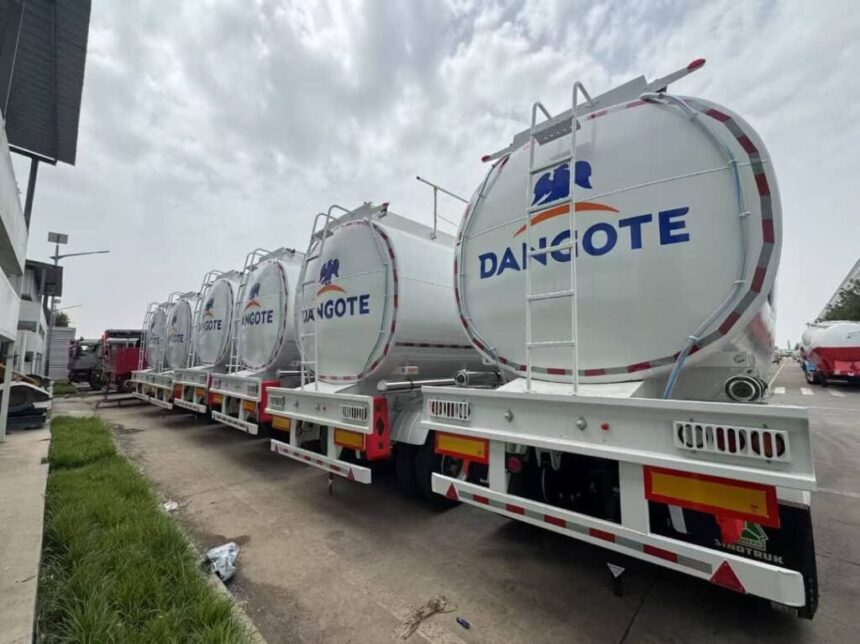

Fresh concerns over a possible disruption in Nigeria’s petrol supply chain have emerged as oil marketers slow down fresh product purchases following the Dangote Petroleum Refinery’s decision to price petroleum products in United States dollars, a move that has unsettled the deregulated downstream market and reignited debate over fuel imports, foreign exchange pressures and the legality of dollar-denominated domestic fuel sales.

Industry operators say many marketers are adopting a cautious approach, reluctant to replenish stocks amid uncertainty over exchange rate risks, replacement costs and the refinery’s new pricing model. The development has heightened fears that prolonged buying hesitancy could tighten supplies in some parts of the country if existing inventories run low.
The development follows Dangote Refinery’s announcement that it would henceforth invoice petroleum marketers in dollars for gantry and coastal sales of Premium Motor Spirit (petrol), Automotive Gas Oil (diesel) and aviation fuel, ending the naira-based payment arrangement introduced under the Federal Government’s naira-for-crude policy.

Under the new pricing template, petrol is quoted at $0.779 per litre, diesel at $1.087 per litre, while aviation fuel sells for $0.942 per litre. The refinery explained that all previously issued naira-denominated proforma invoices had become invalid, although liquefied petroleum gas transactions remain exempt from the dollar pricing regime.
Why Dangote switched to dollars

The refinery attributed the policy shift to mounting difficulties in sourcing sufficient domestic crude under the naira-for-crude arrangement.
Although the Federal Government introduced the initiative in late 2024 to reduce pressure on Nigeria’s foreign exchange market and support local refining, industry data indicate that Dangote has been receiving far fewer crude cargoes than required to operate efficiently. Reuters reported that the refinery needs between 13 and 15 cargoes monthly but received only seven in May, forcing it to increasingly import crude at international prices and pay suppliers in dollars.
The problem has been compounded by rising international crude prices following renewed geopolitical tensions in the Middle East, increasing the refinery’s foreign exchange requirements.
Industry officials say the refinery could no longer sustain the mismatch of purchasing crude in dollars while selling refined products in naira, prompting the commercial decision to align sales currency with production costs.
Marketers hesitate
The policy, however, has created a dilemma for petroleum marketers.
Many downstream operators earn revenue in naira but would now need scarce foreign exchange to purchase products from the refinery, exposing them to exchange rate volatility and increasing financing costs.
The Petroleum Products Retail Outlets Owners Association of Nigeria and the Independent Petroleum Marketers Association of Nigeria have warned that widespread dollar pricing of petroleum products could worsen foreign exchange demand, increase pump price volatility and gradually deepen dollarisation of the economy. They have urged the Federal Government to restore stable crude supplies to local refiners under the naira-for-crude framework.
Industry sources said some marketers have delayed fresh purchases pending greater clarity on the implementation of the new policy and possible government intervention.
Import option regains momentum
The uncertainty has simultaneously strengthened the argument of marketers advocating continued fuel imports as a safeguard against supply disruptions.
Only weeks before Dangote’s announcement, the Nigerian Midstream and Downstream Petroleum Regulatory Authority approved fresh import permits for petrol and diesel for the third quarter of 2026.
The approvals, granted to several downstream operators, were intended to maintain supply security amid concerns over declining inventories and fluctuations in domestic refinery output.
The latest developments are expected to reinforce calls for maintaining an open and competitive downstream market rather than depending almost exclusively on one refinery.
Earlier this year, marketers opposed Dangote Refinery’s legal challenge seeking to invalidate import licences issued by the regulator, arguing that import permits remain essential to guarantee energy security and healthy competition in the deregulated market.
Is dollar pricing legal?
The refinery’s decision has also sparked debate over whether petroleum products meant for domestic consumption should be priced in foreign currency.
However, senior regulatory officials told The PUNCH that the arrangement does not violate the Petroleum Industry Act.
According to the officials, the PIA permits refiners to recover legitimate operating costs and earn commercial returns on their investments. Since Dangote increasingly purchases crude oil in dollars because of inadequate domestic supply, they argued that dollar-denominated product pricing falls within the commercial freedoms guaranteed under the law.
The regulator reportedly maintains that the challenge lies not with the refinery’s pricing policy but with the inability of the domestic crude supply framework to consistently meet the refinery’s requirements.
Wider implications
Energy analysts warn that the controversy highlights unresolved structural weaknesses in Nigeria’s post-subsidy petroleum market.
Despite commissioning Africa’s largest refinery with a nameplate capacity of 650,000-700,000 barrels per day, Nigeria continues to grapple with inadequate domestic crude allocation, foreign exchange constraints and disagreements over the future balance between local refining and fuel imports.
Analysts note that unless domestic crude supply improves significantly, local refining alone may not immediately insulate Nigeria from global oil price movements or exchange rate shocks.
For consumers, the immediate concern is whether marketers’ reluctance to replenish inventories will translate into product shortages or another round of higher pump prices in the coming weeks.