

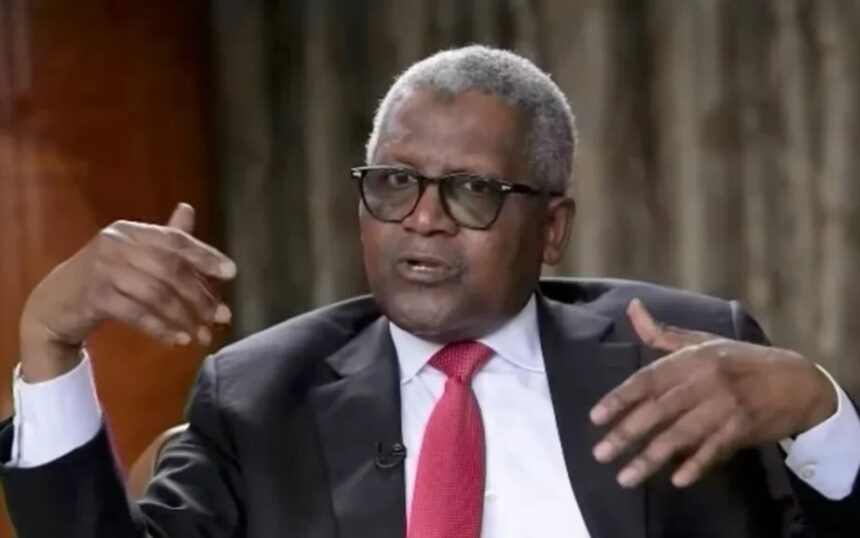

The President of Dangote Group, Aliko Dangote, has said having a male heir to take over his business empire is not a priority, stressing that any of his three daughters could eventually lead the conglomerate.

Dangote made the disclosure during an interview with ARISE News on Tuesday, while discussing succession, corporate governance and the future of the Dangote Group.
The billionaire businessman said he had identified the potential of his daughters, Halima, Fatima and Mariya, who have all held senior positions within the family-owned business empire.

Asked whether he could envisage one of his daughters taking over the group, Dangote said, “I think, yes, I can see one of them. I’ve been watching all of them, so I can definitely see one of the three that can actually lead.”
He said his daughters’ involvement in the family business was driven by their own interests rather than pressure from him.

“They are very, very interested in the business. I’m not forcing them to come and be part of this business, no. They are very interested, and they enjoy it,” he said.
The industrialist expressed confidence that his daughters could take the conglomerate beyond what he had achieved, saying their education and creativity could help position the company for further growth.
“One of them can be better than me, I never expected to perform this much,” he said.
“But I’m sure they’re highly educated, so they will be more creative. So most likely, they might be even taking the company to the next level.”
Asked whether he believed all three daughters were capable of leading the business, Dangote responded, “All of them.”
The businessman was also asked whether he still hoped to have a son, particularly against the background of traditional expectations surrounding male heirs in parts of Northern Nigeria.
He dismissed the issue as a priority, saying biological gender was no guarantee that a family legacy would be preserved.
“Sometimes you can pray for God to give you a son, but that son might be the one to bring down the name of the family,” Dangote said.
“Sometimes when God doesn’t give you something, don’t push. I don’t think a son would have done something better than these three daughters that I have. That one, I think, you know, it’s not my priority.”
He reiterated that point, saying, “Even if I had a son, I don’t think the son would have done better than these three daughters that I have.”
Beyond choosing a family successor, however, Dangote said his broader succession strategy was focused on establishing a corporate structure capable of protecting the business regardless of who eventually owns or controls it.
“I want this company to be run professionally. I want to have the highest level of governance,” he said.
He cited multinational companies such as Microsoft and Apple as examples of businesses that had continued to operate and grow beyond their founders.
Dangote said he wanted the Dangote Group to have structures that would prevent family interests from undermining the company.
“We want to make sure that we make it very difficult for any family member to come and destroy anything,” he said.
The businessman also linked his succession philosophy to what he described as his broader ambition for Africa.
He said his principal legacy was not merely the creation of a family business empire but contributing to the industrialisation of the continent.
“What I want to leave as a legacy is to industrialise Africa,” Dangote said.
“I cannot do it alone, but I’m 100 per cent sure that in the next two or three years, other Africans will join.”
The Dangote Group has interests spanning cement, manufacturing, fertiliser, food processing and petroleum refining, with the Dangote Petroleum Refinery representing a major expansion of the group into the energy sector.