
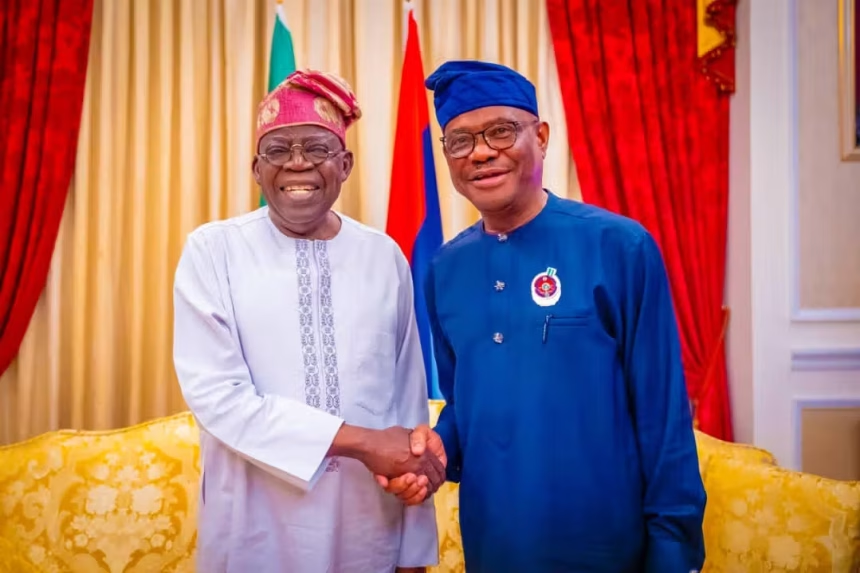

The Minister of the Federal Capital Territory, Nyesom Wike, has disclosed that President Bola Tinubu is fully aware of his political activities and the operations of the so-called Rainbow Coalition ahead of the 2027 general election.

Wike’s disclosure has brought into sharper focus the increasingly unconventional political alliances taking shape ahead of the next presidential election, with the former Rivers State governor insisting that his cross-party mobilisation for Tinubu’s re-election is not an alliance with the ruling All Progressives Congress.
The former Peoples Democratic Party governor made the disclosure during an appearance on Arise News’ Prime Time, while responding to opposition from APC governors to the Rainbow Coalition, which he said was supporting Tinubu and not the APC.

The Progressive Governors Forum, chaired by Imo State Governor Hope Uzodimma, had warned against political arrangements capable of weakening the APC, creating divided loyalty or undermining the party’s candidates in the 2027 elections.
But Wike rejected the suggestion that he should seek the approval of APC governors for his political activities
According to him, the governors’ hostility towards him predates the Rainbow Coalition and was triggered largely by Tinubu’s decision to appoint him, a prominent PDP figure, as FCT minister.
“Let me tell you, all these things that you are seeing, it didn’t start today. It started with my ministerial appointment,” Wike said.

More significantly, he said his political activities were not being conducted behind the President’s back.
“There is nothing that I do that I don’t tell Mr President,” he said.
The statement places the President’s knowledge of the coalition at the centre of the emerging political controversy and suggests that Wike considers his mobilisation for Tinubu’s second-term bid compatible with his continued political identity as a PDP chieftain.
Wike stressed that the Rainbow Coalition was established to mobilise support for Tinubu across party lines and should not be interpreted as an attempt to move the PDP into the APC.
“I have never approached the APC or the Governors’ Forum to form an alliance,” he said.
“There’s no day I went to the Governors’ Forum to align between both coalitions. There’s no day.”
‘We are supporting Tinubu, not APC’
Wike argued that Nigerian voters have historically demonstrated that presidential and legislative elections can produce different voting patterns, even when conducted on the same day.
He cited the experience of the 2023 elections, when Tinubu’s presidential performance in some states did not correspond with the performance of APC candidates in National Assembly elections.
He specifically referenced Imo State, where he said Tinubu obtained less than 10 per cent of the presidential vote while APC candidates won two senatorial seats and the Labour Party secured one.
He also cited Ebonyi, where Tinubu lost the presidential election while APC candidates won all three senatorial seats.
“An election that was held the same day. What happened that the electorate knew how to vote for the president of the Labour Party and they voted for APC at the National Assembly election?” he asked.
Wike said the same principle could apply in 2027, arguing that politicians could support Tinubu for president while backing candidates of their respective parties in legislative and state elections.
“The governors of Osun, Anambra and Abia states are supporting the president’s re-election. Won’t they still support the candidates of their parties in other elections? So where is the confusion?” he asked.
The argument, however, underscores the unusual political landscape developing ahead of 2027: formal party structures may remain intact while politicians simultaneously build alliances that cut across those same party lines.
For Wike, there is no contradiction.
His political objective, he said, is to help secure Tinubu’s re-election rather than to become an APC member or negotiate a formal alliance between the PDP and APC.
Wike attacks APC governors
The FCT minister also took aim at APC governors who have criticised the Rainbow Coalition, describing them as politically sophisticated but lacking political initiative.
He said the governors should concentrate on their own political calculations rather than attempt to dictate the activities of a PDP politician.
“I’m not answerable to APC governors,” Wike said.
He also challenged Uzodimma to examine the voting pattern in Imo during the 2023 presidential election rather than focus on his coalition.
Wike argued that the 2023 results demonstrated that political alliances could produce different outcomes across presidential, senatorial and other elections.
His broader contention is that supporting Tinubu does not automatically translate into support for every APC candidate contesting in 2027.
That position directly clashes with the concern expressed by the APC governors, who have argued that alliances that encourage politicians to operate across party lines could undermine the ruling party’s candidates and weaken party cohesion.
Rivers as Wike’s political example
Wike also used Rivers State as an example of what he described as the political consequences of the Rainbow Coalition.
He claimed that the arrangement had helped reduce political conflict in the state and contributed to an environment without litigation over party candidates.
“Because of our Rainbow Coalition, we no longer have Rivers of blood. There is no litigation on party candidates in Rivers State, unlike in Imo State,” he said.
Wike said a similar arrangement could be replicated in Bayelsa State, claiming that PDP politicians in the state were working for Tinubu.
“That can happen in Bayelsa State. The whole PDP there is working for the President,” he said.
He also declared that Tinubu would win in the Federal Capital Territory.
“As I sit here today, I will tell you that the President will win in the FCT,” he said.
A new test of party politics
Wike’s intervention highlights one of the central questions likely to dominate Nigerian politics before the 2027 elections: how far can politicians depart from their parties’ formal structures while retaining their positions and influence within those parties?
The former Rivers governor remains a PDP figure but is serving in a federal cabinet headed by an APC president. At the same time, he is helping mobilise political support for the President’s re-election through an organisation that deliberately cuts across party boundaries.
The APC governors, meanwhile, are insisting that the ruling party must protect its candidates and prevent alliances that could create conflicting political loyalties.
The disagreement is therefore bigger than the personal friction between Wike and some APC governors. It reflects a clash between two approaches to Nigerian politics — one built around formal party structures and collective party loyalty, and another based on flexible alliances that allow politicians to support different candidates at different levels of an election.